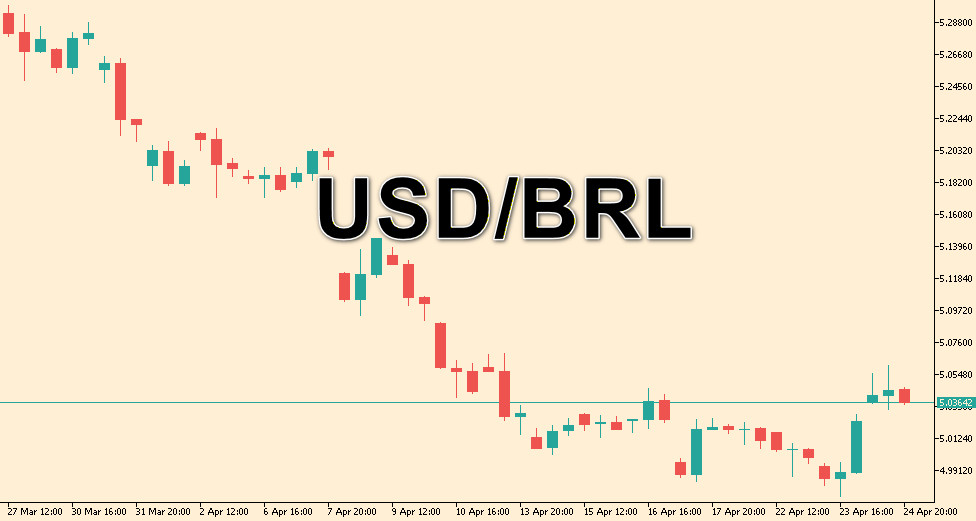
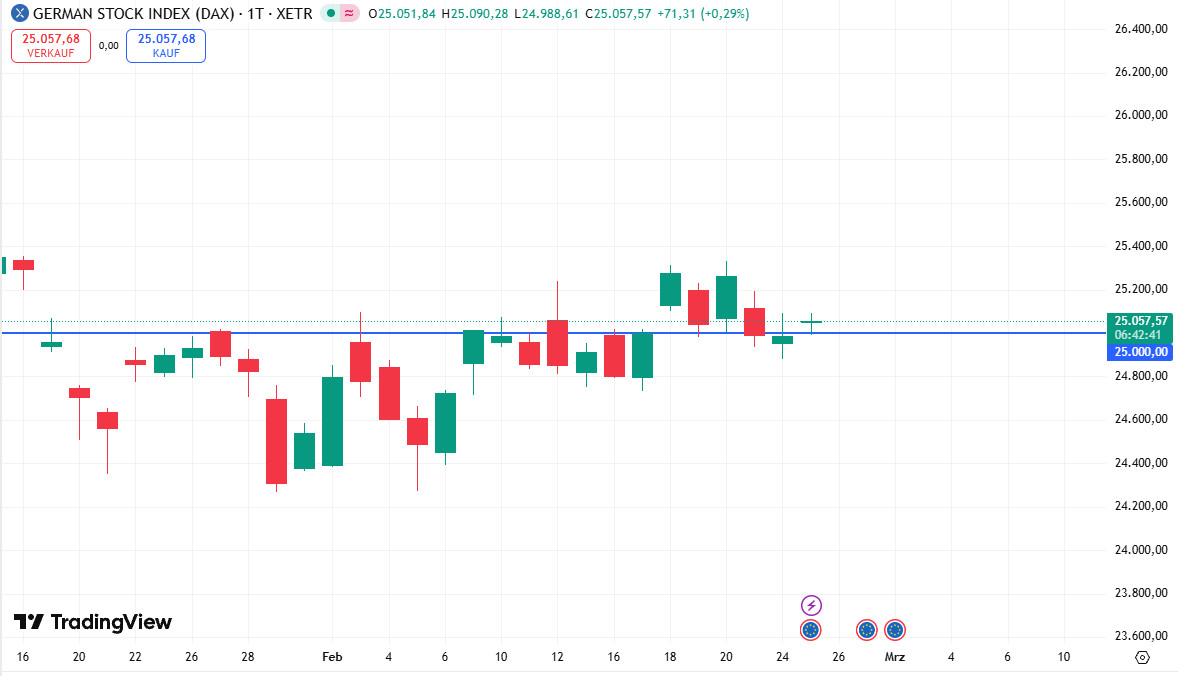
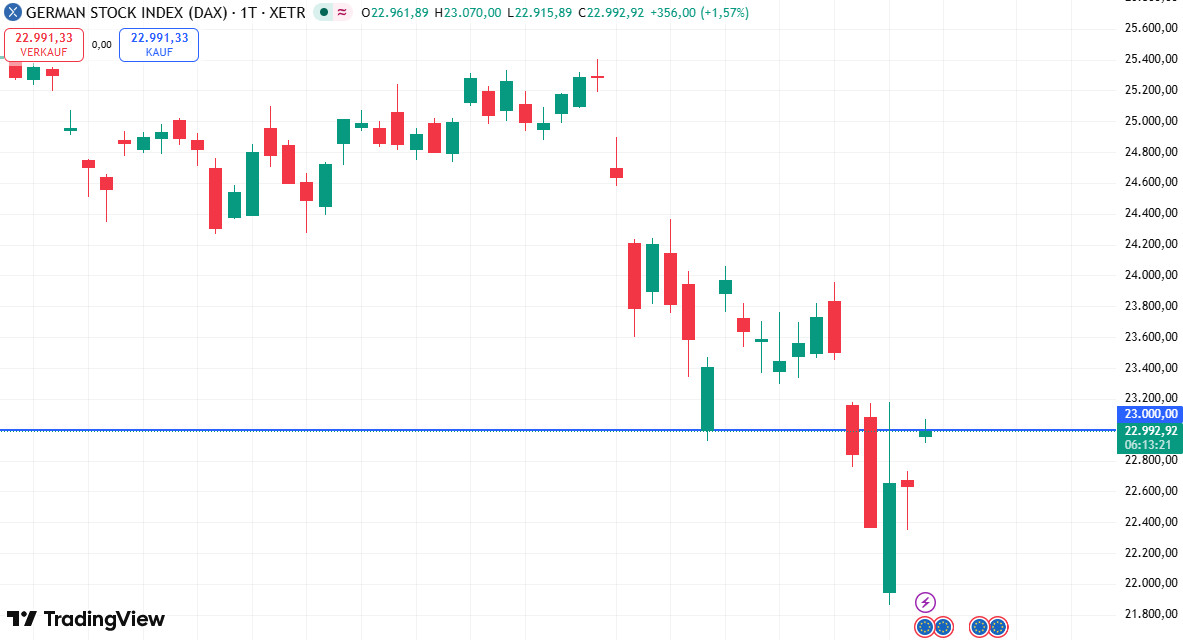
The Brazilian real is coming under pressure against the US dollar, influenced by several factors. Despite a slight recovery during the session, the situation remains tense and could prove decisive for future developments.
Fundamental Factors Weigh on the Real
The pressure on the Brazilian real is closely linked to developments in capital flows. Brazil is currently running a larger current account deficit, meaning more foreign capital is needed to finance the gap between imports and exports. If these inflows fall short of expectations, an imbalance arises: fewer dollars are available while demand for foreign currency remains high. As a result, the real loses value against the US dollar.
In addition, monetary policy is coming into focus. If interest rates in Brazil continue to fall or become less attractive, the incentive for international investors to keep capital in the country diminishes. So-called carry trades, which benefit from interest rate differentials, are particularly sensitive to such changes. If capital is withdrawn or less new investment flows in, pressure on the currency increases.
In the current environment, a relatively strong US dollar is acting as an additional factor. As investments in the United States become more attractive, capital tends to flow out of emerging markets — an effect that puts further pressure on the real.
Technical Assessment: Counter-Move Within a Downtrend
From a technical perspective, the overall trend on the daily chart remains downward, even though a recovery is underway in the current session. Such counter-movements are common within existing trends and can be triggered in the short term by position adjustments or stabilization in the market environment. A resistance level appears to be forming on the hourly chart around 5.06200.
On the downside, important support levels are coming into focus and could be tested if weakness returns. On the upside, previous resistance zones represent potential hurdles that would need to be cleared for a sustained recovery.
Mexican Peso Shows Relative Strength
While the Brazilian real remains under pressure, the Mexican peso is showing greater stability and is posting slight gains against the US dollar. One possible reason is the still attractive interest rate differentials, which continue to make the peso relatively appealing to international investors.
This divergence highlights that currencies can behave differently despite similar external conditions, especially when fundamental factors such as capital flows and interest rate expectations vary.
Financial markets showed a clear recovery at the start of the week. Comments from US President Donald Trump about possible talks with representatives of Iran and a potential end to hostilities boosted optimism among market participants on Monday. After major indices initially came under pressure during the day, they ultimately closed the session clearly in positive territory.
Cautious start in Europe despite positive signals
On Tuesday, however, trading in Europe is showing a more cautious tone. Although Asian markets are providing positive signals – Japan’s Nikkei 225 is up around 1.56%, while Hong Kong’s Hang Seng is gaining about 2.74% – European indices are only benefiting to a limited extent.
The DAX is currently down around 0.30%, while the Euro Stoxx 50 is losing approximately 0.26%. France’s CAC 40 is trading close to the flat line and remains largely directionless.
The muted reaction may suggest that market participants are taking note of the recent statements, but still have doubts about a rapid de-escalation in the Persian Gulf.
US futures lack clear direction
A look at US index futures also paints a cautious picture. Dow Jones futures are currently down around 0.17%, while S&P 500 futures are losing approximately 0.15%.
The relatively small declines indicate that markets are not yet forming a clear trend and are weighing optimism about potential talks against ongoing uncertainty.
Oil prices move higher again
In the commodities market, oil prices are once again showing movement. After US crude WTI fell to around 83 US dollars per barrel the previous day, prices have now risen back above the 90 US dollar mark.
Brent crude from the North Sea is also moving higher, but remains below the 100 US dollar level, currently trading at around 98.30 US dollars per barrel.
Gold stabilizes as US dollar weakens
Gold prices are stabilizing following the recent recovery and are posting slight gains. The precious metal is currently up around 0.4%, trading near 4,460 US dollars per ounce.
Gold may be supported by a weaker US dollar. A softer dollar reduces the cost of commodities for buyers outside the dollar area and could also lower demand for US dollars in international trade, particularly in the energy sector.
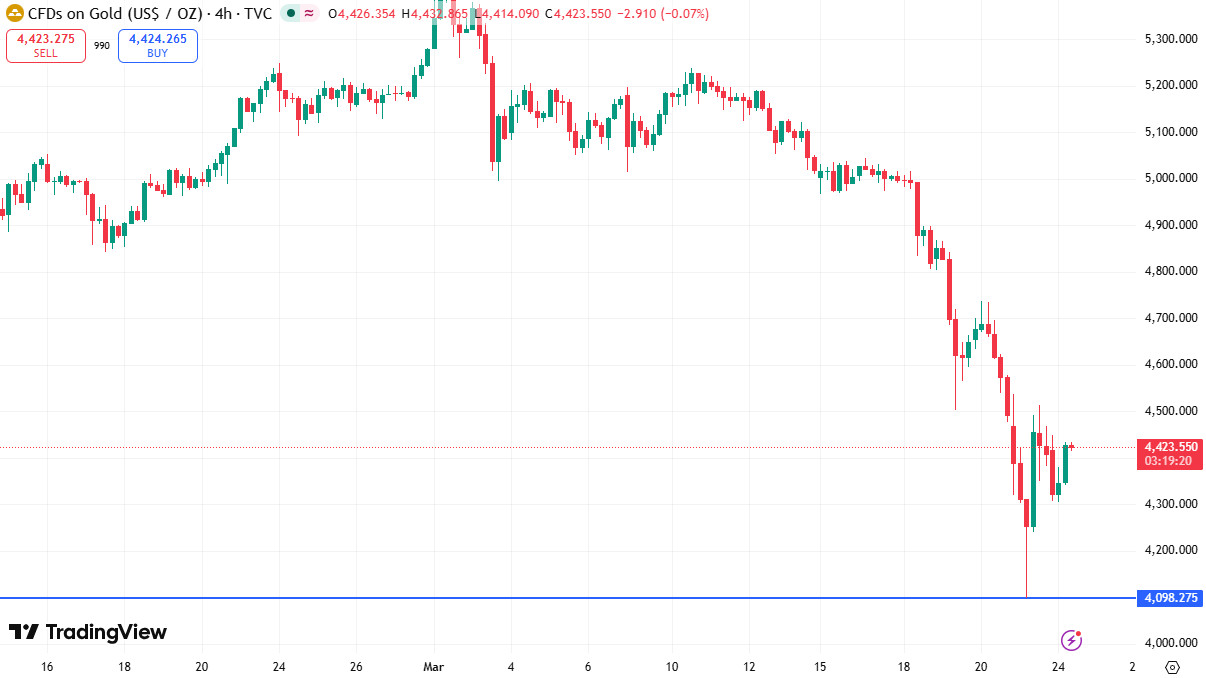
After falling to 4,100 USD on Monday, gold has managed at least a partial recovery. | Chart source: TradingView
Bitcoin recovers
Cryptocurrencies are also showing a more positive tone. Bitcoin is currently up around 3.72% and has climbed back above the 70,000 US dollar level, trading at approximately 71,095 US dollars.
Ethereum, which was the weakest major cryptocurrency the previous day, is also rebounding strongly after its recent losses and is up around 5.35% to approximately 2,158 US dollars. Among the strongest performers this morning is Solana, rising about 6.7% to around 91.93 US dollars.
Outlook: optimism meets skepticism
Markets remain influenced by hopes of potential talks in the Middle East. At the same time, the cautious development at the start of the week suggests that doubts about a quick resolution persist.
Market direction is therefore likely to depend heavily on new developments in the geopolitical situation. Even small signals of progress or setbacks in potential negotiations could have a noticeable short-term impact on market sentiment.
US President Donald Trump announced yesterday evening that the ceasefire would be extended. This news noticeably improved sentiment in the markets. Until that decision, markets had still been under significant pressure yesterday.
With the extension of the ceasefire, hopes are now rising for a lasting peace in the Persian Gulf. Many investors are also expecting a noticeable easing in energy prices as a result.
Oil prices decline after ceasefire extension
Yesterday, oil prices had still been rising during the course of the day, as the end of the ceasefire was approaching. Both US crude WTI and North Sea Brent temporarily climbed well above the $90 mark again.
Following the extension of the ceasefire, this trend has reversed. Currently, WTI crude is trading on the spot market at $87.95 per barrel. This corresponds to a decline of around 1.05%. The price of Brent is falling somewhat more moderately by 0.67% and is currently at around $93.20 per barrel.
Equity markets breathe a sigh of relief
Equity markets are showing a moderate recovery following the latest developments in the Persian Gulf. However, the cautious optimism and only slightly declining oil prices suggest that many investors remain skeptical about whether the peace talks will ultimately succeed.
After mixed signals from Asia – Japan somewhat weaker, China mostly firmer – pre-market futures trading is showing restrained optimism. Futures on the German benchmark index DAX are currently rising by around 0.11%. Futures on the TechDAX are gaining about 0.30%. France’s CAC 40 is up 0.14%, while the Euro Stoxx 50 is somewhat more subdued with a gain of 0.06%.
US markets show stronger recovery
The recovery is more pronounced in US equity indices. Futures on the Dow Jones are currently up around 0.48%. The S&P 500 is gaining about 0.52%, and Nasdaq 100 futures are rising by as much as 0.68%. As in Europe, technology stocks are benefiting the most from the positive developments.
US dollar consolidates, gold price rises
Yesterday, the US dollar gained against most currencies amid the threat of the ceasefire ending. Since the extension of the ceasefire, however, it has eased slightly and is currently moving within a narrow range.
The EUR/USD currency pair is currently trading at 1.1748, up 0.03%. GBP/USD is gaining 0.12% at 1.3521. USD/JPY is down around 0.08% at 158.23.
The gold price is rising again following the latest developments in the Persian Gulf. It is currently trading at $4,764 per troy ounce, which is about 1.34% higher than the previous day.
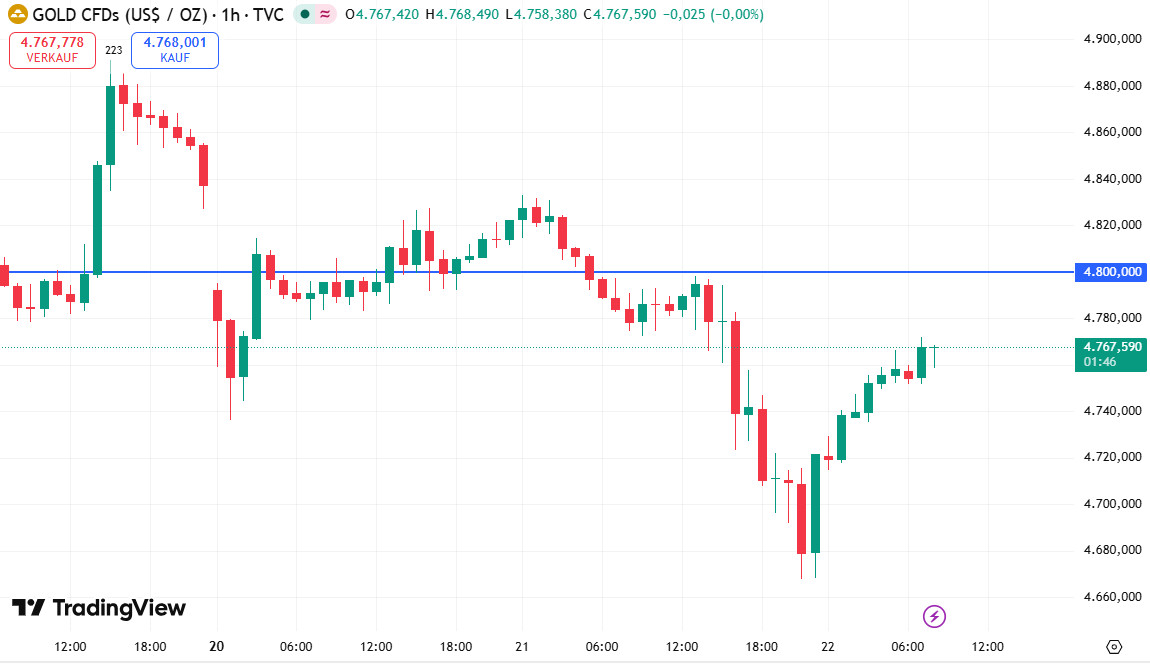
After a sharp decline the previous day, the gold price is moving back toward the $4,800 mark. | Chart source: TradingView
Bitcoin and altcoins significantly stronger
The relief over a potential peace in the Persian Gulf is clearly visible in the crypto market. Bitcoin is currently trading at $77,992, up 2.62%. This puts it just below a two-month high.
Ethereum is also gaining significantly, trading at $2,394 with an increase of 3.30%. The biggest daily gainer comes from the meme coin segment: MemeCore is currently up an impressive 23.27% at $4.3483.
Market sentiment remains cautious
A pattern that has been observed since early March is currently repeating itself. As hopes for successful peace negotiations rise, oil prices decline and optimism returns to the markets. At the same time, however, skepticism is growing as to whether these talks will actually succeed. As a result, recoveries following positive news tend to remain moderate.
Overall, the market environment remains challenging for now. A sustainable improvement is likely to occur only if there is a genuine breakthrough in the negotiations.
Financial markets are continuing their downward movement from Friday at the start of the new week. New threats against energy infrastructure in Iran are creating ongoing uncertainty and pushing crude oil prices higher.
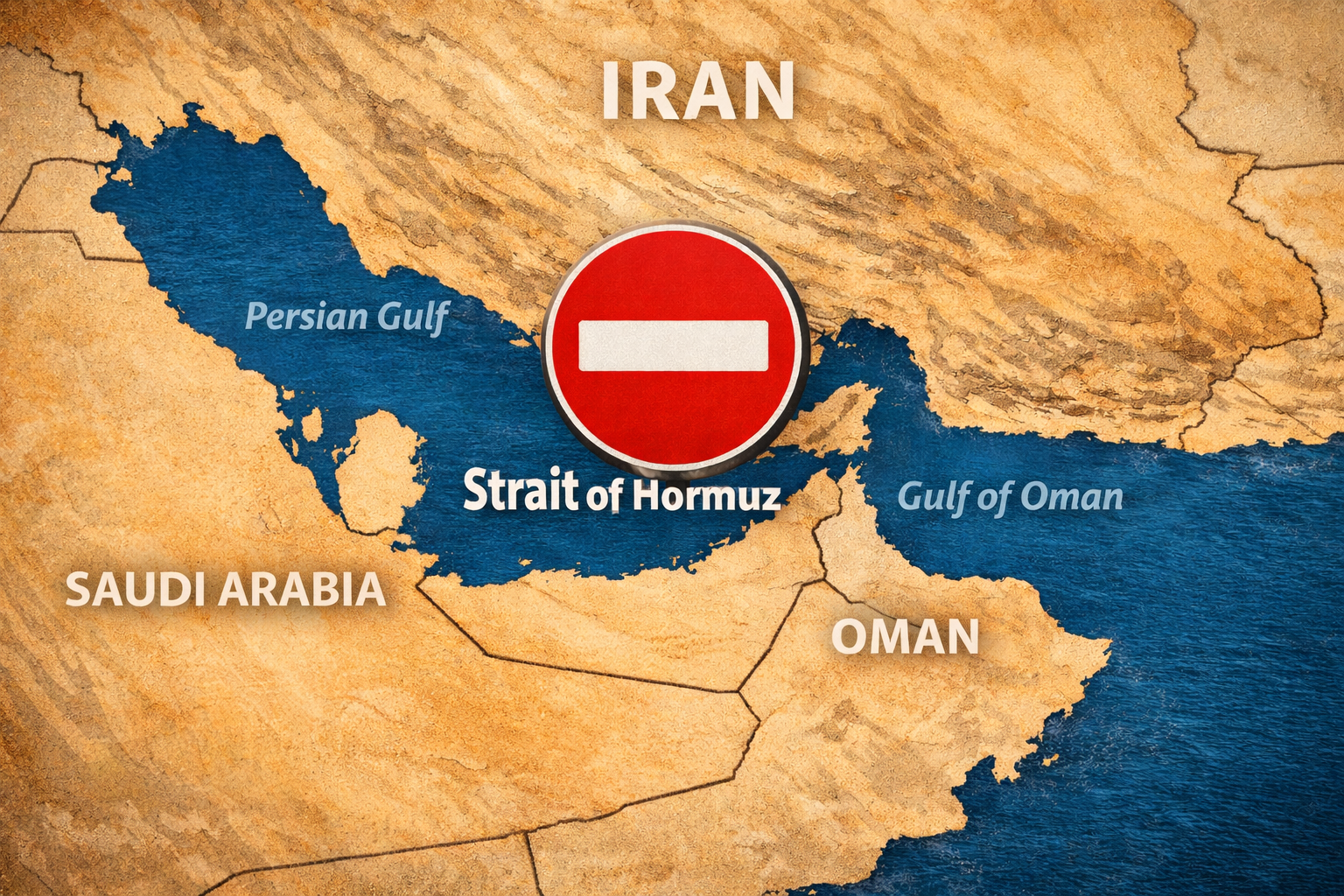
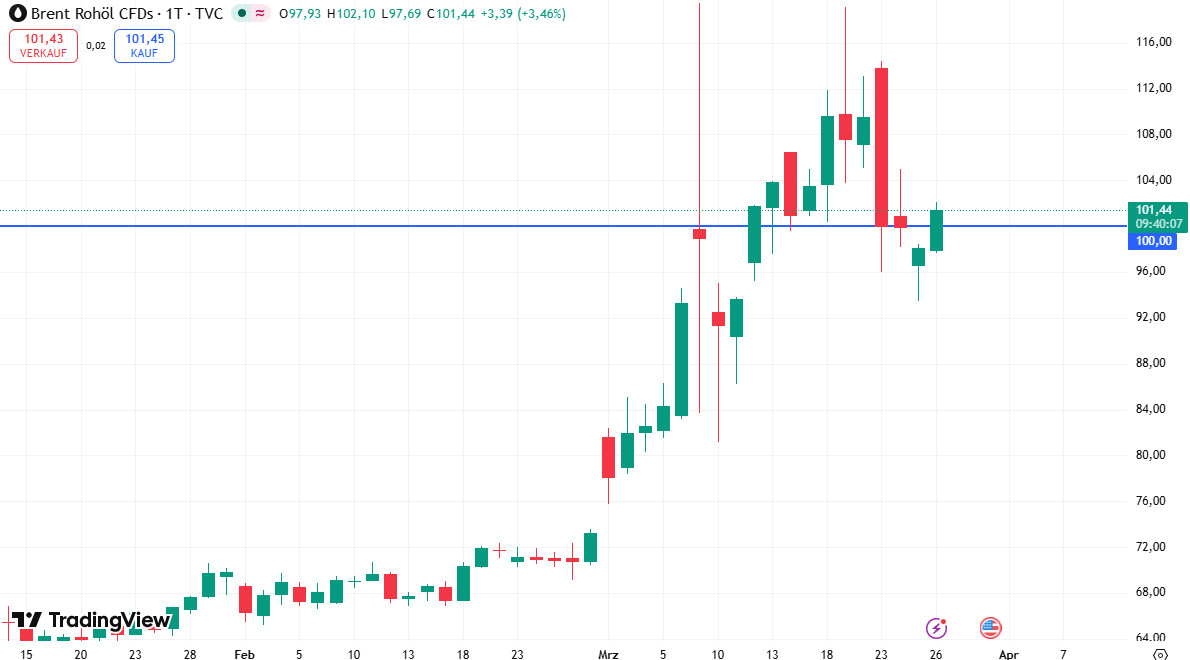
Instead of signs of easing tensions around the Strait of Hormuz, threatened retaliatory actions by Iran are weighing on market sentiment. Oil prices are rising by around 2% at the start of the week. US crude WTI is trading again near the 100 US dollar per barrel mark, while Brent crude from the North Sea is climbing to around 108 US dollars.
Weak signals from Asia
Asian markets are providing clearly negative signals at the beginning of the week. Japan’s Nikkei 225 is down around 3.35%, while Hong Kong’s Hang Seng is falling by approximately 3.93%.
The weak performance reflects growing nervousness among market participants and suggests that European stock markets may also start the trading session under pressure.
Futures indicate a weak start in Europe
Pre-market trading already points to notable losses. DAX futures (June) are down around 1.95%, while CAC 40 futures (April) are losing about 2.10%. Euro Stoxx 50 futures (June) are also declining by roughly 1.70%.
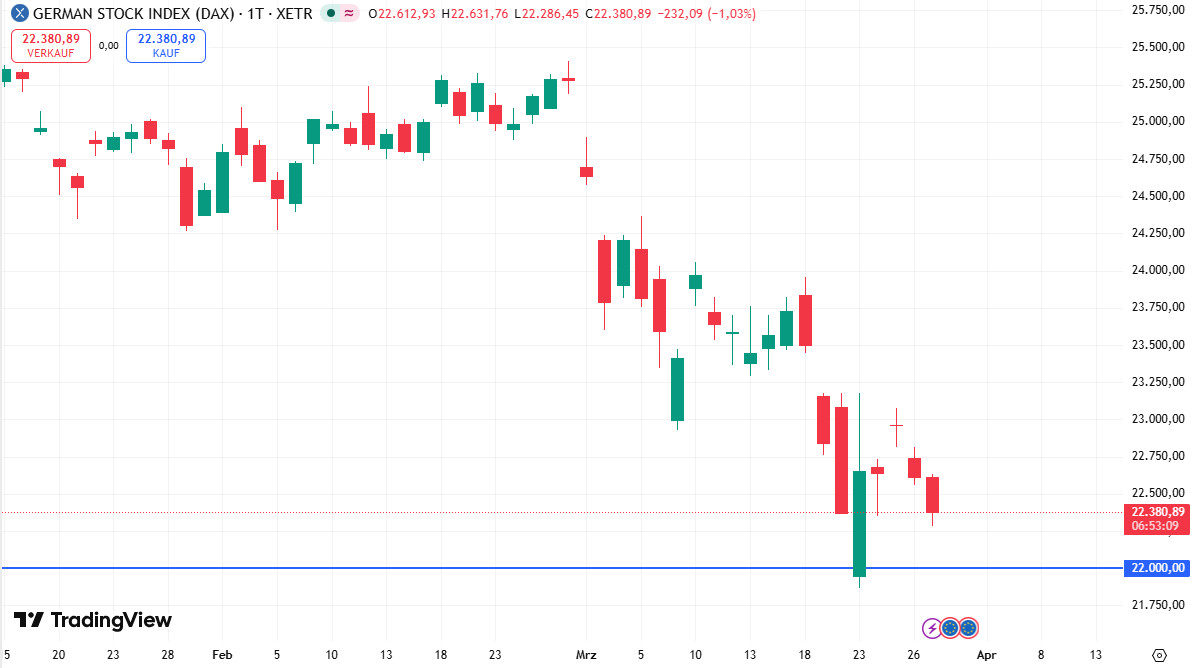
This puts the 22,000-point level into focus for the DAX. If this important support level does not hold, downward pressure on the index could increase further.
US index futures are also trading lower in pre-market activity, although the declines are more moderate. Dow Jones futures are currently down around 0.55%, while S&P 500 futures are losing approximately 0.70%.
The comparatively smaller reaction may be due to the fact that the US economy is less dependent on oil imports, as the United States itself is one of the world’s largest oil producers.
Gold and silver under strong pressure
Gold prices remain under significant pressure. Rising oil prices, falling equity markets, and increased demand for the US dollar are weighing on the precious metal at the start of the week.
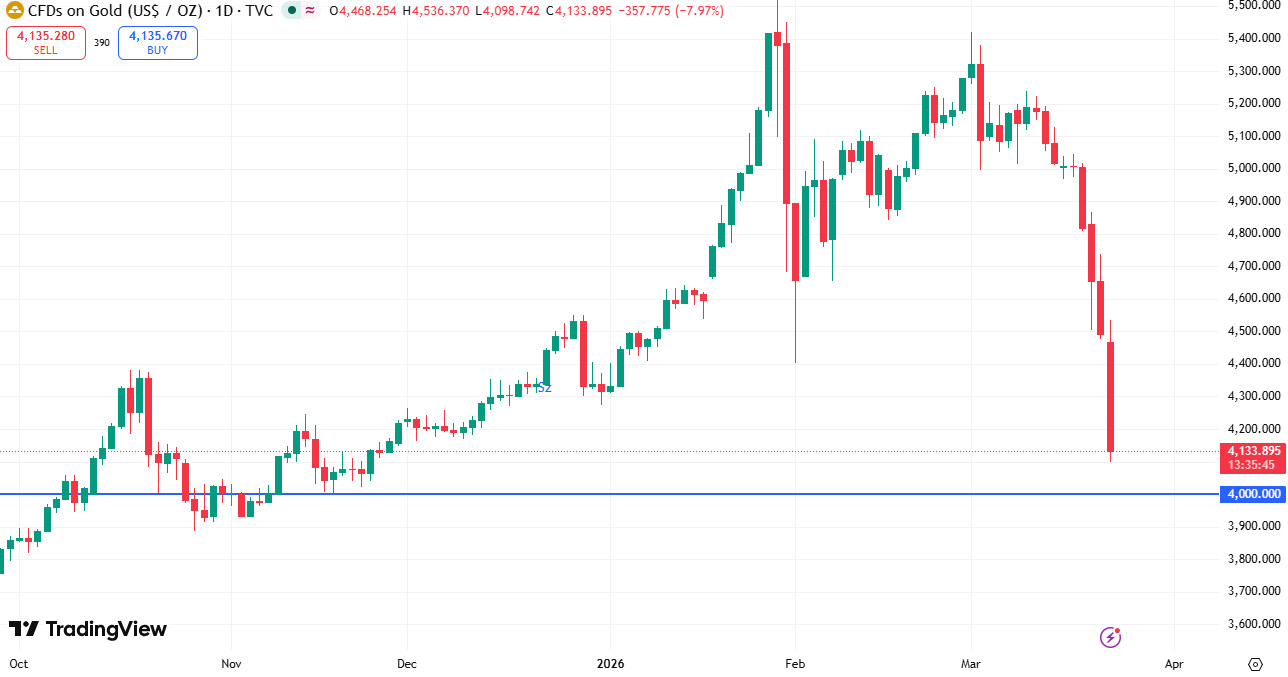
Gold is currently down around 7.4% and has fallen below the 4,300 US dollar level. If this level is broken sustainably, the area around 4,000 US dollars could become the next key zone for market participants.
Silver is showing even greater weakness. It is down around 10% and is currently trading just below 62 US dollars. Here, the 60 US dollar level is likely to be closely watched as an important support.
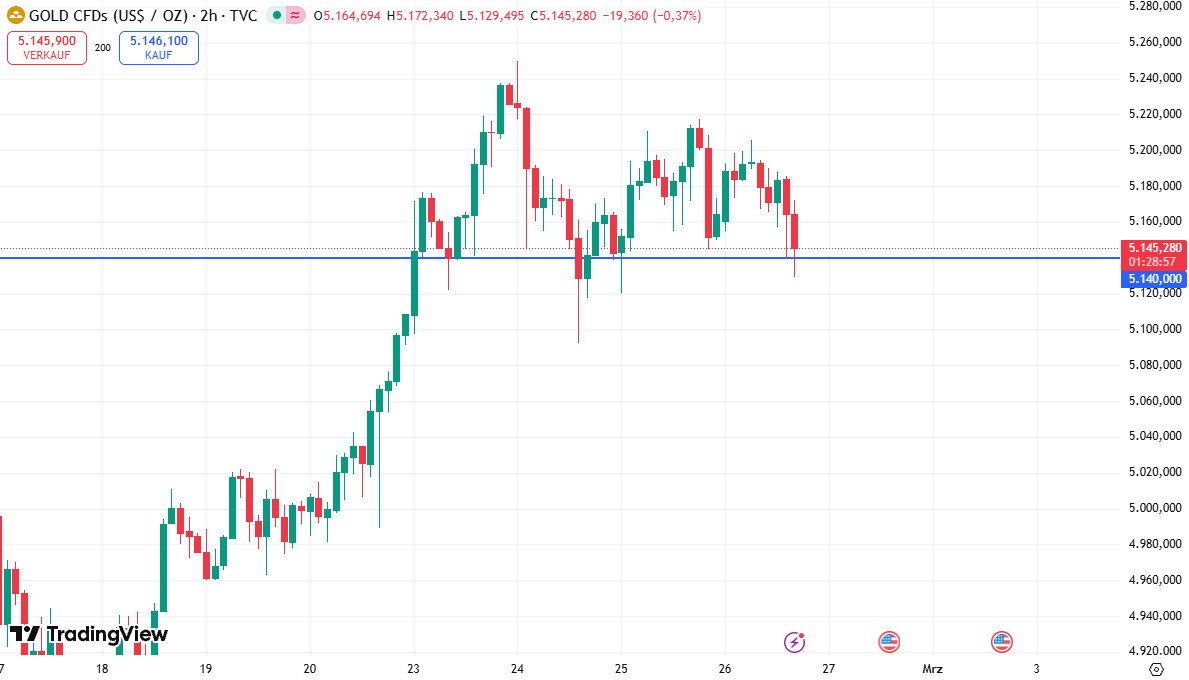
Gold remains under heavy pressure and is approaching the 4,000 US dollar level. | Chart source: TradingView
Crypto market also weaker
Cryptocurrencies are also unable to escape the negative market sentiment. Bitcoin has fallen back below the 70,000 US dollar mark and is currently trading around 68,350 US dollars, representing a decline of about 1.2%.
Ethereum is showing even more weakness, dropping around 3.4% to approximately 2,038 US dollars. This brings the psychologically important 2,000 US dollar level back into focus.
Outlook: geopolitics remains the key driver
Market developments this week are likely to remain heavily influenced by the geopolitical situation in the Middle East. In particular, potential escalations involving energy infrastructure and the Strait of Hormuz will remain in focus for investors.
At the same time, macroeconomic data should not be overlooked, as it may also influence market movements. In the current fragile environment, even individual headlines could be enough to significantly shift market direction in the short term.
Markets currently appear to be guided by a sense of calm, which should not obscure the underlying nervousness among market participants. After the situation in the Persian Gulf did not escalate further despite the continued blockade of the strait by both sides, hope is once again shaping market sentiment and a slight recovery is emerging.
Oil prices edge lower
Although the situation regarding the blockade of the Strait of Hormuz remains unchanged, oil prices are declining on Tuesday. This could be another indication that Iranian representatives may still attend the peace talks in Islamabad, even though participation had been officially canceled by the Iranian leadership. And even though prices remain well above last Friday’s closing levels, they are showing signs of cautious optimism.
Following the price surge at the start of the week, US crude WTI is currently trading on the spot market at around 86.45 US dollars per barrel, down about 0.95% from the previous day. Brent crude is showing slightly less stability. It is currently trading at around 91.60 US dollars per barrel on the spot market, about 0.60% below the previous day’s price.
Equity markets cautiously optimistic in the morning
After the market open, European equities are following the cautiously optimistic signals from Asia. The absence of further escalation and the relative stability in oil prices are likely supporting the mildly positive sentiment. Additional impulses may come at 11:00 CET when the ZEW economic sentiment data for Germany and the eurozone are released.
The German benchmark index DAX is currently up 110 points at 24,554, representing a gain of 0.45%. The Euro Stoxx 50 is rising by around 0.22% to 5,995 points. The French CAC 40 is slightly weaker, trading just below the flatline at 8,325 points with a decline of 0.07%.
US indices are also showing a positive tone in pre-market futures trading this morning, after closing the previous session in negative territory. Futures on the Dow Jones are currently about 0.15% higher, S&P 500 futures are up around 0.20%, and Nasdaq 100 futures are gaining approximately 0.30%.
US dollar stabilizes, gold declines, BTC consolidates
After weakening against most currencies at the start of the week, the US dollar stabilized somewhat overnight. Against the euro, it is currently gaining around 0.10%, with the EUR/USD pair trading at 1.1775.
The gold price, however, is weaker again this morning. After nearly recovering its losses from the start of the week yesterday, it has given back most of those gains overnight. Combined with moderate gains in equity markets, the decline in gold may indicate that market participants are gradually moving away from a risk-off positioning. Gold is currently trading at around 4,782 US dollars per ounce, down about 0.55%.
The crypto market has entered a consolidation phase in the absence of new impulses. Bitcoin is currently trading at around 76,185 US dollars, while Ethereum is at 2,321 US dollars. Among altcoins, Stellar (XLM) stands out today, rising by about 5.79% to 0.17864 US dollars.
Calm markets – but no all-clear
The current market movement suggests stabilization at first glance, but it continues to be driven largely by expectations. The absence of new escalation and slightly declining oil prices are supporting hopes for a potential easing, without confirming it.
This leaves the environment characterized by underlying uncertainty. As long as no concrete progress is made in the conflict in the Persian Gulf, the current phase of calm is likely to remain vulnerable to rapid shifts in sentiment, with new impulses capable of changing market direction at any time.
Financial markets are starting the final trading day of the week on a positive note. After the significant volatility of recent days, a stabilization is emerging, which could be attributed to the absence of further escalation in the Middle East and the resulting decline in oil prices.
In particular, the fact that a larger retaliation following the recent attacks on gas facilities has not materialized appears to be reducing risk perception among market participants, at least for now. Discussions about alternative transport routes between Saudi Arabia and Iraq may also have helped ease concerns about potential supply shortages in the oil market.
Oil prices decline significantly
The oil market is showing a clear reversal. Brent crude has fallen by around 10 US dollars per barrel from yesterday’s high and is currently trading at approximately 103.50 USD. US WTI crude is also declining and is now trading around 93 USD after testing the 100 USD level the previous day.
The decline suggests that part of the previously priced-in risk premium is being removed from the market.
Equity markets recover
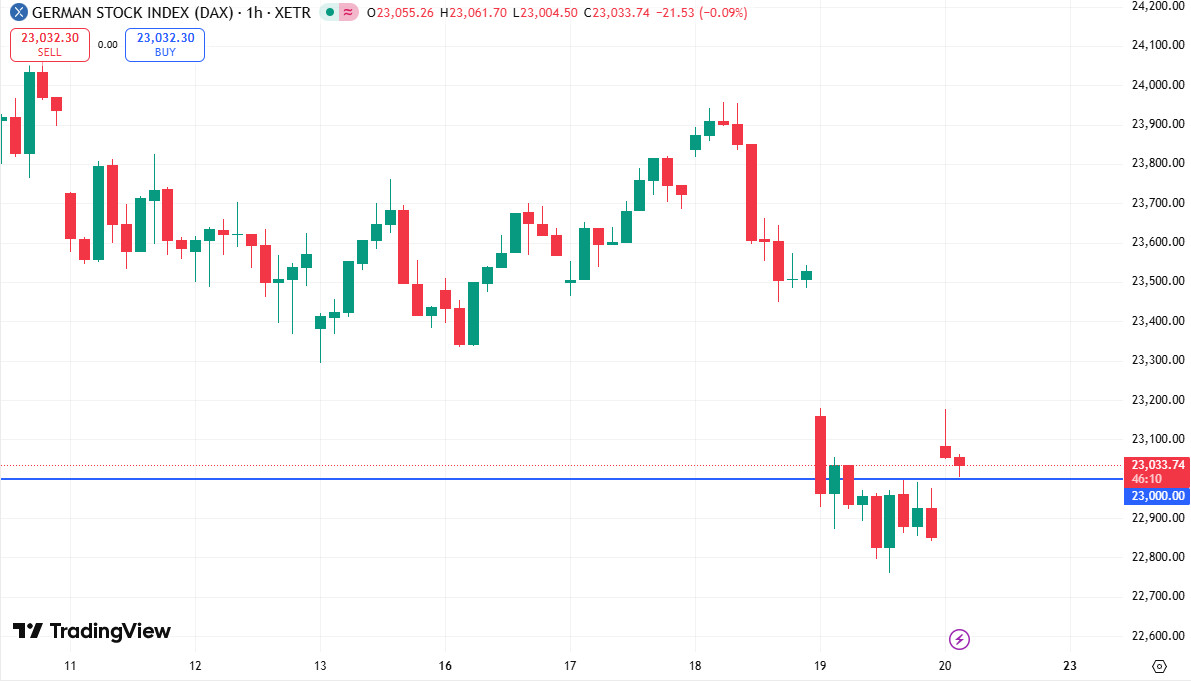
The easing in the oil market is supporting equity indices. The DAX is currently up around 1.4%, or roughly 320 points, moving back above the 23,000 level. The Euro Stoxx 50 is also gaining around 1.3%, while the French CAC 40 is rising more moderately by about 0.9%.
US index futures are also pointing to a positive start, although gains remain more limited at around 0.25% on average. Technology stocks are comparatively weaker, which may be linked to recent developments surrounding Micron.
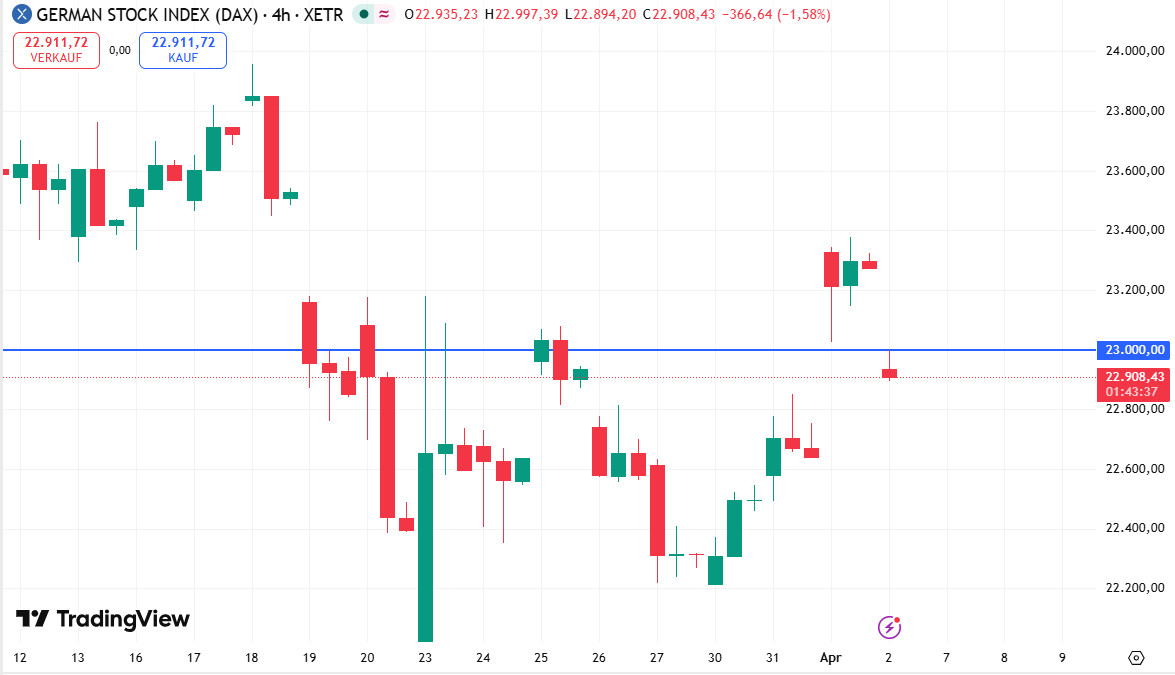
The DAX started Friday on a firmer note but is still struggling around the 23,000 level. | Chart source: TradingView
Gold stabilizes after sharp decline
After the sharp losses of the previous day, gold is stabilizing on Friday. The precious metal is currently trading within a range between 4,650 and 4,730 US dollars per ounce, entering a consolidation phase. In this range, a short-term resistance level could form.
Silver shows a similar pattern. After falling to around 65 US dollars, it is currently trading below the 74 US dollar level, which may act as resistance.
US dollar weakens
The US dollar is weakening following the decline in oil prices. One possible explanation could be reduced demand for the dollar, as it is closely linked to global energy trade.
The EUR/USD pair has moved clearly above the 1.15 level and is currently trading around 1.1575.
Bitcoin shows cautious recovery
The crypto market is also showing a slightly positive tone. Bitcoin is up around 1.7% to approximately 71,150 US dollars, making it one of the stronger performers among major cryptocurrencies.
Ethereum, by contrast, is rising more modestly by around 0.3% to about 2,166 US dollars. On a weekly basis, the picture is more mixed: while Ethereum is up around 3.4%, Bitcoin is slightly negative at around -0.5%.
Market outlook into the weekend
Markets are stabilizing toward the end of the week, as further escalation in the Middle East has so far not materialized. The decline in oil prices appears to be a key relief factor for equity markets.
At the same time, the environment remains fragile. New geopolitical developments could quickly trigger renewed volatility, leaving investors and traders in a challenging environment.
While markets were still able to post a strong recovery on Friday and stock indices reached new all-time highs, the start of the week brings a reset. The reopening of the Strait of Hormuz announced on Friday was already declared over again on Saturday.
The situation escalated further after the US Navy fired on and boarded an Iranian container ship attempting to break through the blockade. As a result, oil prices rose by up to 7% at the start of trading, while equity indices came under pressure.
Oil price stabilizes at elevated levels after market open
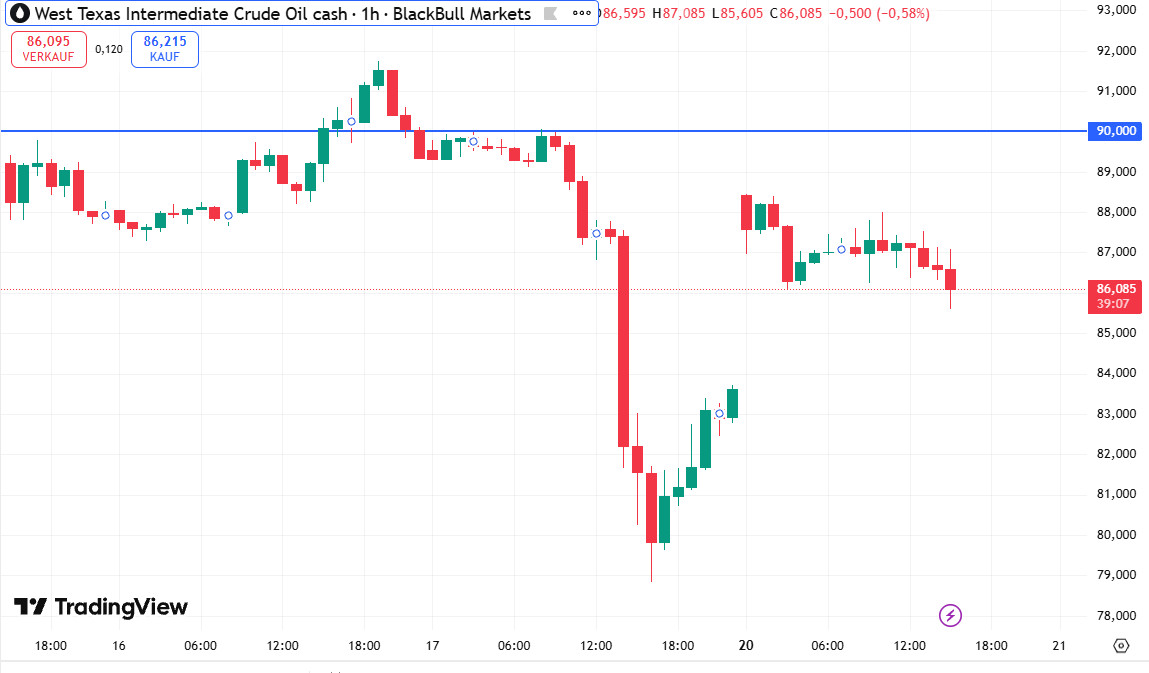
Due to the renewed escalation in the Persian Gulf, oil prices rose significantly, peaking at gains of up to 7%. However, as the feared escalation did not materialize following the boarding of the Iranian vessel, oil prices eased slightly and stabilized at elevated levels.
US crude WTI is currently trading on the spot market at around 86.89 US dollars per barrel, representing an increase of approximately 5.3%. The price of North Sea Brent crude has risen back above the 90 US dollar mark and is currently trading at around 91.20 US dollars per barrel, up about 4.8%.
The relatively stable oil price may indicate that there is still hope for a solution to the conflict mediated by Pakistan.
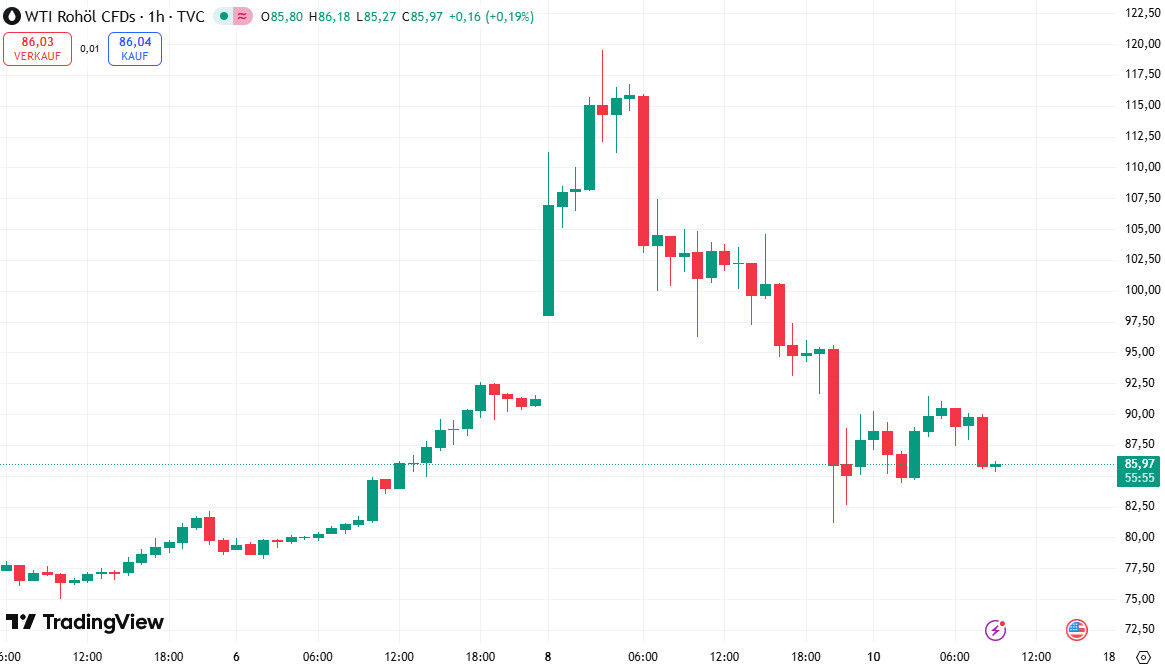
US WTI crude opened significantly higher but stabilized during the session. | Chart source: TradingView
Equity markets under pressure again amid escalation concerns
Equity markets reacted to the renewed developments in the Persian Gulf with concern over rising energy prices. Particularly in Europe, higher energy costs could place additional strain on companies in an already challenging economic environment.
The German benchmark index DAX is currently down around 1.35%, or 331 points, at 24,367. The Euro Stoxx 50 is showing a similar move, declining by approximately 1.34%, or 81.8 points, to 5,976.
The US market, however, opened Monday with only modest losses near the flatline. Shortly after the opening bell, the Dow Jones is up 0.04%, the S&P 500 is down 0.2%, and the Nasdaq 100 is trading around 0.27% lower. This suggests that US markets are, for now, more resilient to the conflict than European markets.
US dollar initially stronger, gold price declines
The US dollar initially benefited at the start of the new trading week from rising oil prices and the resulting increased demand for the currency. However, as prices stabilized, the dollar returned to Friday’s levels against most currencies.
The EUR/USD exchange rate is currently trading at around 1.1763, marking a marginal decline of 0.01%.
Gold initially fell sharply below the 4,800 US dollar per ounce mark at the start of trading. It has since regained this level, currently trading at around 4,804 US dollars, but still remains down about 1.2% compared to Friday’s close.
Bitcoin and altcoins give back part of their gains
Cryptocurrencies are also under pressure again due to the renewed escalation in the Persian Gulf. After Bitcoin briefly rose above 78,000 US dollars on Friday, it is currently trading at around 75,230 US dollars.
Ethereum has also pulled back from its recent high of 2,465 US dollars and is currently trading at around 2,317 US dollars.
Between escalation and de-escalation – markets lack clear direction
The current market development once again highlights how quickly sentiment can shift in the context of the Persian Gulf conflict. While hopes for de-escalation can trigger short-term recoveries, renewed escalation leads to immediate increases in risk premiums.
As long as this pattern persists and no concrete progress toward a sustainable solution is made, the market environment is likely to remain characterized by high uncertainty. Short-term movements will continue to be driven heavily by individual headlines, while establishing a reliable trend remains difficult.
Financial markets are under clear pressure at the start of trading. The DAX is currently down around 2.35%, falling below the 23,000-point level. The Euro Stoxx 50 is also losing about 2%, while US index futures are trading more moderately lower ahead of the open, down around 0.4% on average.
At the same time, other asset classes are also showing significant moves. Particularly notable is the sharp decline in gold, which has fallen to around 4,700 US dollars per ounce and even briefly dropped below this level.
Gold under pressure despite geopolitical risks
The decline in gold may appear unusual at first glance, as geopolitical tensions typically support the precious metal. However, in the current market environment, a different mechanism appears to be dominating.
On the one hand, fixed-income investments are once again attracting more attention from investors. Rising or stable government bond yields make interest-bearing assets more attractive compared to gold, which does not generate any yield.
On the other hand, the need for liquidity may be playing an important role. During periods of falling equity markets, positions are often reduced to build cash or offset losses elsewhere. This can lead to selling pressure in gold, even if geopolitical tensions remain elevated.
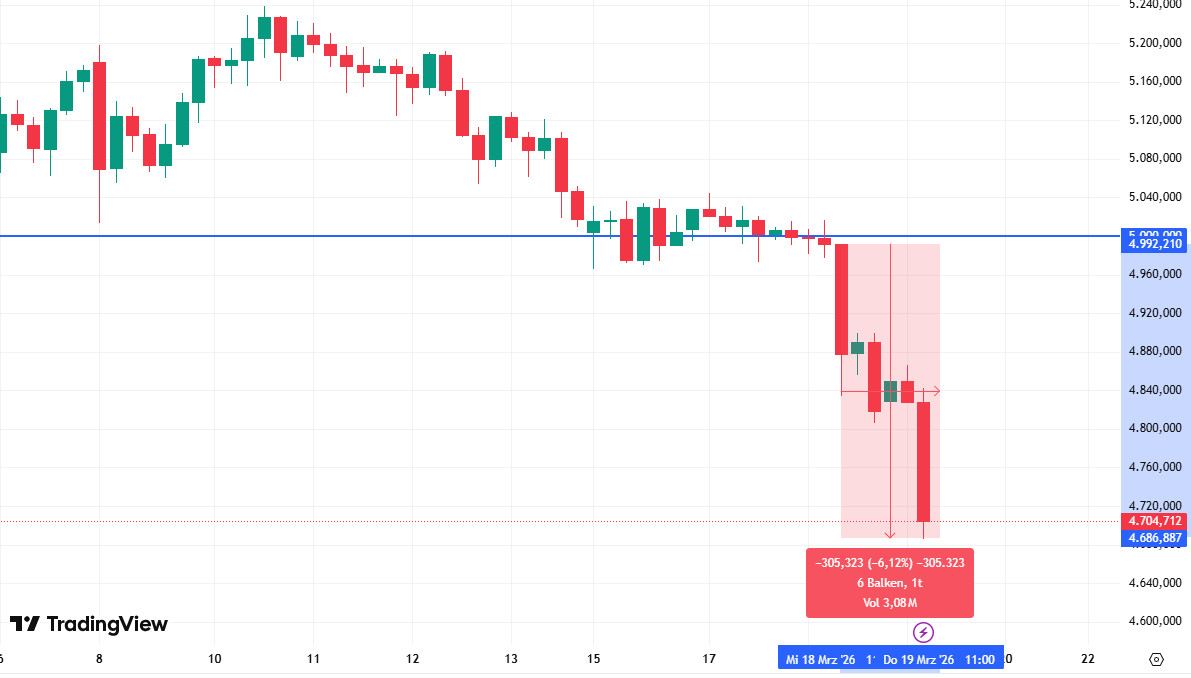
The chart shows that after breaking below 5,000, gold dropped quickly toward the 4,700 level. | Chart source: TradingView
Dollar gains strength
The US dollar is strengthening again in the current environment. The EUR/USD pair has fallen below the 1.15 level and is currently trading around 1.146. A stronger dollar adds further pressure to gold, as the metal is priced in US dollars and becomes more expensive for buyers outside the dollar area.
Crypto market follows the weakness
Cryptocurrencies are also under pressure. Bitcoin is down around 5.3% and is once again approaching the 70,000 US dollar level. A break below this key support could potentially open the way toward 66,000. This suggests that digital assets are currently being perceived more as risk assets rather than as traditional safe havens.
ECB in market focus
Investor attention is also turning to monetary policy. The European Central Bank (ECB) is scheduled to announce its interest rate decision later today. While major changes are not necessarily expected, market participants will focus on signals regarding the future policy path.
The combination of geopolitical risks and monetary policy uncertainty could further reinforce the cautious tone in markets.
Conclusion
Current market movements show a clear pattern: equities, gold, and cryptocurrencies are all under pressure at the same time, while the US dollar is gaining strength. This suggests that investors are increasingly building liquidity and reducing exposure to risk assets.
At the same time, the environment remains fragile. New impulses from monetary policy or geopolitical developments could quickly lead to another shift in market direction.
New statements from US President Donald Trump about a possible near-term end to the conflict meet mixed signals from Asia at the end of the week. However, this combination is not leading to a clear directional move, but rather to caution across markets.
Accordingly, the start of trading is uneven: while the DAX is posting slight gains in the morning, overall momentum remains limited. Market participants are reacting cautiously to the prospect of de-escalation without fully pricing it in.
European markets cautiously optimistic – new records in the US
Although hopes for an end to the conflict in the Persian Gulf continue to rise, optimism in European markets remains relatively contained. The German benchmark DAX is currently up by 88.7 points, or 0.37%, at around 24,240 points, still roughly 1,200 points below its all-time high reached in January.
A similar picture is seen in the Euro Stoxx 50 and France’s CAC 40. The Euro Stoxx 50 is up around 0.25% at 5,948 points, while the CAC 40 gains 0.31% to 8,288 points.
Nasdaq 100 at record high, but US rally remains selective
The picture in the US is notably different. While the S&P 500 had already reached new highs on Wednesday, the Nasdaq 100 followed yesterday, marking a new all-time high. The upward move is once again driven by growth-oriented and technology stocks.
At the same time, the rally remains clearly selective. The Dow Jones is still noticeably below its record level, suggesting that traditional industrial and blue-chip stocks are not benefiting to the same extent. A look at US index futures shows moderate gains in pre-market trading, led by the Dow Jones up 0.33%, followed by the S&P 500 up 0.15%. Nasdaq 100 futures are currently trading near flat.
After reaching a new ATH on Thursday, the Nasdaq 100 is extending gains in pre-market trading. | Chart source: TradingView
Oil prices decline again
Oil continues its consolidation after the sharp rise from the previous day has largely been reversed. While prices remain elevated, a sustained breakout to the upside has not materialized so far.
The oil market is therefore not confirming the recently increased expectations of escalation, but at the same time is not signaling full relief. Instead, it suggests that market participants still assume limited risks to global oil supply.
Weaker dollar provides support
Oil receives additional support from the currency market. The US dollar is currently weaker, trading against the euro at around 1.1785. A weaker dollar tends to support commodity prices, as oil is traded in US dollars and becomes cheaper for buyers outside the dollar area.
Combined with the currently calm situation in the Persian Gulf, this results in an overall stable environment that supports the cautiously positive market sentiment, without providing a clear all-clear signal.
Gold below 4,800 – crypto market lacks momentum
The gold price remains relatively stable but has fallen back below the 4,800 US dollar mark, currently trading at around 4,790 US dollars per ounce. Despite improved sentiment in stock markets, the metal remains at elevated levels, indicating continued demand for hedging.
Gold is also supported by the weaker US dollar, which further boosts demand. Overall, the development reflects the current market environment: while risk assets benefit from hopes of de-escalation, some market participants remain cautiously positioned.
Bitcoin back above 75,000 US dollars
The crypto market, on the other hand, appears calmer. After recent gains, there is currently a lack of new catalysts.
Bitcoin is currently trading at around 75,501 US dollars, moving back above the 75,000 US dollar level, which has recently acted as resistance. Whether it can sustainably hold above this level will depend on further impulses. The broader crypto market remains largely unchanged, consolidating recent gains in a sideways move.
Rising optimism, but outlook remains uncertain
Market optimism is clearly increasing. The absence of new escalation, the prospect of negotiations, and stable developments in commodity markets are supporting expectations of further easing.
However, a reliable assessment of future developments remains difficult. As long as concrete progress in negotiations is lacking, market sentiment is likely to remain heavily driven by individual news and short-term developments.
After a cautiously positive start to European trading, sentiment in financial markets deteriorated noticeably in the early afternoon. The trigger may have been new concrete threats from Iran against energy infrastructure in the Gulf region.
According to reports, Iran’s Revolutionary Guards have called for the evacuation of several oil and gas facilities in Saudi Arabia, the United Arab Emirates, and Qatar. The indications of potential attacks are increasing concerns about the stability of global energy supply and are causing noticeable movements in the markets.
Oil prices rise significantly
The reaction is particularly evident in the oil market. Brent crude has climbed back above the 100 US dollar level and is currently trading at around 106 US dollars per barrel, while US WTI has risen to approximately 98 US dollars. This suggests that a renewed risk premium for potential disruptions to production and transport chains is being priced in.
Equity markets turn negative
Rising oil prices and growing uncertainty are weighing on equity markets. The DAX has turned clearly negative and is currently down around 0.70%. In the US, major indices also opened weaker on Wednesday. The Dow Jones is currently down about 0.75%, the S&P 500 is losing around 0.45%, and the Nasdaq 100 is trading roughly 0.40% lower.
The development suggests that investors are increasingly pricing in risks to the global economy as well as higher costs resulting from rising energy prices.
US dollar shows limited reaction
In the foreign exchange market, the picture is more mixed. The US dollar only benefited briefly from the increased uncertainty and continues to trade above the 1.15 level against the euro.
The relatively muted reaction of the dollar may indicate that investors are not fully shifting into traditional safe-haven positions, but are instead building liquidity and reducing exposure across different asset classes.
Gold and cryptocurrencies also under pressure
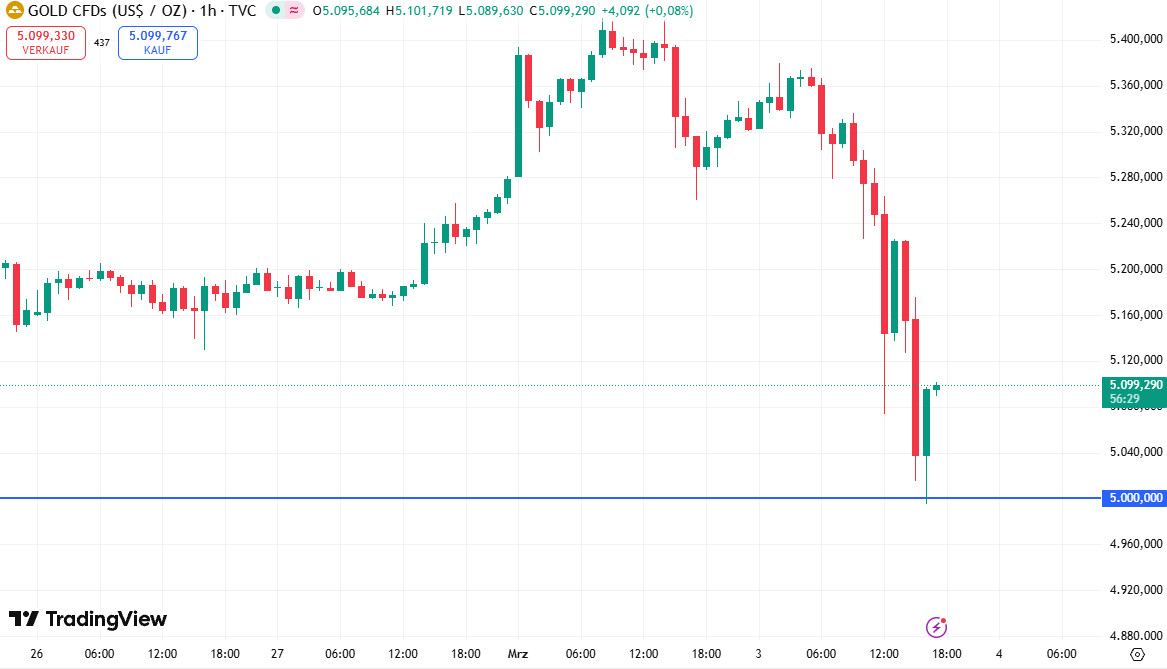
Both traditional and alternative asset classes are showing weakness. Gold has fallen clearly below the 5,000 US dollar level and is currently trading at around 4,873 US dollars per ounce.
Bitcoin is also under pressure, dropping to around 71,200 US dollars, representing a decline of approximately 3.7%. This suggests that investors are currently increasing liquidity and reducing risk exposure.
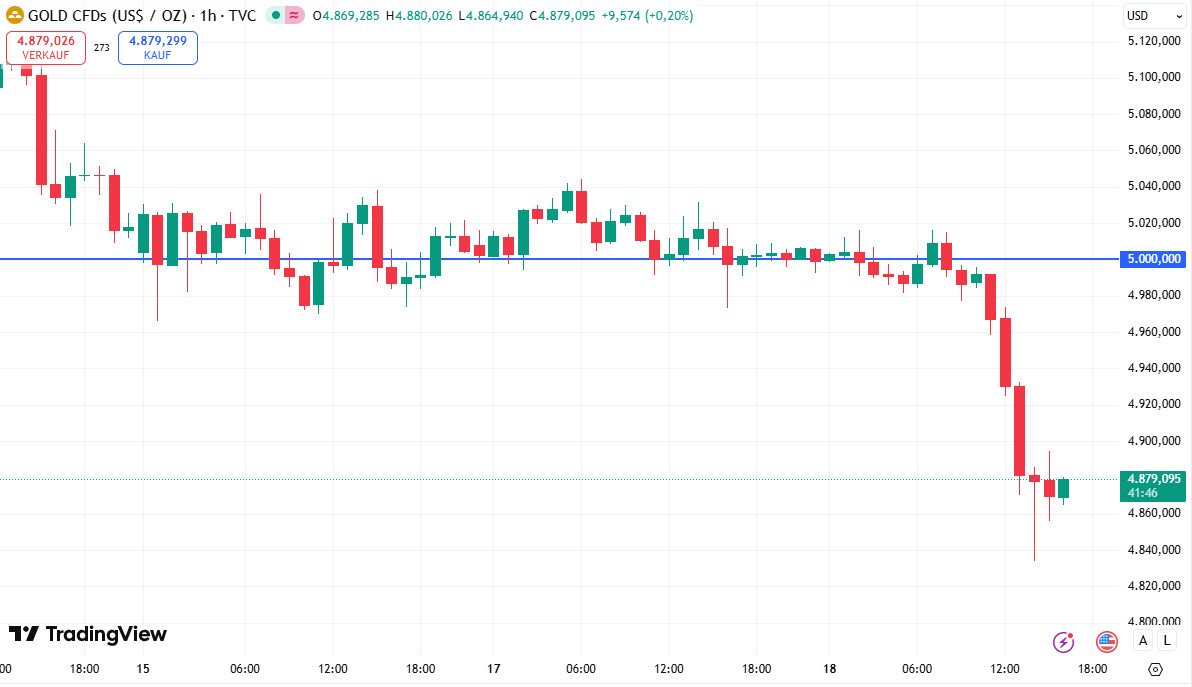
Gold has dropped significantly below the 5,000 US dollar level on Wednesday.
Conclusion for market participants
The latest threats against energy infrastructure in the Middle East are leading to a clear reassessment in the markets. While oil prices are rising, equities, precious metals, and cryptocurrencies are coming under pressure at the same time.
At the same time, recent developments have shown that market movements can quickly reverse as news flow changes. For investors and traders, this creates a challenging environment in which short-term impulses are playing an increasingly important role.
Financial markets appear surprisingly stabilized following recent geopolitical tensions. While the situation around the Strait of Hormuz had been marked by significant risk premiums in recent days, the current absence of immediate military action is now contributing to a noticeable easing.
One of the triggers for the latest move was a statement by US President Donald Trump, suggesting that Iran remains interested in an agreement. Similar signals in recent weeks had repeatedly triggered short-term recoveries, which, however, later proved to be unsustainable.
Lack of new attacks seen as positive signal
In the current situation, however, a potential difference is emerging: despite the now ongoing blockade of Iranian oil exports and continued mutual threats, there have so far been no confirmed military incidents at sea. There are also currently no reports of new attacks on Tehran or military bases in Iran. As a result, the ceasefire remains stable for now, and immediate escalation is avoided, which markets interpret as a cautiously positive signal.
The key question now is how the situation develops over the next 24 to 48 hours. Observers assume that Iran may use this phase to test the actual enforcement of the blockade at sea without immediately risking open military confrontation.
If no incidents or military clashes occur during this period, it could further support the current market stabilization. At the same time, it remains unclear whether this represents a sustainable de-escalation or merely a temporary phase without immediate military action.
Stock markets firm, but rally not broadly supported
US markets: New highs, but mixed picture
The positive momentum for the trading day comes from the US, where major indices were mostly able to post gains in the previous session. The S&P 500 reached a new all-time high, while the Nasdaq 100 closed just below it. In contrast, the Dow Jones showed weakness and ended the session with a slight loss of 0.15%.
This development suggests that the current upward move is primarily driven by growth-oriented and technology-focused stocks, while traditional industrial and blue-chip stocks are already showing early signs of weakness.
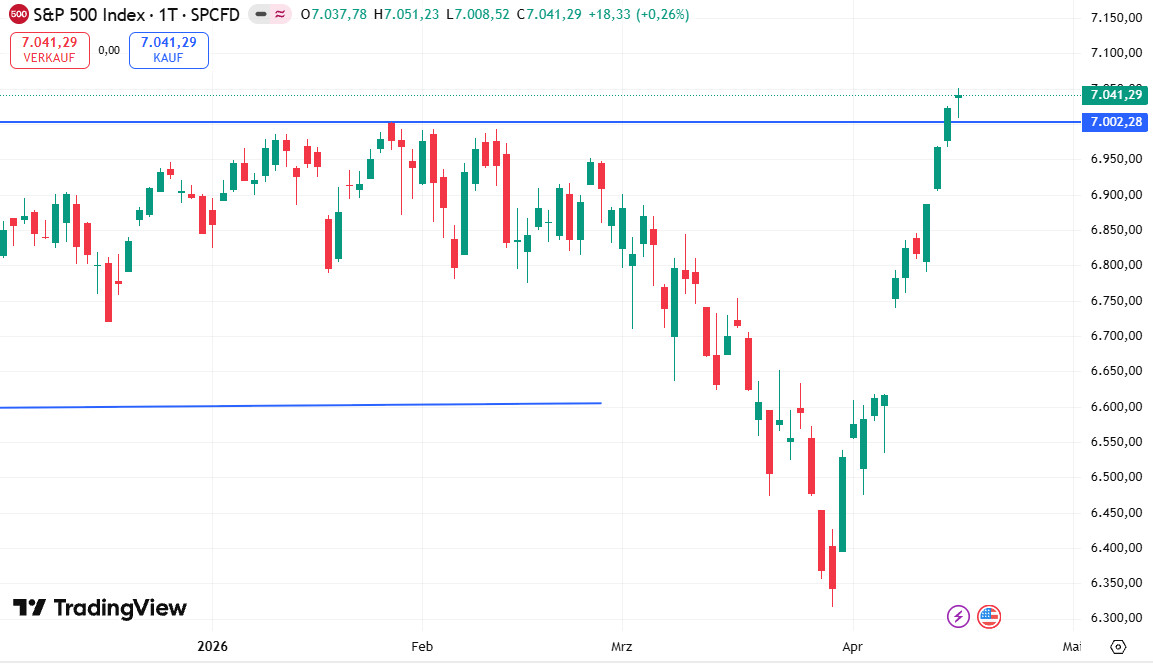
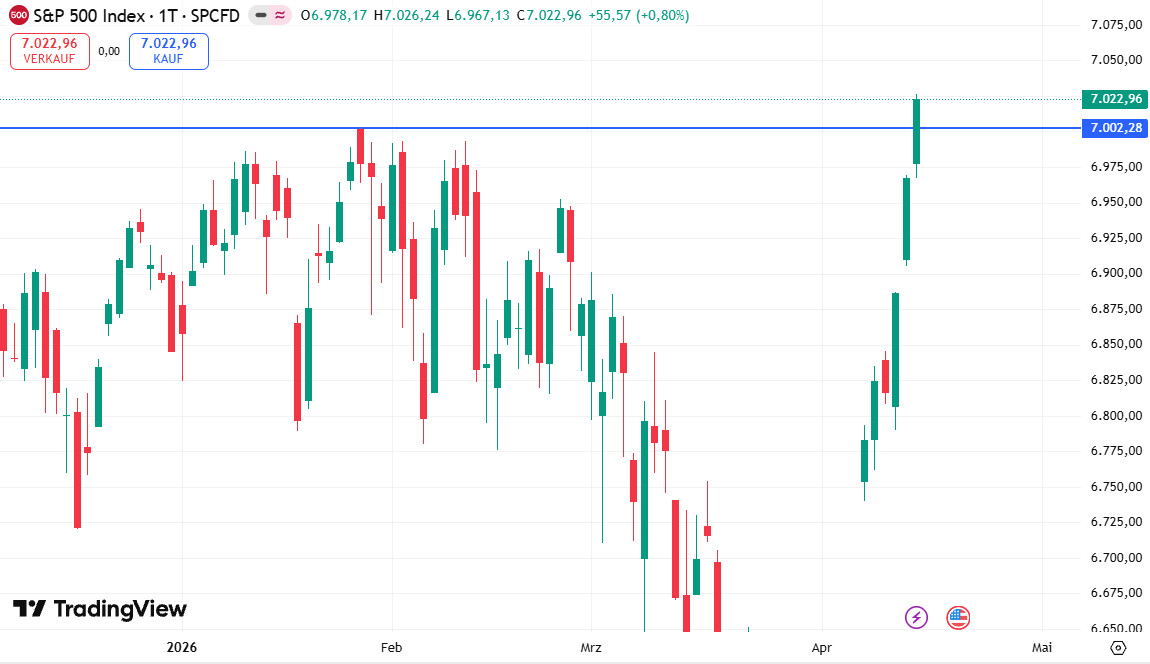
The S&P 500 reached a new all-time high yesterday and continues to show a positive pre-market trend. | Chart source: TradingView
Strong earnings support sentiment
The market is also supported by the ongoing earnings season. In particular, major US banks reported quarterly results that in some cases clearly exceeded expectations, strengthening confidence in the economic outlook. The current rally is therefore not driven solely by geopolitical hopes but is also supported by solid fundamentals.
Europe: Mixed picture despite positive cues
Asian markets largely followed the positive trend overnight and started the trading day higher. In Europe, however, a more differentiated picture is emerging.
While the CAC 40 is currently up around 0.45%, the DAX remains significantly more cautious and is hovering around the flatline.
This divergence suggests less of a unified market impulse and more of a sector rotation. While more defensive and consumer-oriented stocks are in demand in the CAC 40, the DAX is weighed down by more cyclical sectors such as industry and exports. The weaker performance of the Dow Jones provides additional context.
Current price action
In detail, the DAX is currently trading at around 24,100 points, nearly unchanged from the previous day, while the CAC 40 is up approximately 0.45%. The Euro Stoxx 50 is also slightly higher but does not fully match the strength of the French market.
Oil stabilizes – weaker US dollar provides support
After the sharp movements of recent days, the oil market is currently much calmer. Prices are stabilizing below the 100 US dollar per barrel mark, signaling no immediate escalation in the Persian Gulf.
This relative stability is viewed by markets as a supportive factor. While fears of supply disruptions recently led to noticeable risk premiums, the current development suggests that market participants are now assuming a more limited disruption rather than a sustained supply shock.
Oil supported by weaker US dollar
Oil prices are also supported by developments in the foreign exchange market. The US dollar is currently weaker, trading against the euro at around 1.1785. A weaker dollar tends to support commodity prices, as oil is traded in US dollars and becomes cheaper for buyers outside the dollar area.
In the current market environment, these effects reinforce each other: while geopolitical tensions are not signaling immediate escalation, the weaker dollar adds further stability. Oil therefore remains a key indicator of how seriously markets currently assess the risk of further tensions.
Gold above 4,800 US dollars – crypto market consolidates
The gold price remains robust and has once again established itself above the 4,800 US dollar mark. It is currently trading at around 4,832 US dollars per ounce, slightly higher on the day. This development underscores that, despite improved market sentiment, there is still a degree of demand for hedging.
Gold thus reflects the current market environment: while risk assets benefit from hopes of de-escalation, some market participants remain cautiously positioned. The renewed move above 4,800 US dollars can therefore also be seen as a sign that confidence in a lasting easing has not yet been fully established.
Bitcoin consolidates below 75,000 US dollars
The crypto market, on the other hand, is entering a phase of consolidation. After Bitcoin and many altcoins posted strong gains over the past three trading days, momentum is currently limited.
Bitcoin is currently trading at around 74,688 US dollars, remaining below the 75,000 US dollar level, which has increasingly acted as resistance. The broader crypto market is also largely unchanged and is digesting recent gains in a sideways movement.
Overall, the development suggests that markets are entering a stabilization phase after the recent rally. While gold remains in demand as a hedge, the crypto market currently lacks fresh catalysts for further upside.
Hope drives outlook in a fragile environment
Current market movements present an overall constructive picture but are largely driven by expectations. The absence of new military incidents, stable oil prices, and strong corporate earnings support risk appetite and contribute to a noticeable easing in markets.
At the same time, there is still a lack of reliable signals pointing to a sustainable de-escalation. There are no concrete developments in negotiations or a clear shift in the geopolitical situation so far.
This leaves the current trend vulnerable to rapid reversals. Should new tensions arise or hopes for a diplomatic solution be disappointed, sentiment could deteriorate just as quickly as it has recently improved.
Financial markets appear to be reacting to new developments in the Middle East midweek. According to reports, the US Air Force has struck Iranian missile positions near the Strait of Hormuz, reportedly destroying key military infrastructure that had threatened shipping routes. Following the news, markets showed increased activity, which may indicate at least a temporary easing of tensions.
The reaction in the oil market is clearly reflected in the prices of WTI and Brent crude oil. The price of a barrel of US WTI crude fell overnight to a key support level around 91 US dollars and is currently trading near 92.50 USD. Brent crude also declined and is now trading below the 100 US dollar mark at around 99.50 USD.
Falling oil prices support equity markets
Falling oil prices are having a positive impact on the stock markets and major indices such as the DAX and Euro Stoxx 50. Lower energy costs reduce potential pressure on companies and the broader economy. A possible easing of tensions in the Strait of Hormuz may also alleviate concerns about disruptions in oil supply, which is reflected in improved market sentiment.
The DAX is trading around 0.60% higher after the market open, while the Euro Stoxx 50 is up approximately 0.94%. US index futures are also pointing higher ahead of the open, currently gaining around 0.65% on average.
However, further developments in equity markets may remain cautious. The Federal Reserve’s interest rate decision is scheduled for 19:00 CET. While no change in rates is expected, market participants will focus on the accompanying statement and comments from Fed Chair Jerome Powell during the press conference at 19:30 CET for clues about future monetary policy.
The press conference will be broadcast live and can be followed via the official Fed livestream.
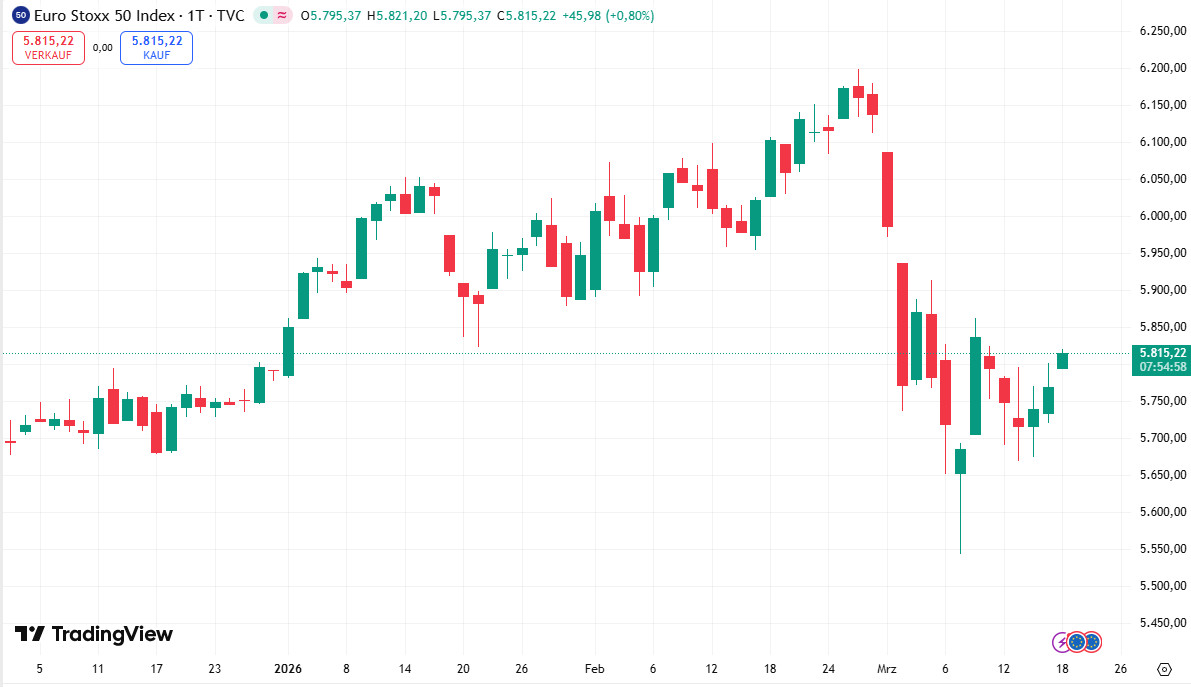
The Euro Stoxx 50 reacts positively to developments in the Persian Gulf and opens clearly higher | Chart source: TradingView
Dollar weaker, gold remains under pressure
In the foreign exchange market, the US dollar is showing slight weakness. The EUR/USD exchange rate has risen back above the 1.15 level. The reduced demand for the dollar may indicate that investors are currently seeking less hedging.
Meanwhile, gold remains weak and continues to struggle with the 5,000 US dollar per ounce level. Despite the geopolitical backdrop, the precious metal is not managing to sustainably benefit from its role as a safe haven.
Crypto market remains stable
The crypto market appears relatively unaffected by the latest developments. Bitcoin continues to attempt a sustained move above the 74,000 US dollar level. This suggests that the digital asset space remains largely detached from short-term movements in traditional markets.
Conclusion
Current market movements suggest that investors are interpreting the latest developments in the Middle East as at least temporarily easing. The decline in oil prices appears to be a key driver of the improved sentiment in equity markets.
At the same time, the environment remains fragile. Further geopolitical developments could quickly provide new impulses and reverse the current trend.
Financial markets appear surprisingly stabilized after recent geopolitical tensions. While the situation around the Strait of Hormuz had been marked by significant risk premiums in recent days, the current lack of immediate military actions is now contributing to a noticeable easing.
One trigger for the latest move was a statement by US President Donald Trump, suggesting that Iran remains interested in an agreement. Similar signals in recent weeks had repeatedly triggered short-term recoveries, which, however, later proved to be unsustainable.
Lack of new attacks seen as positive signal
In the current situation, however, a potential difference is emerging: despite the now ongoing blockade of Iranian oil exports and continued mutual threats, there have so far been no confirmed military incidents at sea. There are also currently no reports of new attacks on Tehran or military bases in Iran. As a result, the ceasefire remains stable for now, and immediate escalation is avoided, which markets interpret as a cautiously positive signal.
The key question now is how the situation develops over the next 24 to 48 hours. Observers assume that Iran may use this phase to test the actual enforcement of the blockade at sea without immediately risking open military confrontation.
If no incidents or military clashes occur during this period, it could further support the current market stabilization. At the same time, it remains unclear whether this represents a sustainable de-escalation or merely a temporary phase without immediate military action.
Oil price declines significantly
After oil prices had already fallen below the 100 US dollar per barrel mark on the spot market yesterday morning, futures have now followed. May futures on WTI crude are currently down around 1.60% and are trading at approximately 97.50 US dollars. Futures on Brent crude are down 0.41% and are currently at around 98.95 US dollars per barrel.
Falling oil supports stock markets
Stock markets are currently driven by expectations of further de-escalation and declining oil prices. After markets had started the week significantly lower due to failed negotiations, sentiment improved noticeably during the afternoon. European indices were able to recover most of their losses by the close, while US indices moved clearly into positive territory by the evening.
In pre-market trading, the German benchmark index DAX is currently up a solid 0.76% at around 24,103 points. The Euro Stoxx 50 is up 0.68% pre-market, while the French CAC 40 shows a more moderate gain of 0.20%.
US index futures, on the other hand, show little movement this morning after already closing the previous trading day with strong gains.
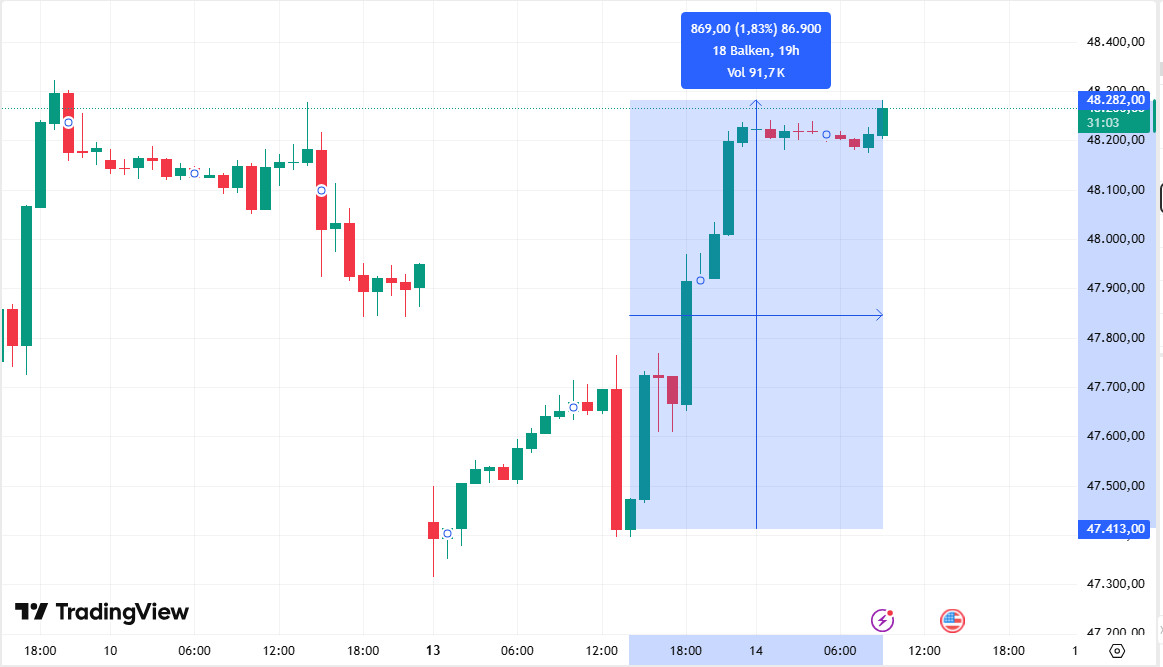
After a weak start to the week, the Dow Jones has recovered significantly. | Chart source: TradingView
Weaker US dollar, firm gold price
The falling oil price and the associated lower demand for US dollars in global trade are weighing on the US currency. Against the euro, the dollar is currently trading at 1.1780, down around 0.18% on the day. The USD/JPY pair has also moved away from the 160 level and is currently down 0.21% at around 159.09.
The gold price, on the other hand, is benefiting from the weaker dollar. After starting the week at around 4,650 US dollars per ounce yesterday, it is now trading at approximately 4,786 US dollars and is once again approaching resistance near 4,800 US dollars.
Bitcoin and altcoins on the rise
The crypto market shows a clear recovery this morning. Bitcoin is currently up around 5.45% and, at approximately 74,621 US dollars, has risen above the 74,000 US dollar mark for the first time in four weeks.
Ethereum is performing even more strongly. The second-largest cryptocurrency by market capitalization is up around 9.2% and is currently trading at approximately 2,385 US dollars. This makes ETH one of the strongest performers among major cryptocurrencies at the moment.
Plenty of hope, but fragile markets
The current decline in oil prices and the recovery in equity markets appear to be largely driven by hopes that the current calm could lead to a lasting de-escalation in the region. At the same time, it remains unclear whether and to what extent negotiations are actually continuing behind the scenes.
As long as there are no concrete developments or confirmed agreements, the situation remains fragile. This means that the current recovery – similar to previous weeks – could quickly lose momentum again if tensions escalate.
Financial markets are currently showing a relatively stable picture. After the sharp swings of the past week, many asset classes are moving within their established ranges. Oil prices remain elevated, the US dollar stays firm, and major equity indices are showing only moderate movements.
This cautious tone may also reflect the upcoming monetary policy decisions. Meetings of both the Federal Reserve and the European Central Bank are scheduled in the coming days, which could lead many market participants to adopt a wait-and-see approach.
However, this apparent stability does not mean that nothing is happening beneath the surface. While broader markets are currently moving sideways, individual stocks are increasingly coming under pressure – a possible sign that investors are reassessing expectations.
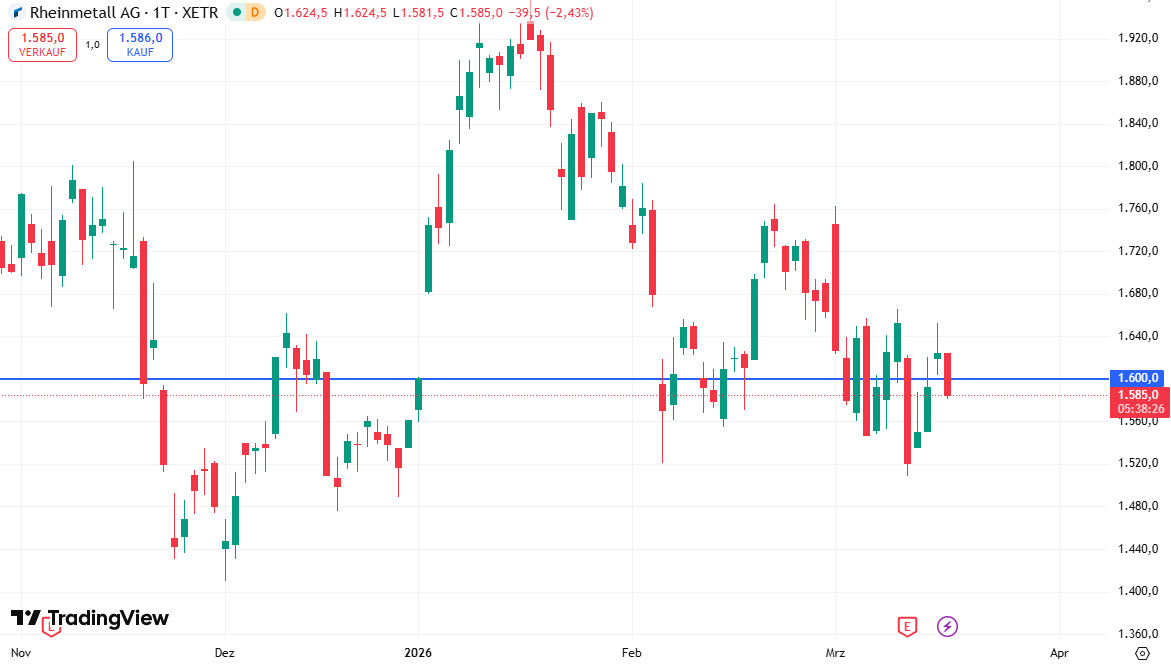
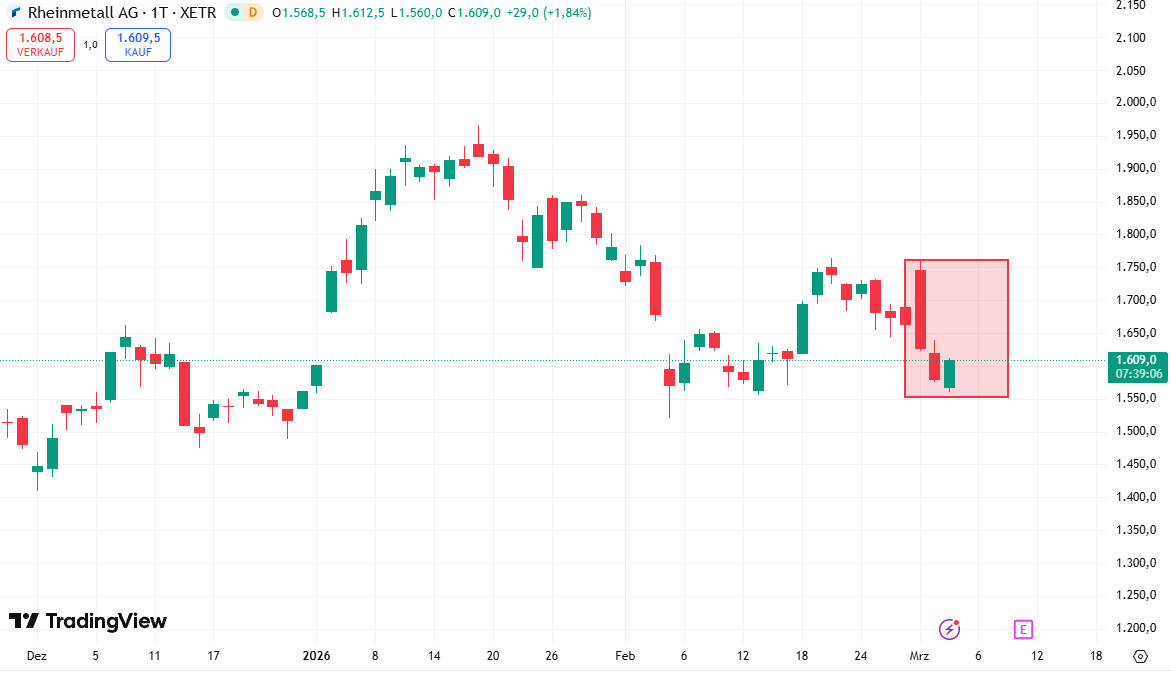
Rheinmetall under pressure despite geopolitical backdrop
One example of this development is the stock of German defense company Rheinmetall, which is currently down around 2%. At first glance, this weakness may appear surprising, as geopolitical tensions are generally seen as supportive for the defense sector.
However, the price action could suggest that investors are reassessing expectations regarding future demand. The strong rally of recent years has been closely linked to rearmament driven by the war in Ukraine, which has been characterized by conventional land warfare.
The current geopolitical situation in the Persian Gulf, however, has a different structure, with risks to energy infrastructure and trade routes taking center stage. In such an environment, demand dynamics may be less clear, which could lead to a more cautious investor outlook.
Although the company operates across multiple defense segments, current market behavior may indicate that investors are shifting their expectations. In the view of many market participants, other aspects of modern conflicts are currently in focus, while demand visibility in certain segments appears less clear.
In addition, potential changes in the Ukraine conflict may also play a role. If the situation were to ease, expectations for future demand in certain equipment categories – which have recently driven much of the sector’s momentum – could also shift.
Rheinmetall is increasingly under pressure and is currently testing the 1,600 EUR level | Chart source: TradingView
Winners and losers become more visible
The development in Rheinmetall highlights that market movements are increasingly becoming more selective. While major indices are stabilizing, individual stocks are reacting more sensitively to changes in the geopolitical environment and investor expectations.
Energy companies in particular continue to benefit from elevated oil prices, while sectors with high sensitivity to energy costs – such as airlines or parts of the industrial sector – are facing pressure.
This suggests that markets may currently be in a phase of differentiation. Instead of broad-based movements, the focus is shifting toward how geopolitical developments affect individual business models.
Conclusion
Even though major markets appear relatively stable at the moment, the environment remains challenging for investors. Current movements are increasingly shifting toward individual stocks, where expectations, perception, and geopolitical developments are being priced in more selectively.
For investors and traders, this could mean that stock selection is currently becoming more important than the overall market direction. Which sectors and companies may benefit from or be negatively affected by the current geopolitical situation is likely to become clearer in the coming days and weeks.
Financial markets are starting the new week relatively composed, even though the geopolitical situation has clearly intensified. Following the breakdown of negotiations between the United States and Iran and the announcement of a blockade on Iranian oil exports by the United States, market participants are now focusing on the start of the measure, which is scheduled to take effect at 10:00.
Oil reacts, but remains notably restrained
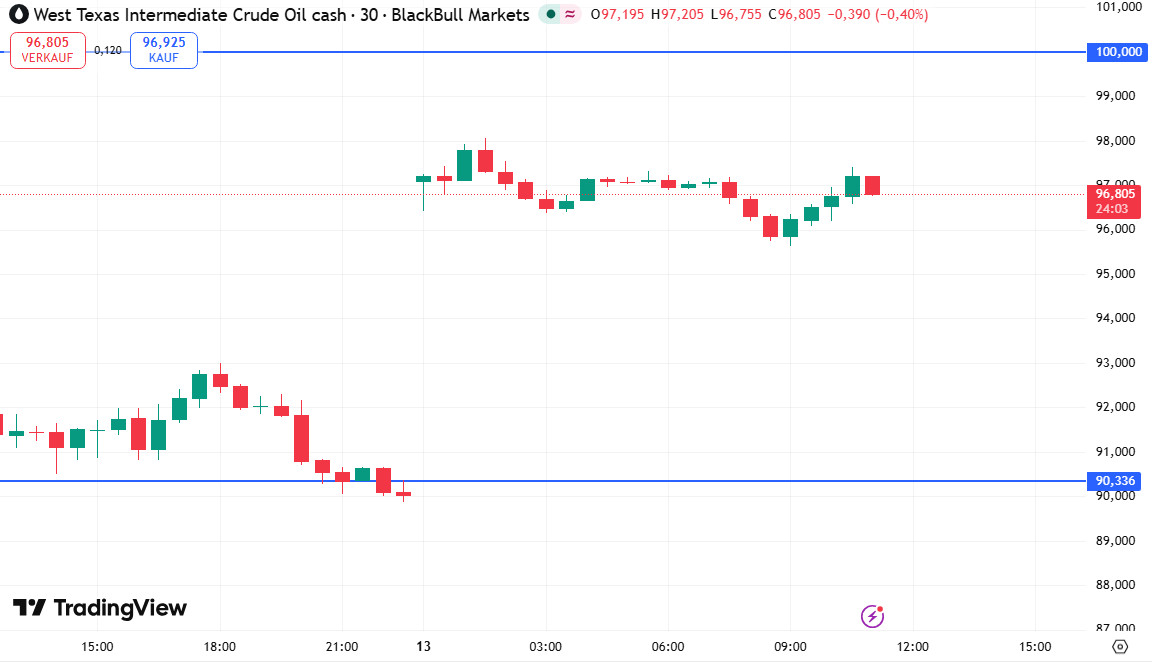
What stands out above all is the market reaction: Despite a potentially affected share of around 20–25% of global oil trade, a move above the 100 US dollar mark has so far failed to materialize. Oil prices did rise, but remain clearly below the levels that had been discussed as possible escalation scenarios before the negotiations began. WTI briefly rose to 98.13 US dollars per barrel on the spot market, while North Sea Brent only briefly reached 100.19 before immediately falling back below the 100 US dollar mark.
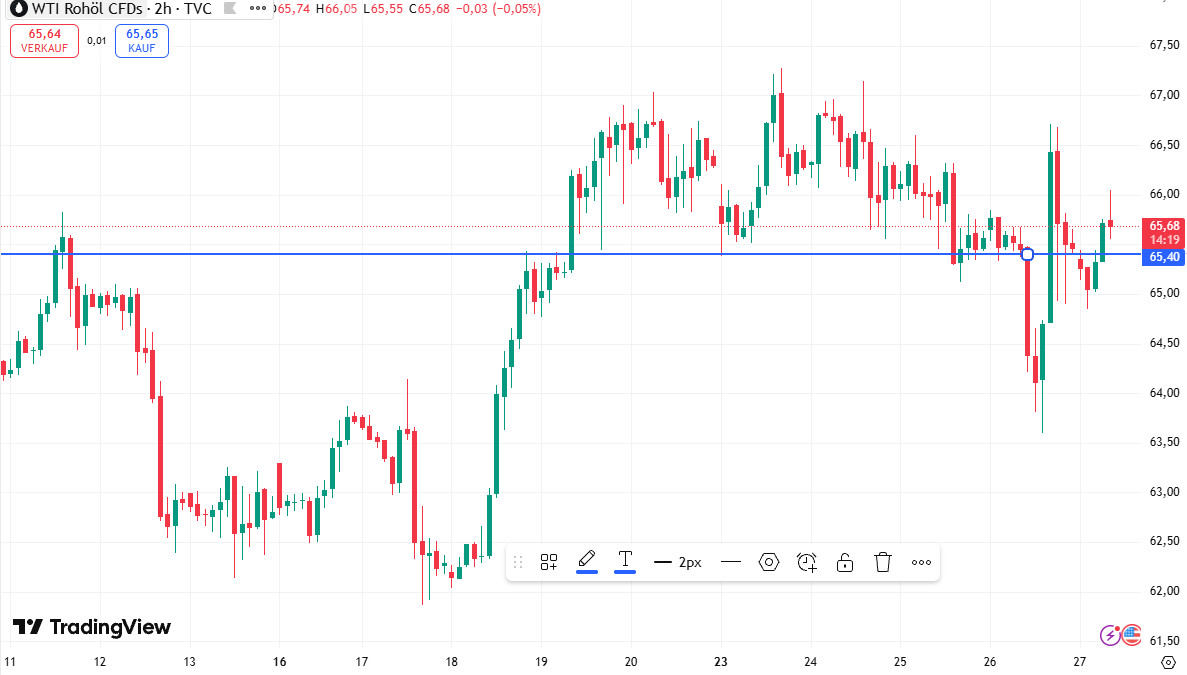
WTI crude rises sharply after the breakdown of negotiations, but remains clearly below the 100 US dollar mark. | Chart source: TradingView
Equity market shows slight recovery
At the same time, equity markets already showed a slight recovery in pre-market trading after having started the new trading week significantly lower. Overall, the reaction is noticeably less hectic than during the broader course of the conflict and in the days before the negotiations, when even the mere possibility of escalation led to noticeable risk premiums at times.
The German DAX is currently recording a loss of around 1.22% at 23,563 points, after a daily low of 23,502 points. The Euro Stoxx 50 is currently trading 1.05% lower, while the French CAC 40 is down around 1.10%.
A look at US index futures shows that they are also trading lower in pre-market trading, although losses remain relatively moderate so far. Futures on the Dow Jones are currently down around 0.49%, the S&P 500 by 0.61%, and the Nasdaq 100 is the biggest loser with a decline of around 0.72%.
Dollar stronger and gold searching for direction
The US dollar started the trading week stronger, not least due to the prospect of rising oil prices. Although it has given back part of its initial gains, it is still up around 0.25% against the euro at 1.169. A similar picture can be seen against the Japanese yen, which at 159.66 is currently losing around 0.24% against the US currency.
The gold price fell sharply to around 4,670 US dollars per ounce after the breakdown of US-Iran negotiations. Due to the unclear situation as to whether the escalation will actually be implemented, it has since recovered and moved back above the 4,700 US dollar mark. Gold is currently trading at around 4,731 US dollars.
Bitcoin holds above 70,000 US dollars
Bitcoin and altcoins are also recording losses due to the changed situation in the Persian Gulf. Bitcoin is currently down around 1.33%, but remains above the important 70,000 US dollar mark at 70,665 US dollars.
The situation is similar for Ethereum. The second-largest cryptocurrency by market capitalization is currently down around 1.41% and is trading at 2,182 US dollars. On a weekly basis, however, both cryptocurrencies are still showing gains: BTC +2.31% and ETH +2.23%.
Assessment and outlook
At first glance, this behavior appears contradictory. A blockade in the region around the Strait of Hormuz affects a central hub of global oil trade and carries the potential for significant supply disruptions. Nevertheless, the market does not currently appear to be pricing in an immediate worst-case scenario, but rather a combination of limited disruption, possible rerouting of supply flows, and continued uncertainty regarding the actual implementation of the measures.
Oil prices received additional support from a new threat from Tehran. Iran stated that in the event of a threat to its own ports, no port in the entire region would remain safe. The statement points to a possible expansion of tensions beyond the Strait of Hormuz.
However, this has so far only led to a moderate counter-movement in the market after prices had previously eased slightly. A clear escalation premium has therefore not yet emerged, suggesting that market participants are still waiting for concrete disruptions in physical oil flows.
The threat itself remains conditional. While the United States is initially targeting Iranian oil exports through a blockade and has so far not announced any direct attacks on ports, Tehran is explicitly linking an expansion of tensions to the event that its own port infrastructure is threatened.
This distinction may be one reason why the market is acknowledging the statements but is not yet pricing in immediate escalation.
Iran threatens infrastructure in neighboring states
With the latest threat from Tehran, another risk is moving into focus for the markets: a possible expansion of tensions to infrastructure across the entire Persian Gulf. Iran stated that if its ports are threatened, no port in the region would remain safe.
Such a scenario would go far beyond a disruption of shipping through the Strait of Hormuz. During earlier phases of the conflict, there have already been attacks on energy facilities and critical infrastructure in several Gulf states, underlining the vulnerability of the entire region.
For the oil market, such a development would have far-reaching consequences. In addition to possible disruptions to production and exports, uncertainty regarding the safety of transport routes and loading ports would increase significantly. This would extend the risk beyond individual routes to the entire regional energy system.
At the same time, it remains unclear whether such an escalation will actually occur. The threats are still conditional and have therefore been interpreted cautiously by the market.
Markets continue to be shaped by the crisis in the Persian Gulf at the start of the week. While many traditional asset classes remain under pressure or trade sideways in the current environment, cryptocurrencies are showing relative strength this morning. Ethereum is gaining about 7%, while Bitcoin is rising more moderately by just under 3%. Major altcoins such as Cardano are also recording strong gains.
The development suggests that some market participants are currently seeking short-term return opportunities in the crypto market, while other asset classes remain more strongly influenced by geopolitical risks and a firm US dollar.
Oil prices remain the key gauge of geopolitical risk
The oil market continues to be the most important driver of sentiment in financial markets. Ongoing tensions in the Persian Gulf mean that a geopolitical risk premium remains embedded in crude oil prices.
The North Sea benchmark Brent and the US benchmark WTI are currently fluctuating around the 100 US dollar per barrel level. Prices are rising moderately in early trading, suggesting that market participants continue to price in possible disruptions to key transport routes in the Middle East.
As long as tensions in the region persist, oil prices are likely to remain a key indicator of the overall risk environment in global markets.
Crypto market rises – altcoins outperform Bitcoin
Cryptocurrencies currently stand out as a notable exception in an otherwise mixed market environment. Bitcoin is up around 2.8% and is once again approaching the 73,500 US dollar level, where a short-term technical resistance appears to be forming.
The move is even more dynamic among several major altcoins. Ethereum is gaining around 6.6% and trading at 2,245.60 USD, while Solana, at 92.90 USD and up roughly 5%, is also among the stronger large cryptocurrencies.
The stronger performance of altcoins suggests that investors within the crypto market are once again seeking higher risk exposure. During phases when Bitcoin rises moderately, short-term capital flows often shift toward more volatile cryptocurrencies with greater upside potential.
Ethereum clearly ranks among the stronger altcoins at the start of the week with gains of more than 6%. | Chart source: TradingView
Equity markets start the week cautiously
Equity markets are showing a cautious tone at the start of the week. European exchanges opened moderately higher, while US index futures are also trading slightly in positive territory.
However, moves remain limited so far, as many investors continue to monitor geopolitical developments in the Middle East. Uncertainty about potential effects on energy prices and global supply chains means that larger risk exposures are currently being built only cautiously.
Dollar strengthens again – precious metals under pressure
In the foreign exchange market, the US dollar is regaining some strength after the losses seen at the end of last week. The EUR/USD exchange rate is currently about 0.12% higher at around 1.1425. This trend could indicate that the U.S. dollar is further strengthening its position as a safe-haven currency in the current environment.
A stronger dollar is also weighing on several commodities. Gold is currently struggling with the psychologically important 5,000 US dollar per ounce level, while silver is falling more sharply and has dropped below the 80 US dollar mark.
Since precious metals are mostly traded in US dollars, they become more expensive for buyers outside the dollar area when the US currency strengthens. This can add short-term pressure on prices.
Conclusion
Markets remain heavily influenced by geopolitical risks at the start of the week. While oil prices and the US dollar benefit from the uncertainty, equity markets are so far showing only cautious stability.
The relative strength of the crypto market stands out in particular, with several major altcoins posting significant gains. Whether this trend continues or represents only a short-term capital rotation will likely depend on how both geopolitical developments in the Persian Gulf and the direction of the US dollar evolve in the coming trading days.
On Friday morning, markets appear to be searching for direction. However, the past 24 hours have shown that even smaller geopolitical signals can trigger reactions. After oil prices rose again yesterday due to growing skepticism about the success of the ceasefire and stock markets declined, this movement was halted in the early evening.
X post by Benjamin Netanyahu sparks hope
At around 18:00 CET, the Israeli Prime Minister posted on X (formerly Twitter) that he had ordered the direct start of peace negotiations with Lebanon. As an end to hostilities had been a key demand by Iran for implementing the ceasefire and reopening Hormuz, this immediately sparked hope in the markets.
As a result, oil prices dropped by around 4%, and the previously weak US stock market quickly moved into positive territory. As it later became clear that negotiations do not necessarily mean an immediate end to fighting in Lebanon, oil prices edged slightly higher again. However, indices were largely able to hold on to their gains.
Oil price at potential resistance
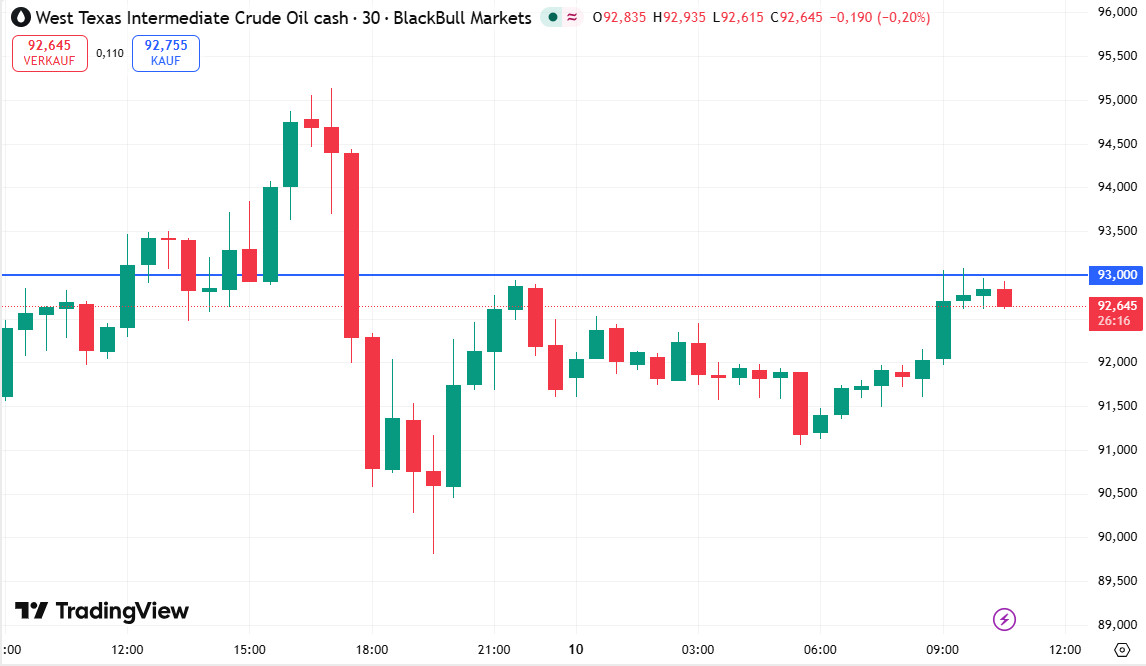
After the price of WTI crude fell to around 90 US dollars per barrel on the spot market in the early evening, it rebounded to the 93 US dollar level. This level was not broken during the evening session. Currently, however, the price is trading slightly above it at 93.25 US dollars. Brent crude shows a similar pattern and is currently trading just above the temporary resistance at 95.35 US dollars per barrel.
After falling in the evening, the 93 USD level is acting as resistance for WTI this morning. | Chart source: TradingView
Stocks in wait-and-see mode
Following the evening impulse, stock markets started trading with gains of around 0.55%. These gains are currently being largely maintained. However, the overall market appears to be in a wait-and-see mode, looking for new catalysts.
The German benchmark index DAX is currently up 0.49% at 23,874 points, about 20 points below its intraday high. The French CAC 40 shows a similar pattern, gaining 0.20% and trading at 8,263 points.
US dollar above 1.16 against the euro
The US dollar weakened against most currencies following the announcement of the ceasefire agreement. Against the euro, it moved back above the 1.16 level and even briefly rose above 1.17 yesterday evening. Currently, the dollar is gaining around 0.20% against the euro, with the EUR/USD pair trading at 1.1678. The US dollar is also strengthening against the yen, with USD/JPY currently at 159.31, about 0.22% higher than the previous day.
Gold and Bitcoin consolidate
The gold price has moved slightly away from yesterday’s high at the resistance level of 4,800 US dollars per ounce. It is currently trading sideways around 4,750 US dollars.
Bitcoin and most altcoins show a similar pattern. BTC briefly approached the 73,000 US dollar level overnight but failed to break above it. Since yesterday’s recovery, the price has been moving within a range between 73,000 and 70,500 US dollars. It is currently trading at 71,596 US dollars, up 0.50% on the day.
Markets remain defensive ahead of the weekend
Ahead of the weekend, many market participants appear to have adopted a more defensive stance. Given the ongoing nervousness and the sometimes strong reactions to geopolitical developments, this would be understandable.
Financial markets are mostly weaker at the end of the week. While geopolitical tensions related to the Iran crisis continue to create uncertainty, many asset classes are reacting with falling prices. Cryptocurrencies, however, currently stand out as a notable exception.
Crude oil is posting moderate gains amid the tense situation in the Middle East. Both the North Sea benchmark Brent and the US benchmark WTI are currently fluctuating around the 100 US dollar per barrel level. At the same time, equity markets are losing ground. The DAX and the Euro Stoxx 50 are currently trading around 1.00% lower, while US index futures are also down by an average of about 0.35% in pre-market trading.
Strong dollar weighs on several asset classes
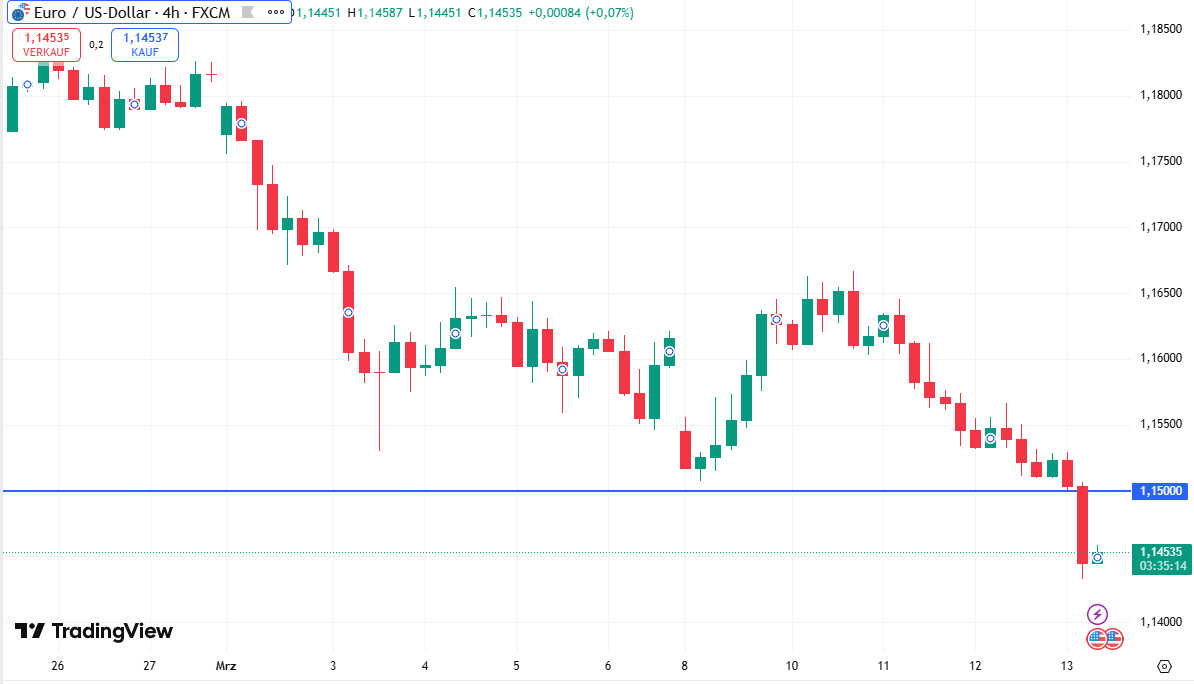
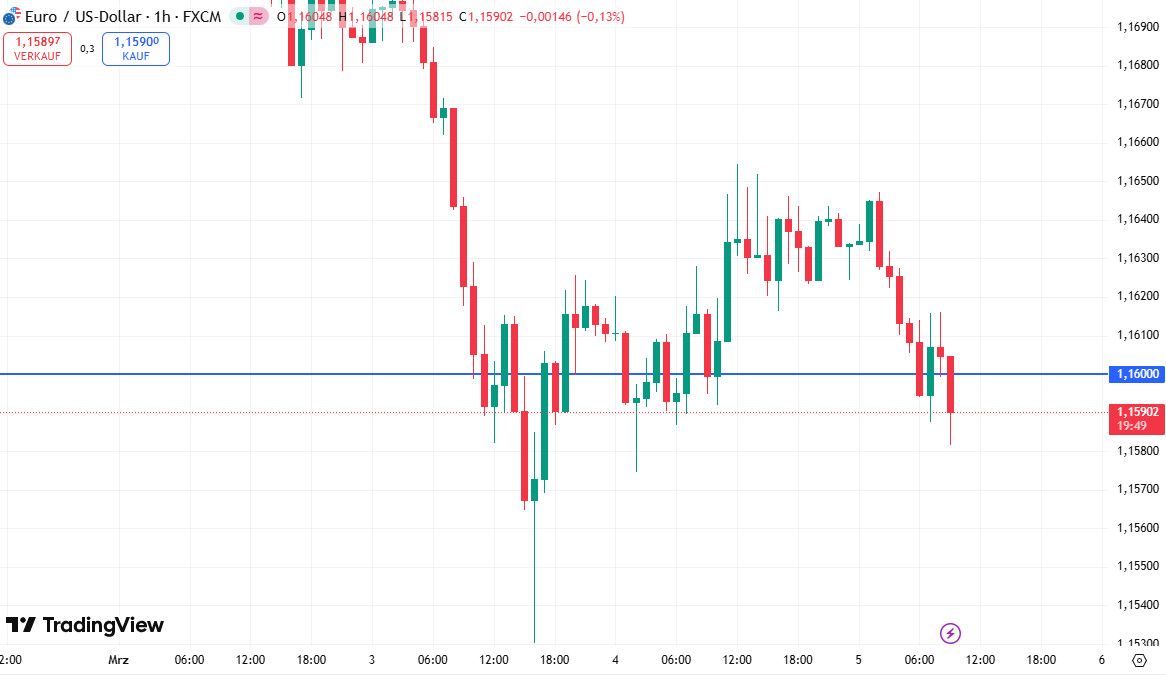
In the foreign exchange market, the US dollar continues to strengthen its role as a classic safe-haven asset. Against the euro, EUR/USD has fallen below the 1.15 level. The pair is currently down about 0.5% and trading at 1.1455. During periods of geopolitical uncertainty, capital often flows into the dollar as many investors view it as highly liquid and a traditional safe-haven currency.
A stronger dollar also affects other asset classes. Commodities such as gold or industrial metals are mostly traded in US dollars. When the dollar rises, these goods become more expensive for buyers outside the dollar area, which often leads to declining prices.
Equity markets can also suffer from a strong dollar. On the one hand, financing costs for companies outside the United States may increase. On the other hand, international capital flows are often redirected toward dollar-denominated assets. This dynamic could currently contribute to the pressure on indices such as the DAX or the Euro Stoxx 50.
The EUR/USD 4-hour chart highlights how strongly the US dollar has strengthened since the beginning of March. | Chart source: TradingView
Metals under pressure
While energy prices benefit from geopolitical risks, precious and industrial metals are currently under pressure. Gold is down about 0.6% and has fallen below the 5,100 US dollar per ounce level. Silver is declining even more sharply, losing around 2.6%.
Industrial metals are also showing weaker performance. Falling prices may indicate that market participants expect lower demand from the industrial sector. Such movements are often interpreted as a possible signal of weakening momentum in manufacturing.
Cryptocurrencies move higher
In contrast to many traditional asset classes, cryptocurrencies are currently showing strength. Bitcoin is up about 2.8%. Ethereum is also gaining around 2.6%, while Cardano is rising roughly 4.5%.
The reasons for this development are not entirely clear. However, it is possible that some market participants currently view cryptocurrencies as an alternative asset class amid the geopolitical environment, while equities and some commodities are facing increased pressure. In times of heightened uncertainty, capital often shifts between different asset classes.
Conclusion
The current market environment presents a mixed picture. While geopolitical risks support energy prices and put pressure on equity markets, precious and industrial metals are also losing value. At the same time, the US dollar and, somewhat unexpectedly, cryptocurrencies are benefiting.
Whether this development proves to be a short-term rotation or a more sustainable trend will likely depend on how both the geopolitical situation and expectations for the global economy evolve in the coming days.
The ceasefire agreed yesterday is already showing signs of fragility, which is once again unsettling markets. The reopening of the Strait of Hormuz is also still not guaranteed, as we previously reported. These uncertainties are driving oil prices higher again and putting pressure on stock markets.
Risk premium on oil rises again
The fragile ceasefire and the uncertain situation in the Strait of Hormuz have already led to a higher risk premium on oil prices. As a result, US crude WTI has moved back above the 90 US dollar per barrel mark. Currently, WTI is up around 2.25% on the spot market, trading at 93.35 US dollars. Brent crude is also rising, gaining around 1.80%, with a barrel currently priced at 96.00 US dollars.
Stock markets under pressure
Stock markets are once again coming under stronger pressure due to renewed uncertainty surrounding the situation in the Persian Gulf. The possibility of prolonged disruptions to oil supply is fueling concerns about higher costs, particularly in the manufacturing sector. However, rising transport and logistics costs are already placing a significant burden on the services sector as well.
The German benchmark index DAX has given back part of yesterday’s gains. Currently, the index is down 0.95% at 23,781 points. The Euro Stoxx 50 is losing 1.01% and stands at 5,853 points. The French CAC 40 is moving in a similar range, down 0.92% at 8,187 points.
A look at US index futures shows declines in pre-market trading as well, although they remain more moderate so far. Dow Jones futures are currently down 0.30%, S&P 500 futures are off by 0.23%, and Nasdaq 100 futures show the smallest losses at -0.14%.
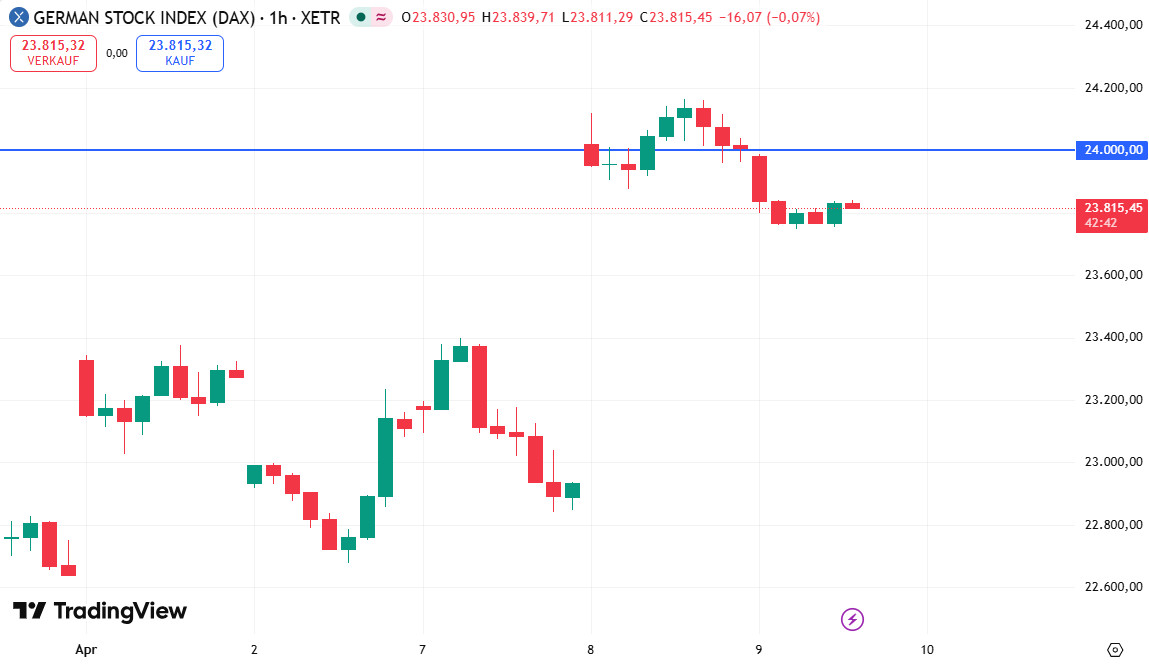
Renewed market uncertainty causes the DAX to give back part of yesterday’s gains and fall below 24,000 points. | Chart source: TradingView
US dollar weaker, gold price stable
The US dollar had already weakened yesterday due to expectations linked to falling oil prices. While the trend has slowed, it continues today. Against the euro, the US dollar is currently down around 0.15%, with EUR/USD trading at 1.1680. Against the Japanese yen, however, the US currency is gaining about 0.26%, with USD/JPY at 158.90. This means the yen has given back roughly half of its gains from the previous day against the dollar.
The gold price is currently holding near yesterday’s closing level. The precious metal is trading at around 4,742 US dollars per ounce, although it has moved significantly lower from yesterday’s high of 4,857 US dollars.
Bitcoin currently stable above 70,000 US dollars
The crypto market is also being affected by the unclear developments in the Persian Gulf. However, Bitcoin remains relatively stable above the 70,000 US dollar mark and is currently trading at 71,118 US dollars, down 0.78%. Losses are more pronounced for Ethereum, which is down 3.03% and is currently trading at 2,179 US dollars.
Outlook remains uncertain
The outlook for further developments remains largely unclear. The breaches of the ceasefire between Iran and the US have not yet led to a renewed escalation of the conflict. This uncertainty, combined with the unclear situation in the Strait of Hormuz, is likely to keep market participants cautious in what remains a challenging environment.
An attack on a tanker off the Iraqi coast initially caused nervousness in financial markets overnight. As seen in several incidents in the Persian Gulf in recent weeks, a now familiar pattern emerged: oil prices jumped sharply in the short term, stock indices came under pressure and traditional safe-haven assets such as gold moved higher.
However, only a few hours later a counter-move began. As no further signs of escalation emerged, markets calmed again, risk assets recovered and part of the initial price movements was reversed.
Oil prices initially react strongly
The most immediate reaction occurred in the energy market. The price of a barrel of the US benchmark WTI briefly climbed to nearly 95 US dollars overnight, while the North Sea benchmark Brent also moved significantly higher.
In the meantime, however, the situation has calmed again. WTI is currently trading at around 91 dollars per barrel, noticeably below the overnight highs. Brent has also given back part of its gains. The development suggests that traders are pricing in a higher short-term risk of possible disruptions to oil supply, but tend to reassess this view quickly when an immediate escalation fails to materialize.
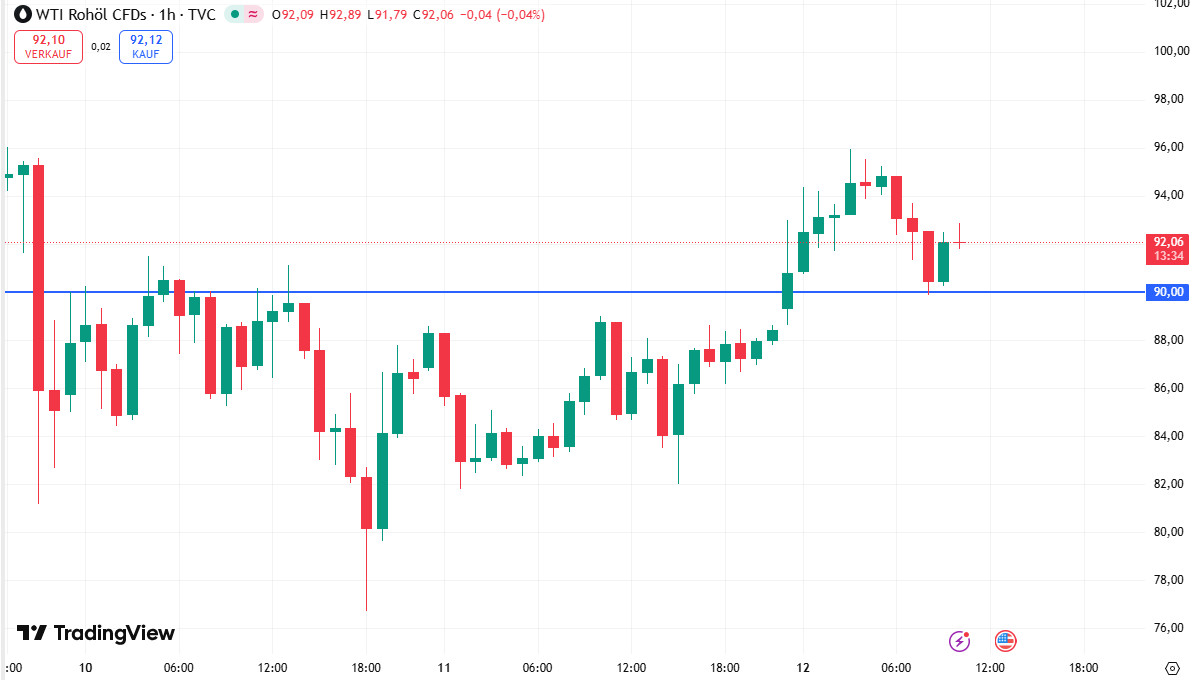
WTI crude has given back part of its recent rise but is currently finding support around 90 dollars. | Chart source: TradingView
Stock markets recover after the initial shock
A similar pattern can be seen in equity markets. After the first reports of the attack, major indices initially came under pressure as investors reacted to potential risks for energy supply and the global economy.
As the immediate uncertainty eased, however, markets began to recover. Many market participants appear to price in geopolitical headlines cautiously at first before reassessing the actual economic implications. Germany’s benchmark DAX started the trading day almost unchanged and is currently showing a slight decline of around 58 points.
Dollar gains – gold remains stable
In the foreign exchange market, the US dollar posted moderate gains, benefiting from its role as a traditional reserve and safe-haven currency. During periods of geopolitical uncertainty, capital often flows into the dollar, which can provide short-term support for the greenback.
Meanwhile, gold prices remain stable at elevated levels. Although a stronger US dollar typically acts as a headwind for gold, the precious metal managed to hold on to part of its recent gains. This suggests that some investors continue to seek protection against geopolitical risks.
Later in the day, US economic data could provide additional impulses. Weekly initial jobless claims will be released at 13:30. Following the recently weaker labor market data, investors are paying close attention to whether further signs of cooling in the US labor market might emerge. The labor market is considered one of the most important indicators for interest rate decisions by the Federal Reserve.
Conclusion
The latest market movements once again highlight how sensitively investors react to geopolitical headlines. At the same time, they also show that such reactions are often short-lived.
Markets tend to react reflexively to new risks before traders and investors more carefully assess the actual implications for supply, demand and the broader economy. As long as individual incidents do not lead to a sustained escalation, many of these movements may remain temporary. For investors and traders, this currently creates a rather challenging market environment.
The agreement reached overnight on Wednesday on a ceasefire and the reopening of the Strait of Hormuz initially triggered strong euphoria in the markets. One possible reason is that only limited concrete details were available at first, leaving room for interpretation among market participants.
Hopes for a potential lasting peace in the Persian Gulf likely played a key role. As developments progressed, however, it became clear that while a first step toward de-escalation had been taken, the path to a sustainable solution remains difficult and fraught with uncertainty.
An agreement on shaky ground
The foundation on which many market expectations currently rest is the announced reopening of the Strait of Hormuz. On closer inspection, however, this foundation appears highly fragile.
Shipping companies remain cautious about passing through the strait, partly due to missing or insufficient insurance coverage for the route.
Strait of Hormuz only open on paper
In addition, Iran has reportedly raised the idea of imposing a toll of around 2 million US dollars per passage. Alongside legal questions regarding international waterways, this further increases uncertainty among shipping companies.
Many market participants may view passage without payment as a potential risk and fear attacks on vessels that attempt it.
There are also reports suggesting that parts of the route may have been mined. This assessment is supported by observations that ships from countries allied with Iran are apparently using alternative routes closer to the Iranian coast and nearby islands.
Ceasefire remains fragile
Despite the agreed ceasefire, reports indicate that isolated drone attacks have continued. Targets in Gulf states are said to have been affected.
One attack reportedly caused damage to energy infrastructure in Kuwait, while Saudi Arabia stated it intercepted several drones before they reached their targets.
Oil prices rise again, stocks weaken
Oil prices are reacting to the growing uncertainty with a slight increase. US crude WTI has moved back above the 90 US dollar per barrel mark, while Brent crude is currently trading at around 95 US dollars.
Equity markets, on the other hand, are showing a more subdued reaction. In Asia, major indices are slightly lower. Japan’s Nikkei 225 closed down around 0.53% at 56,010 points, while the Shanghai Composite fell about 0.69% to 3,967 points.
After Tuesday’s strong rebound, financial markets are already showing signs of caution again on Wednesday morning. Following the stabilization in oil prices after their spike at the start of the week, which allowed equity indices to move higher, a certain degree of sobering sentiment now appears to be setting in.
On Monday, the price of WTI crude temporarily reached a high of around 113 US dollars. It has since calmed considerably and is currently trading at about 85 US dollars per barrel – even slightly below last week’s level.
New doubts about a quick de-escalation
One possible reason for the more cautious mood could be that hopes for a quick end to the military confrontation involving Iran may have been overly optimistic. Statements earlier this week suggesting that the war was practically over had initially brought significant relief to the markets.
However, new reports about possible military activity in the Persian Gulf are now creating renewed uncertainty. Reports about an attempt to mine the Strait of Hormuz could point to a potential escalation in this key oil transit region.
Any disruption of this central trade route would significantly affect crude oil supply and could therefore also have consequences for the global economy.
After Monday’s spike, oil prices have stabilized below last week’s closing level. | Chart source: TradingView
DAX opens weaker
Against this backdrop, European stock markets are starting the session on a weaker note. The DAX is currently down about 1.05 percent, falling clearly back below the 24,000-point mark.
The Euro Stoxx 50 is also declining, currently losing around 43 points, or roughly 0.75 percent.
Economic data are providing little support. The consumer price index (CPI) released in the morning came in at 1.9 percent, in line with expectations and therefore offering no new impulse for the markets.
Dollar slightly stronger, gold eases
In the foreign exchange market, the US dollar is showing modest strength. The dollar index is currently up about 0.11 percent. Nevertheless, the EUR/USD pair continues to hold above the 1.16 level.
Gold prices are edging lower in early trading and are currently around 5,190 US dollars per ounce, representing a decline of just under one percent.
The cryptocurrency market is also showing limited movement so far. Bitcoin continues to trade near the upper boundary of its recently established range, currently around 69,600 US dollars.
Conclusion
After the strong rebound seen the previous day, markets appear to be entering a phase of consolidation. Renewed geopolitical uncertainty in the Persian Gulf may currently be prompting investors to act more cautiously.
Whether this represents merely a short pause or a renewed shift in market direction will likely continue to depend heavily on further developments in the geopolitical situation.
Overnight, the United States, Israel, and Iran agreed on an initial temporary ceasefire. The mediated agreement also includes the reopening of the Strait of Hormuz for shipping. Following the announcement, oil prices dropped by up to 15%, while stock markets launched a strong rally despite ongoing uncertainties.
Oil prices plunge sharply
After the end of the blockade in the Strait of Hormuz was announced, oil prices fell significantly. The prospect of secure transport for the previously blocked roughly 20% of global oil trade led to a rapid removal of the risk premium that had been priced in.
Oil prices have now returned to levels seen in early April, when initial hopes for a de-escalation in the conflict emerged.
US crude oil (WTI) dropped to an intraday low of 85.97 USD per barrel and is currently trading at around 89.50 USD. Brent crude reached a daily low of 90.65 USD per barrel and is currently down around 10% at approximately 92.60 USD.
Stock markets start rally
Following the sharp decline in oil prices and the prospect of easing tensions, stock markets already posted strong gains in pre-market trading. This movement continued and intensified after the European session opened.
Germany’s DAX briefly moved above the 24,000-point level shortly after the market opened. It is currently trading around 23,975 points, up approximately 4.55%. France’s CAC 40 is also showing strong gains, rising about 3.95% to around 8,220 points.
US index futures are also reacting clearly to the geopolitical developments but remain somewhat behind the gains seen in Europe. Dow Jones futures are up around 2.34%, the S&P 500 gains approximately 2.52%, and the Nasdaq 100 shows the strongest increase at around 3.30%.
Following the agreement with Iran, the DAX opened significantly higher and is now testing the 24,000 level. | Chart source: TradingView
Gold rises despite easing tensions
The gold price is also reacting with a notable increase, gaining around 2.25% to approximately 4,812 USD per ounce.
The simultaneous rise in both stocks and gold could indicate that market participants still see a need for hedging and are not fully discounting the risk of renewed escalation.
Bitcoin back above 70,000 USD
The crypto market once again shows increasing correlation with traditional markets. Bitcoin is currently up around 4.05% and trading at approximately 71,743 USD, moving closer to the upper boundary of the price channel established over the past two months.
Whether a sustained breakout will occur remains to be seen.
Ethereum is again among the strongest performers, rising around 6.72% to approximately 2,256 USD. Cardano is also recovering after previous losses, gaining about 6.89% to around 0.2611 USD.
Uncertainty remains
Despite the strong market reaction, the remaining risks should not be overlooked. The current agreement is only a temporary solution and leaves key conflict issues unresolved.
Ceasefire is time-limited
The agreed ceasefire is initially limited to two weeks. During this period, further negotiations would need to lead to a longer-term or permanent agreement. Otherwise, the risk of renewed escalation remains.
Strait of Hormuz – reopening with questions
Although the reopening of the Strait of Hormuz has been agreed upon, its practical implementation remains uncertain. Tankers waiting in the Persian Gulf are still hesitant to pass and are demanding additional security guarantees.
In addition, future use of the route could be subject to conditions. Reports suggest that potential fees are being discussed, which could significantly increase transport costs.
Core conflicts unresolved
The central disputes between the parties remain unresolved. While Iran is demanding an end to sanctions, the United States is maintaining a cautious stance.
The issue of uranium enrichment also remains unresolved. It was a key trigger for the conflict from the US perspective, while Iran continues to hold its position.
Additionally, both sides currently present themselves as the winners of the conflict, which further complicates negotiations for a lasting agreement.
Following the current market optimism, attention may increasingly shift back to the question of whether a sustainable solution is truly achievable. As a result, the risk of renewed volatility remains high and should be considered by market participants.
International financial markets are showing signs of relief amid possible indications of easing tensions in the conflict with Iran. This reaction is particularly visible in the energy market: oil prices have plunged sharply since yesterday’s daily high.
Oil price loses around 30 percent from daily high
The price of crude oil has now fallen back to the level seen last Friday. From yesterday’s high, this corresponds to a decline of around 32 US dollars, or nearly 30 percent.
The trigger for the sharp move was growing optimism that a blockade of the strategically important Strait of Hormuz might be off the table for the time being. Market participants point out that the Iranian navy appears to have been largely neutralized following the recent military confrontations.
Additional support for this assessment came from statements by the US president, who said the war in Iran was “almost over.”
The WTI chart shows a truly remarkable price development in crude oil from the start of the week until this morning. | Chart source: TradingView
Relief in the energy market supports stock markets
The sharp drop in energy prices also helped stabilize stock markets. Lower oil prices are often seen as positive for many companies, as they reduce production and transportation costs or at least prevent further increases.
At the same time, a possible de-escalation in the Middle East could ease concerns about disrupted supply chains. These factors already contributed to a clear recovery in equity markets yesterday evening.
Several major indices were able to largely recover their losses from early trading.
Positive signals from Asia and rising futures
Market signals from Asian trading are also clearly positive. Japan’s benchmark index, the Nikkei 225, ended the session up exactly 3.0 percent, or 1,579 points.
In Europe, futures also point to a friendly start to the trading day. DAX futures are up around 1.68 percent in pre-market trading.
In the United States, the gains in index futures are somewhat more moderate. They are currently trading about 0.2 percent higher on average. The reason is that US indices had already recovered significantly during late trading in the previous session.
Weaker dollar supports gold price
Alongside the recovery in equity markets, the US dollar is trading slightly weaker. The EUR/USD currency pair has climbed back above the 1.16 level.
Gold is benefiting from this development. The precious metal is currently up around 1.6 percent, trading at roughly 5,185 US dollars per troy ounce.
The cryptocurrency market is also in focus. Bitcoin, often referred to as “digital gold,” is once again testing the 70,000 US dollar level after failing to sustain a breakout above this threshold in recent trading.
Conclusion
The easing tensions in the Persian Gulf and the prospect of a possible end to the military conflict are allowing markets to breathe a sigh of relief since yesterday. This could create the opportunity for a more sustainable recovery in global stock markets.
At the same time, the situation remains fragile. Even the perception of renewed escalation could trigger significant reactions in financial markets once again.
This Tuesday, geopolitical signals once again appear to be shaping market behavior. After rising skepticism about the success of the ceasefire proposal from yesterday pushed oil prices higher – with WTI above 105 USD and Brent above 108 USD – the market reverses course this morning without a clearly identifiable trigger.
This market behavior could indicate that progress is being made in the background talks regarding a ceasefire, or at least that no complete blockade by any of the conflicting parties is currently visible.
Oil prices fall again in the morning
Oil prices initially declined yesterday on hopes of a ceasefire in the Persian Gulf but rose again significantly as skepticism increased. This morning, around 10:00 CET, another reversal took place.
US crude oil (WTI) fell from around 105.20 USD per barrel to an intraday low of 101.83 USD. Brent crude declined from approximately 108.30 USD to a daily low of 104.33 USD.
Prices have since recovered slightly. WTI is currently trading at around 104.20 USD, while Brent is priced at approximately 107.40 USD per barrel.
WTI crude oil fell below 102 USD in the morning before recovering later. | Chart source: TradingView
Stocks react with gains
Equity markets are reacting positively to the decline in oil prices, with major European indices posting gains. Germany’s DAX rises by around 0.75% to 23,340 points, while France’s CAC 40 gains approximately 0.70% to 6,021 points.
The UK’s FTSE also records gains but lags behind eurozone indices with an increase of around 0.20%.
A look at index futures shows a mixed picture in pre-market US trading. Futures on major US indices are currently slightly positive at around 0.15%, pointing to a potentially positive opening on Wall Street. However, this could change quickly depending on geopolitical developments.
US dollar and gold remain stable
Aside from minor fluctuations, the US dollar remains relatively stable against most currencies. EUR/USD rises slightly to around 1.1550, while USD/JPY gains about 0.3% and trades at 159.74.
The gold price also shows little movement. It remains within a similar range as the previous day and is currently trading at around 4,668 USD per ounce. The 4,700 USD level continues to act as resistance.
Bitcoin and altcoins await new impulses
The crypto market appears relatively calm today. Bitcoin is trading in a narrow range between approximately 68,300 and 69,200 USD. It is currently priced at around 68,700 USD, down about 1.5%.
Cardano, which was among the strongest cryptocurrencies yesterday, is now one of the larger losers, declining by around 5.47% to approximately 0.2428 USD.
Outlook: Forecasts remain difficult
The current market environment makes reliable forecasts challenging. With few major macroeconomic data releases expected today, geopolitical developments are likely to remain the primary driver.
The high level of uncertainty and rapidly changing dynamics in the Persian Gulf could continue to trigger swift and sometimes abrupt market movements.
Oil prices rose above the $100 per barrel mark at the start of the week. The move is causing nervousness in financial markets. Major indices in Asia came under pressure, and the trend is continuing in Europe. Just minutes after trading began, Germany’s benchmark DAX index fell below the 23,000-point mark.
Oil prices rise after attack on Iranian oil infrastructure
The latest market movements are being driven by rising oil prices. The background could be geopolitical tensions in the Middle East following reports that Iranian oil infrastructure was attacked by Israel.
Crude oil prices reacted sharply at the start of the week. The US benchmark WTI (West Texas Intermediate) is currently trading at around $101 per barrel. Brent crude from the North Sea has climbed to about $107.
Rising energy prices are often seen as a risk factor in financial markets because they could fuel inflation and weigh on economic growth.
The price of WTI crude oil climbed above $100 shortly after trading began | Chart source: TradingView
Asian markets fall sharply
The biggest losses at the start of the week were seen in Asia. Japan’s benchmark Nikkei 225 closed down 5.24 percent, or roughly 2,913 points.
Investors had already reacted during the Asian session to the geopolitical tensions and rising energy prices.
Losses continue in Europe
Negative sentiment is also continuing in Europe at the start of trading. Germany’s benchmark DAX index is currently down around 2.6 percent and has fallen below the 23,000-point mark.
Markets are not only being weighed down by rising energy prices. Weak economic data from Germany are also adding pressure. According to the latest figures, German industrial orders fell by 11.1 percent, significantly more than expected. Economists had anticipated a decline of “only” 4.2 percent. In addition, the previous month’s figures were revised downward by 1.2 percent.
The data are considered an important indicator for economic developments in Germany, the largest economy in the eurozone.
The European benchmark index Euro Stoxx 50 is also currently trading about 2.9 percent lower.
US futures show more moderate losses
Pre-market signals from the United States are somewhat less negative. Futures on major US indices are currently down around 1.5 percent.
This suggests that while market participants are reacting to rising energy prices, they are initially taking a more differentiated view of the situation.
Gold stable – US dollar firmer – Bitcoin returns to downward channel
While stock markets are under pressure, the gold price remains relatively stable. The precious metal is still trading around $5,100.
At the same time, the US dollar is showing strength. The EUR/USD exchange rate is currently stabilizing around 1.15. A stronger dollar can tend to limit gains in gold, since the precious metal is traded internationally in US dollars.
The cryptocurrency market, meanwhile, is showing renewed weakness. The cryptocurrency Bitcoin appears to have ended its previous breakout for now and is moving back within an existing downward channel.
Morning outlook
Developments in financial markets at the start of the week are being driven primarily by geopolitical tensions in the Middle East. The sharp rise in oil prices above the $100 mark is creating nervousness in stock markets and is weighing particularly on equities.
The current situation suggests that markets could remain exposed to increased volatility. The overall direction is likely to depend largely on whether the conflict escalates further or whether signs of de-escalation begin to emerge.
On Easter Monday, financial markets typically see limited activity. This year, however, geopolitical developments around the Persian Gulf are causing a slight deviation from this pattern. A proposal for a possible ceasefire triggered at least mild reactions in early trading.
Mediators present ceasefire plan
Mediators in the conflict – Pakistan, Turkey, and Egypt – have presented a plan for a 45-day ceasefire to the involved parties. The proposal includes a temporary halt to hostilities as well as a suspension of the blockade in the Strait of Hormuz.
If implemented, this could mark a significant step toward de-escalation and particularly ease pressure on the oil market. However, the proposal has already been viewed critically by Iran. An official representative stated that the plan largely reflects US demands and lacks sufficient guarantees for Iran.
At the same time, the call for guarantees could be interpreted as a sign that a willingness to negotiate exists in principle, even if a short-term agreement remains uncertain.
Oil prices decline
Oil prices are reacting with moderate losses to the reports. US crude oil (WTI) is down more than 2% in early trading and is currently trading around 101.10 USD per barrel. Brent crude is also pulling back from recent highs and is currently trading at approximately 104.90 USD per barrel.
The move of the oil prices could indicate that market participants are partially removing the risk premium that had previously been priced in.
Following hopes for a ceasefire, oil prices decline and WTI moves back toward the 100 USD level. | Chart source: TradingView
US futures show cautious recovery
While major European exchanges remain closed on Easter Monday, trading continues as usual on Wall Street. A look at index futures suggests cautiously positive sentiment.
Dow Jones futures are currently up around 0.18%, while the S&P 500 gains approximately 0.40%. The tech-heavy Nasdaq 100 shows somewhat stronger performance, rising about 0.70%.
The move could be linked to hopes for a possible, though still uncertain, easing of tensions in the conflict.
US dollar weaker, gold slightly higher
The US dollar is showing some weakness in response to the latest developments. Against the euro, it declines by around 0.34%, with EUR/USD rising to approximately 1.1556. The dollar is also slightly weaker against the Japanese yen, trading at around 159.13.
The gold price is benefiting from the weaker dollar. After falling below the 4,700 USD level at the end of last week, it is currently up around 0.6% and trading at approximately 4,702 USD per ounce.
Bitcoin and altcoins show signs of recovery
The crypto market is also showing early signs of recovery. Bitcoin rises by around 4.13% and is currently trading near 69,800 USD, moving closer again to the 70,000 USD level.
Ethereum shows stronger gains, rising about 5.38% to around 2,154 USD. Altcoins are also showing strength – Cardano gains approximately 6.22% and is currently trading at around 0.2575 USD.
Outlook: Uncertainty remains dominant
The past weeks have shown how strongly markets currently react to individual geopolitical developments. While the ceasefire proposal is providing short-term relief, the overall situation remains uncertain.
As long as no concrete progress is made, even individual statements or developments could once again trigger significant movements in financial and commodity markets.
Global equity markets are trading mostly higher on Friday ahead of the release of the US labor market data. Investors are focusing on the Nonfarm Payrolls (NFP), scheduled for 14:30 CET, as the report provides key insight into the strength of the US labor market and is closely watched as an indicator for potential interest rate decisions by the Federal Reserve.
In Asia, markets closed with solid gains. Japan’s Nikkei 225 rose by around 1.3%, while Hong Kong’s Hang Seng advanced 2.34%.
European markets are also starting the final trading day of the week on a positive note. Germany’s DAX is up around 0.9%, or roughly 210 points, shortly after the opening bell, while the Euro Stoxx 50 is trading about 0.8% higher. Futures on major US indices are also pointing to a slightly positive start ahead of the labor market data. A broader overview of the US indices shows markets currently holding near recent highs.
Oil prices remain elevated amid Middle East tensions
In commodity markets, oil prices remain near the elevated levels seen the previous day as geopolitical tensions in the Middle East continue to intensify. Following reports of expanded attacks by Iran against neighboring countries in the region, concerns about potential disruptions to energy supplies have increased.
US crude oil (WTI) has been able to maintain its higher price level in response to the situation, with a technical resistance currently forming in the area between 80 and 81 USD. Brent crude is showing a similar structure, facing resistance around 84 to 85 USD.
Iran's intensified attacks in the region are driving oil prices to new highs. | Chart source: TradingView
Gold benefits from uncertainty – dollar stable
Gold is meanwhile benefiting from the heightened tensions around the Persian Gulf, rising by roughly 0.9% in early trading.
The US dollar remains relatively stable at the same time, while the EUR/USD exchange rate continues to fluctuate around the 1.16 level.
In the cryptocurrency market, trading has become calmer again following yesterday’s move after the escalation in the Gulf region. Bitcoin is slightly lower but continues to hold above the key 70,000 USD level.
Focus today on the Nonfarm Payrolls
Later in the day, market attention will shift primarily to the release of the US labor market report. The Nonfarm Payrolls are considered one of the most important economic indicators and could trigger notable movements across equity, currency, and commodity markets, depending on the outcome, as the data provide important signals regarding the Federal Reserve’s future monetary policy.
After surprisingly strong labor market data from the United States, the Services PMI is now providing a clear counter-signal. The index fell to 49.8 points in March, dropping below the important 50 level that signals contraction.
In the previous month, the index stood at 51.7, while expectations for the latest report were at 51.1. The decline is therefore significantly stronger than forecast and puts the interpretation of the previously released labor market data into a new perspective.
Contrast to strong labor market data
The development is particularly notable in light of the previously published Non-Farm Payrolls. While the labor market continues to signal strength, the Services PMI points to weakening in a key area of the US economy.
The services sector plays a central role in the US economy, which is why a drop below the expansion threshold of 50 is closely monitored by market participants.
Signs of economic cooling
The unexpectedly weak PMI could indicate that economic momentum in the US is slowing. Particularly in the context of recently rising energy prices and ongoing geopolitical uncertainties, pressure on companies may increase.
At the same time, it remains unclear whether this is a short-term fluctuation or the beginning of a broader trend.
Implications for monetary policy
The current data does not provide clear signals for US monetary policy. While strong labor market data could argue against a rapid easing, the weaker PMI supports a more cautious assessment of the economic outlook.
At the same time, the future direction of the Federal Reserve remains in focus. US President Donald Trump recently named Kevin Warsh as a potential candidate to succeed the current leadership of the central bank. Against this backdrop, uncertainty about the future policy path may persist.
Outlook: Conflicting signals remain
The latest data highlights that the economic situation cannot currently be clearly assessed. Different indicators are sending partly conflicting signals, making it more difficult for market participants to form a clear view.
In such an environment, market volatility is likely to remain elevated, as even individual data releases can quickly shift expectations.
Financial markets are showing mixed signals on Thursday. While the US dollar is gaining strength and adding pressure to equity markets, oil prices remain elevated. Gold is moving largely sideways despite the stronger dollar. Bitcoin, meanwhile, continues its upward move and is approaching the 73,000 USD level.
US Dollar Gains Strength
The US dollar has strengthened against the euro and is currently trading around the 1.159 level. A stronger US currency can tighten global financial conditions, as many commodities and international assets are denominated in dollars.
For investors outside the United States, US assets become more expensive, while capital flows may increasingly shift toward dollar liquidity. During periods of geopolitical uncertainty, the greenback can also benefit from its role as the world’s primary reserve currency.
EUR/USD has fallen back below the 1.16 mark and is currently struggling with resistance around 1.1585.
Equity Markets Remain Under Pressure
Sentiment in equity markets remains cautious. Major US indices are still trading above key support levels but remain under mild pressure. Germany’s DAX is currently down around 0.60%. Futures on US indices show similar movements, with the Dow Jones down about 0.50% and the S&P 500 around 0.39% in negative territory.
A stronger US dollar often acts as a headwind for equities, as it can tighten global financial conditions and indirectly influence financing costs. At the same time, market participants continue to wait for new impulses from the geopolitical situation.
WTI Holds Above 76 USD
Oil prices remain relatively stable and have so far maintained the gains seen overnight. WTI continues to trade around 76 USD per barrel, while Brent is hovering near 82.60 USD.
Prices therefore remain at elevated levels as geopolitical risks continue to influence market expectations. At the same time, currently stable supply conditions are preventing a new dynamic upward move.
Gold Shows Little Movement Despite Stronger Dollar
Gold is currently trading largely sideways in a range between 5,135 and 5,170 USD and shows no strong directional movement despite the recent dollar strength.
Normally, a stronger US dollar acts as a headwind for the precious metal because gold becomes more expensive for buyers outside the dollar area. At the moment, however, this effect appears to be offset by ongoing geopolitical uncertainty.
Bitcoin Approaches 73,000 USD
Bitcoin, meanwhile, continues its upward movement and is approaching the 73,000 USD level. After the cryptocurrency recently reclaimed the zone around 69,000 USD, many market participants are now focusing on the 73,000 USD area.
A detailed analysis of Bitcoin’s current technical situation can be found here:
The stronger US dollar currently remains an important factor influencing multiple asset classes. While equities remain under slight pressure and gold shows limited reaction, oil prices are holding at elevated levels. Bitcoin, on the other hand, continues to show strong momentum and is approaching important technical levels.
Whether this trend continues will likely depend in the coming trading days on the development of the US dollar, geopolitical risks and overall market risk sentiment.
The latest labor market data from the United States appears significantly stronger than expected at first glance. At the same time, downward revisions to the previous month and weaker wage growth present a more nuanced picture of the labor market’s condition.
Nonfarm payrolls increased by 178,000 in March, clearly exceeding expectations. Private sector employment also showed strong growth, rising by 186,000 and coming in well above forecasts.
The unemployment rate edged down to 4.3%, falling below expectations. This initially points to a still robust labor market.
Revisions put strength into perspective
A closer look at the data shows that the previous month was revised significantly lower. Nonfarm payrolls were adjusted from -92,000 to -133,000, while private employment also turned out weaker than initially reported.
This partially puts the current strength into perspective, as part of the positive development could be interpreted as a rebound from the weaker data of the previous month.
Wage growth slows
At the same time, wage growth is showing signs of slowing. Hourly earnings increased by 3.5% year-over-year, coming in below expectations. On a monthly basis, wages rose by 0.2%, also weaker than forecast.
The more moderate wage growth could indicate that price pressures in the labor market are beginning to ease.
Mixed picture for the Fed
Overall, the data presents a mixed picture. While employment figures and the unemployment rate signal strength, weaker wage growth and revisions point to some underlying softness.
For US monetary policy, the data may not provide a clear direction. Continued strength in employment could argue against a rapid easing, while slowing wage dynamics may support a less restrictive stance.
At the same time, the future direction of the Federal Reserve is moving further into focus. US President Donald Trump had already named Kevin Warsh as a potential candidate to succeed the current leadership of the central bank two weeks ago. According to media reports, Warsh is expected to appear before the US Senate Banking Committee in mid-April.
This adds further importance to the debate about the future path of monetary policy. In an environment of mixed economic signals, uncertainty about the central bank’s next steps is likely to remain.
Outlook: Further data will be key
The latest labor market data does not provide a clear direction for the markets. Instead, developments in the coming weeks will likely depend on whether the strength in the labor market is confirmed or whether signs of weakening become more pronounced.
In addition to further labor market data, inflation figures and broader economic indicators are likely to play a decisive role in shaping the Federal Reserve’s next policy steps.
Geopolitical tensions in Iran remain elevated, yet financial markets increasingly show signs of adjustment. While oil prices continue to react sensitively to overnight developments, gold, major equity indices, and the DAX have stabilized during the current session. Panic-driven moves are largely absent at this stage – instead, markets appear to be consolidating at a higher risk level.
Oil Remains Headline-Driven
Oil prices continue to respond directly to military developments. During overnight fighting, prices tend to move higher, only to ease again during regular trading hours. This pattern suggests an ongoing risk assessment rather than a structural supply shock.
As long as no sustained disruptions to production or transportation infrastructure emerge, oil is likely to remain strongly influenced by geopolitical headlines. The current risk environment appears to be priced in, without a new escalation phase being reflected in markets.
Gold Stabilizes Above 5,100 USD
Gold is trading above the 5,100 USD mark, showing relative stability. At the same time, the metal remains below last Friday’s level (February 27, 2026).
A dynamic flight into traditional safe-haven assets has not materialized so far.
The US dollar is fluctuating around the 1.16 level against the euro and remains largely uneventful. As a result, there is currently no additional currency impulse that would significantly support or pressure gold.
US Indices Defend Key Support Levels
Major US indices have so far defended their recently tested support zones. After initial uncertainty, price action has stabilized.
Holding these technical levels indicates underlying demand, although no renewed upside momentum has emerged yet. Markets appear to be in a stabilization phase rather than entering a new acceleration cycle – in either direction.
DAX Returns to the 23,900-Point Area
The DAX, one of the most important stock indices in the eurozone, has also stabilized, returning to the 23,900-point area in the morning session. The index is currently trading slightly below that level, leaving the zone as a key technical reference area.
A sustained break below this level has therefore not materialized.
Rheinmetall Stabilizes Near Support
After Monday’s gains at the start of the week were quickly sold into and weakness continued on Tuesday, the stock stabilized this morning near support around 1,570 euros. The share is currently posting a slight gain.
The fact that a leading defense contractor is not acting as a clear stabilizing force in a tense geopolitical environment highlights the overall restrained market reaction.
Despite escalating tensions in Iran, Rheinmetall gave back its early-week gains and declined toward support near €1,575. | Chart source: TradingView
Bitcoin Tests 69,000 USD Again
Bitcoin is once again approaching the 69,000 USD level. The cryptocurrency shows relative stability but does not exhibit pronounced safe-haven characteristics.
Price movements continue to be driven more by general risk sentiment and liquidity flows than by geopolitical developments.
Conclusion: Adjustment at an Elevated Risk Level
Tensions surrounding Iran remain elevated, yet financial markets are not showing signs of escalating dynamics. Oil reacts selectively to new developments, gold remains stable, equity markets defend key support levels, and the DAX has reclaimed important technical ground.
Overall, markets appear to be adjusting: geopolitical risk remains present – but is currently being absorbed rather than amplified.
Just yesterday, statements by US President Donald Trump on the Iran conflict fueled optimism across financial markets. Only one day later, renewed comments have shifted sentiment back toward fears of escalation. Oil prices are rising sharply, while stocks are once again coming under increased pressure.
This development once again shows how strongly markets are currently reacting to individual statements. A closer look at the key points of the speech and the subsequent market movements provides insight into the underlying causes.
Key statements from Trump’s speech
The speech had been highly anticipated after the US president had already spoken the day before about a “quick end” and a timeframe of two to three weeks. Based on this, expectations of a near-term de-escalation were not entirely unreasonable, and markets reacted broadly positively. This was also supported by expectations of further clarification in the televised address to the nation later that evening.
Threat despite timeframe
While the two-to-three-week timeframe was confirmed, it was simultaneously combined with a clear threat. Trump suggested that the US could launch a massive attack on Iran within that period and stated that the country could be “bombed back to the Stone Age.”
This immediately weakened the previously established expectation of de-escalation.
Warning of retaliation
Regarding potential retaliation by Iran, he stated that this would only lead to even stronger attacks, saying: “If we see them make a move, even a move for it, we’ll hit them with missiles very hard again.” This explicitly included possible strikes on Iran’s energy and oil infrastructure.
The statement suggests that further escalation remains possible at any time. An attack on Iran’s oil infrastructure could have long-term effects on global supply.
Strait of Hormuz in focus
The most critical statement, which may have contributed significantly to market frustration, concerned the Strait of Hormuz. Trump emphasized that the US is not dependent on oil from the region and suggested that countries that are should take responsibility for securing shipping routes themselves, stating: “Go to the strait and just take it.”
The remark that Iran would reopen the strait once the conflict ends did little to reassure markets, especially given the developments of the past four weeks since the conflict began.
Market participants appear to have interpreted this as a signal that the US may not guarantee the security of this key trade route.
Oil prices rise sharply
The reaction in the oil market is correspondingly strong. After the previous day’s decline, prices are rising again significantly, at times gaining up to 7%.
US crude oil (WTI) is currently trading at around 101.00 USD per barrel, once again moving above the 100 USD mark. Brent crude is trading at approximately 105.70 USD.
The move suggests that market participants are once again pricing in a higher risk premium for potential supply disruptions.
Stocks come under pressure
Rising oil prices and increasing concerns about escalation and possible further disruptions to oil supply are weighing on stock markets. If these risks materialize, higher energy prices could further pressure companies and economic growth.
The DAX has given back all of the previous day’s gains and is currently down around 1.30% at approximately 22,968 points. The Euro Stoxx 50 is showing a slightly stronger reaction, falling around 1.70%.
The look at index futures shows that US indices are also expected to open lower. Dow Jones futures are down around 1.18%, while S&P 500 futures are falling by about 1.28% and Nasdaq 100 futures by around 1.61%.
After yesterday’s recovery, disappointment returns today as the DAX falls back below 23,000 points. | Chart source: TradingView
Gold price under pressure from rising yields
The gold price is also under pressure, which could be due not only to rising oil prices but also to higher bond yields.
The yield on 10-year US government bonds rises to around 4.38% amid inflation concerns driven by higher oil prices, increasing the opportunity cost of holding gold.
Gold is currently down around 3.25% and trading at approximately 4,623 USD per ounce.
US dollar gains strength
The US dollar benefits from the situation and is gaining against most currencies. The EUR/USD pair falls back below 1.16 and is currently trading at around 1.1520.
The dollar is also stronger against the Japanese yen. USD/JPY rises to around 159.61, approaching the 160 level again.
Bitcoin and altcoins decline
The crypto market is also seeing losses, although they remain within the recently established trading range.
Bitcoin falls around 2.6% to approximately 66,880 USD, while Ethereum declines slightly more, down about 3.55% to around 2,054 USD.
Outlook: High uncertainty remains
Recent developments once again show how quickly market sentiment can shift. Even individual statements are enough to trigger significant movements.
With upcoming holidays and partially closed markets, uncertainty could increase further. In such an environment, a more defensive positioning may become increasingly important for many market participants.
After roughly one hour of regular trading in the United States, financial markets appear to be stabilizing at elevated stress levels. While oil prices continue to edge higher and the US dollar remains firm, major US indices are trading near key technical support zones. European markets, meanwhile, remain noticeably weaker.
US Dollar Remains the Dominant Driver
The US dollar is once again at the center of market movements. EUR/USD is trading around 1.157, reflecting sustained dollar strength. A stronger dollar tends to tighten global financial conditions and can weigh on risk-sensitive assets and commodities.
Capital flows into dollar liquidity are reinforcing the current pressure on equities and precious metals. For investors outside the United States, dollar-denominated assets become more expensive, adding another layer of strain to global markets.
Gold Under Pressure Despite Ongoing Uncertainty
Gold briefly tested the 5,000 level earlier in the session and is currently trading around 5,058. Notably, the metal has not shown a strong safe-haven response despite ongoing geopolitical tensions.
Dollar strength appears to be a key factor. A rising USD traditionally acts as a headwind for gold, limiting upward momentum even during periods of uncertainty.
Amid a strong USD, the price of gold has already tested the $5,000 mark. | Chart source: TradingView
US Indices Test Key Support Levels
The S&P 500 is trading near the 6,730 support area, with other major US indices positioned close to comparable technical zones. Following a weaker start, price action has moderated.
As long as these support levels hold, the possibility of technical stabilization remains. A sustained break below these areas would increase downside risks, while current conditions suggest consolidation rather than acceleration.
European Markets Show Greater Weakness
The DAX is trading around 23,600, significantly below last Friday’s close near 25,300. European equities appear more sensitive to higher energy prices and currency dynamics.
The combination of elevated oil prices and a firm US dollar continues to weigh on sentiment across the region.
WTI Holds Above Recent Levels
WTI crude is trading around 76.5, reflecting persistent supply-related uncertainty. Rather than reacting to a new escalation, markets appear to be pricing in the continued presence of geopolitical risk.
Higher energy prices contribute to inflation concerns and margin pressure for companies, keeping oil a central variable for equity performance.
Is Dollar Strength Capping the Oil Rally?
While a firm US dollar typically acts as a headwind for commodities, oil prices remain elevated amid ongoing supply concerns. However, continued dollar strength may limit the short-term upside potential.
Bitcoin Stabilizes Near 67,000
Bitcoin is trading around 67,000 after briefly testing 70,000 overnight. The cryptocurrency remains relatively stable but does not currently display a clear safe-haven characteristic.
In the current environment, Bitcoin continues to behave more like a risk asset than a defensive allocation.
Conclusion: Markets at a Technical Crossroads
After the first hour of US trading, volatility has moderated. The US dollar remains the dominant driver, while equities and gold stay under pressure. Oil prices are elevated but not accelerating.
Major indices are positioned near important technical levels, suggesting that markets are in a decision phase rather than a panic-driven sell-off.
The recovery in stock markets, which began yesterday following statements by US President Donald Trump (see previous article), is continuing strongly this morning. The trigger may have been new comments made by the president in the evening (Washington time). At the same time, oil prices are continuing to decline, which could further support the positive sentiment.
US troop withdrawal suggested
Speaking in the Oval Office about the conflict with Iran, the president indicated that the United States could withdraw from the region within two to three weeks and bring the fighting to an end. Notably, he emphasized that no formal agreement with Tehran would be required, as the objective of eliminating the nuclear threat had largely already been achieved.
He also suggested that oil prices could fall significantly once the United States withdraws from the conflict.
Oil prices decline further
Oil prices are reacting this morning with additional losses following the president’s comments. US crude oil WTI is approaching the 90 USD per barrel level and is currently trading at around 92.70 USD. Brent crude has fallen clearly below the 100 USD mark again and is currently trading at approximately 97.65 USD per barrel.
Stock markets extend rally
Stock markets are continuing their upward movement following positive signals from Asia. Japan’s Nikkei 225 is gaining 5.31%, while Hong Kong’s Hang Seng is up around 2.34%.
The German DAX has moved clearly back above the 23,000 point level and is currently trading at around 23,300 points, up approximately 3%. France’s CAC 40 is following with a gain of around 2.35% and is approaching the 8,000 point mark.
Falling oil prices, along with the prospect of lower production costs, could support the positive development, even though the conflict has not yet been resolved.
US index futures are showing a more moderate increase of around 0.45% in pre-market trading, after US indices had already gained between 2.5% and 3.5% on Tuesday.
The DAX opened with a gap above 23,000 points and is currently trading at elevated levels. | Chart source: TradingView
Gold price continues to rise
The gold price has regained the 4,700 USD per ounce level after an initial overnight attempt to rise had failed. It is currently trading at around 4,715 USD, representing a gain of approximately 1.1%.
A possible factor behind the increase could be the weakness of the US dollar, which has declined following the recent statements by Donald Trump. The prospect of easing tensions may reduce demand for the US dollar as a safe-haven asset. EUR/USD is rising to around 1.159, approaching the 1.16 level.
Recovery also in Bitcoin and altcoins
The crypto market is also showing signs of recovery. Bitcoin is currently trading at around 68,950 USD, gaining approximately 2.4%.
The move is more pronounced in Ethereum. The second-largest cryptocurrency is rising by around 4.15% to approximately 2,140 USD, once again showing slightly stronger performance than Bitcoin.
However, on a weekly basis both cryptocurrencies remain in negative territory, with Bitcoin down around 2.4% and Ethereum down about 0.6%, suggesting that the current move may be more of a short-term recovery.
Outlook: high volatility likely to persist
The current market movements show that even vague statements can trigger significant reactions. Concrete agreements or reliable progress are still lacking.
Against this backdrop, the environment remains vulnerable to rapid shifts in direction. If the prospect of a US troop withdrawal does not materialize or new tensions emerge, markets could quickly come under pressure again.
Markets are reacting sharply this morning: WTI crude oil is trading above 74 USD, European indices are under significant pressure, Germany’s DAX is down more than three percent, and the Nikkei closed with steep losses. At the same time, the US dollar is strengthening, while EUR/USD has slipped toward the 1.16 area.
What stands out, however, is that no new military escalation was reported overnight. The Strait of Hormuz had already been under restrictions, and no fresh headlines indicating immediate intensification have emerged. Why, then, are markets reacting more aggressively today?
The answer lies less in a new phase of escalation and more in the growing pricing-in of a prolonged risk scenario.
Markets React Not Only to Events – But to Probabilities
Financial markets do not assess only current events; they primarily evaluate potential consequences. If a geopolitical conflict does not de-escalate quickly, the probability of tangible economic impacts increases with each passing day.
In the current environment, this implies:
Persistent uncertainty regarding energy supply stability
Market participants factoring in extended shipping disruptions
Potential increases in insurance premiums and transportation costs
The longer diplomatic progress remains absent, the more the risk premium expands – particularly in the energy sector. Oil prices therefore respond not only to actual supply disruptions but also to the rising probability that such disruptions could materialize.
This helps explain why WTI is not merely spiking briefly but sustaining gains above technically relevant levels.
Oil: Risk Premium Rather Than Demand Surge
The current move is not driven by a classic demand impulse. Instead, it reflects a geopolitical risk premium.
As long as tensions surrounding the Strait of Hormuz persist, the scenario of constrained supply remains embedded in market pricing. Even without a complete shutdown, uncertainty alone is sufficient to trigger hedging flows.
A breakout above the 73 USD resistance level – trading at 74.75 USD at the time of writing – further reinforces technical momentum as stop orders are triggered and trend-following strategies become active.
After breaking above the 73 USD resistance level, WTI crude is moving toward the weekly high at 75.30 USD. | Chart source: TradingView
Equity Markets: Oil as a Pressure Factor on Margins and Inflation
While energy stocks may benefit from rising prices, broader indices tend to react sensitively to higher commodity costs.
A persistently elevated oil price implies:
Rising input costs for corporations
Potential pressure on profit margins
A renewed inflationary impulse
In an environment where monetary policy remains sensitive to inflation dynamics, sustained oil strength adds another layer of uncertainty regarding future rate expectations.
Markets discount such risks early. This helps explain why equity indices are reacting more forcefully than a single headline might suggest. What we are observing is a reassessment of the broader macroeconomic risk profile.
Equity Indices: Futures Signal Broad Risk Aversion
A look at index futures highlights clear risk aversion: US index futures are trading notably lower, while European and Asian benchmarks are recording even steeper losses. Germany’s DAX has fallen below the 24,000 level after trading above 25,300 as recently as Friday.
US futures are also under pressure, with Dow Jones futures down 1.60% and S&P 500 futures lower by 1.70% in pre-market trading. The comparatively sharper declines in European and Asian markets indicate that global risk sentiment is broadly deteriorating.
This pattern suggests that the move is not confined to individual sectors but reflects an adjustment in overall positioning. Rising energy costs weigh on earnings expectations, while macroeconomic uncertainty prompts portfolio rebalancing. Futures serve as early indicators of how regular US trading may unfold.
These equity signals align with other risk indicators, including US dollar strength and increased volatility in digital assets, reinforcing the current risk-off environment.
The DAX has fallen back to levels last seen in early December 2025 following the outbreak of the conflict. | Chart source: TradingView
Bitcoin Tests 70,000 USD – Risk Asset Under Pressure
The cryptocurrency market is also showing elevated volatility. Bitcoin briefly tested the 70,000 USD level overnight before retreating toward the 67,000 USD area.
While Bitcoin is sometimes discussed as an alternative store of value, periods of pronounced risk aversion often reveal its correlation with broader risk assets. The recent pullback suggests that investors are prioritizing liquidity and reducing overall risk exposure.
Currency Markets: US Dollar Benefits from Risk-Off Flows
The US dollar is strengthening alongside the broader shift in sentiment. During periods of heightened uncertainty, capital typically flows into highly liquid reserve currencies.
The dollar benefits from:
Its status as the world’s primary reserve currency
Deep and liquid capital markets
Relative interest rate dynamics
The move in EUR/USD toward the 1.16 level reflects not only dollar strength but also a broader shift toward defensive positioning.
Why the Reaction Is Intensifying Now
Geopolitical market reactions often unfold in phases:
Initial shock response
Assessment of potential economic impact
Positioning adjustments if de-escalation fails to materialize
Current price action suggests markets are entering the third phase. Institutional investors appear to be adjusting risk exposure as the probability of a prolonged conflict scenario increases.
It is not a new escalation driving markets today, but rather the growing likelihood that tensions will not ease quickly.
Outlook: News Flow Remains the Key Catalyst
Incoming headlines will likely continue to dominate price action in the coming sessions. Key factors include diplomatic developments, shipping activity in the Middle East, and further movements in energy markets.
If tensions remain unresolved, the embedded risk premium may persist. Conversely, clear signals of de-escalation could trigger sharp counter-movements across asset classes.
Today’s market action illustrates a central principle: Markets are driven not only by events, but by their duration and the probabilities investors assign to future outcomes.
Financial markets are reacting noticeably during today’s trading session following statements by US President Donald Trump, which are difficult to interpret at first glance. In a post, Trump stated, among other things, that the United States would no longer be willing to support other countries in the conflict around the Persian Gulf and described Iran as “essentially already weakened.”
Even though this does not represent an official announcement of a ceasefire or concrete negotiation results, the market appears to interpret the statements as a signal of a possible de-escalation or at least a lower likelihood of further escalation.
Oil price declines sharply
The strongest reaction can be observed in the oil market. Crude oil prices are falling significantly after previously being driven higher by geopolitical risks.
US crude oil WTI is currently losing more than 4% and has fallen back below the 100 USD per barrel mark. Brent crude is also recording notable losses and is moving away from its recent highs.
The move suggests that market participants are removing part of the previously priced-in risk premium from oil prices. Even the prospect of reduced escalation appears sufficient to lower expectations of potential supply disruptions.
Stock markets react positively
In equity markets, this development is leading to a counter-move. Falling oil prices are generally seen as a relief for companies and the broader economy, which is reflected in rising stock prices.
It is particularly interesting to observe whether this movement is also reflected at the sector level. Companies in the energy sector or providers of drilling equipment could come under increased pressure due to lower oil prices, while energy-intensive industries may benefit.
Overall, the market reaction suggests that investors interpret the statements less as a political risk and more as a potential sign of easing tensions.
US dollar weakens, gold price rises
In the foreign exchange market, the US dollar is weakening over the course of the session. The EUR/USD exchange rate has moved clearly back above the 1.15 level and is currently trading around 1.154.
The US dollar is also declining against the Japanese yen. USD/JPY has fallen below the 159 level and is currently trading at around 158.9.
The gold price is rising noticeably in response to the current developments. With an increase of around 2%, the precious metal has once again moved above the 4,600 USD per ounce level and is currently trading at approximately 4,657 USD.
This movement highlights that, despite the recovery in equity markets, a certain level of uncertainty remains present in the market.
The simultaneous weakness of the US dollar and the rise in gold prices may indicate that gold is once again seeing stronger demand, without clearly acting as a traditional safe-haven asset.
Crypto market shows little reaction
In contrast, the crypto market shows little reaction. Bitcoin and other cryptocurrencies remain largely directionless and continue to trade within narrow ranges.
This suggests that short-term geopolitical impulses currently have only a limited impact on the price development of digital assets.
Outlook: markets remain sensitive to shifts
The current market movement once again demonstrates how strongly financial markets are reacting to individual statements and potential geopolitical developments.
As long as no clear and sustainable progress toward a resolution of the conflict becomes visible, the environment is likely to remain characterized by high volatility. New statements or opposing signals could quickly reverse the current movement.
For market participants, it therefore remains crucial to closely monitor both geopolitical developments and how they are interpreted by the market.
More than 48 hours after the escalation involving Iran, financial markets continue to react sensitively at the start of the new trading week. Recent developments, including reported attacks on Saudi oil infrastructure, have reinforced geopolitical risk considerations.
While the overall market reaction remains controlled, risk premiums in selected asset classes appear to have increased, particularly in energy and safe-haven assets.
Oil Remains the Central Focus
The oil market continues to be at the center of attention. Reports of attacks on Saudi oil infrastructure have intensified concerns about potential supply disruptions, even though the full extent of operational impact cannot yet be conclusively assessed.
WTI crude is currently encountering resistance near the 73 USD per barrel level. The inability to break significantly higher so far may suggest that markets are pricing in risk, but not yet a sustained supply shock.
Whether oil prices move decisively higher will likely depend on whether further escalation affects key energy production sites or major transport routes such as the Strait of Hormuz.
After the WTI oil price started trading at $75, the $73 mark is currently forming resistance | Chart source: TradingView
Gold Holds Above Key Levels
Gold has extended its strength, trading above the 5,400 USD mark and approaching technical resistance near 5,410 USD. The move suggests continued demand for defensive positioning.
However, price dynamics remain closely tied to headline risk, meaning that any signs of de-escalation could quickly moderate safe-haven flows.
Equity Markets: Regional Divergence
Equity futures indicate that European and Asian markets are currently under more pronounced pressure than their US counterparts. This relative divergence may reflect geographical proximity to the conflict and differing risk sensitivities.
Overall, the decline appears broad but not disorderly. Market behavior suggests reassessment rather than systemic stress at this stage.
Conclusion
More than two days after the escalation, market reactions remain evident but comparatively contained. Investors appear to be adjusting risk expectations rather than pricing in a full-scale economic disruption.
The sustainability of current movements will likely depend on whether geopolitical tensions translate into tangible impacts on energy infrastructure, shipping routes, or broader economic activity.
The latest labor market data from Germany presents a stable picture at first glance, but a closer look reveals early signs of weakening. While the figures largely meet expectations, the typical seasonal spring recovery has so far failed to materialize.
Labor market stable but losing momentum
The unemployment rate remains unchanged at 6.3%, staying at the same level as the previous month. The change in unemployment figures is also largely neutral at 0, after a slight increase in the prior month.
The total number of unemployed declines slightly to 3.021 million, down from 3.070 million in the previous month. However, a drop below the 3 million mark has yet to occur.
The data suggests that the labor market remains stable but is losing momentum. In particular, the absence of a seasonal uptick could indicate that the economic slowdown is becoming more noticeable.
Additional data on overall employment also points to a weakening trend. Early signs of a decline in total employment underline that the economic slowdown may increasingly affect the labor market. According to recent data from Destatis, overall employment is already showing signs of softening.
Risks for export-driven economy
Further developments are likely to depend heavily on global market conditions. Germany’s export-oriented economy remains under pressure, particularly due to developments in the energy sector and ongoing geopolitical uncertainty.
If this environment persists, companies may increasingly be forced to cut costs, which could eventually impact employment levels.
DAX continues recovery
Despite these signals, stock markets are reacting positively. The DAX continues its recovery and is currently trading at around 22,707 points, up approximately 0.96%.
The positive reaction is likely less driven by the labor data itself and more by the absence of negative surprises. The largely expected figures were probably already priced in.
The Euro Stoxx 50 is also trading higher, but lags behind the DAX with a gain of around 0.53%.
Notably, US index futures are currently trading at a similar level to European markets. The Dow Jones is up around 0.97%, the S&P 500 gains about 0.96%, and the Nasdaq 100 rises roughly 0.91%.
This suggests that US markets are no longer clearly outperforming European indices in pre-market trading, which could indicate a shift in market dynamics.
The DAX is approaching the 23,000 level again during the recovery but is facing resistance around 22,700. | Chart source: TradingView
Oil prices decline
There is slight easing in commodity markets. Oil prices declined overnight, with US crude WTI falling back below the 100 US dollar mark and currently trading around 99.60 USD per barrel.
Brent crude is also lower, currently trading at approximately 106.20 USD per barrel.
US dollar stable, gold price recovers
The US dollar has stabilized after slight losses overnight. EUR/USD is currently trading around 1.1474, slightly above the previous day’s level.
The gold price has also stabilized and is trading clearly above the 4,500 USD per ounce level. It is currently around 4,570 USD after failing to break higher toward 4,600 USD overnight.
Bitcoin waiting for momentum
Momentum in the crypto market remains limited. Bitcoin continues to trade within a narrow range around 67,000 USD and currently shows no clear direction.
Ethereum is slightly higher at around 2,057 USD, while other altcoins are also showing mostly moderate movements.
Outlook: Stability with underlying risks
The latest labor market data paints a stable picture but also highlights early signs of weakness. The absence of a spring recovery could indicate that economic conditions are gradually deteriorating.
Without clear impulses from geopolitics or macroeconomic data, the market environment is likely to remain a mix of stability and uncertainty. New developments—particularly in the energy sector or global trade—could quickly shift market direction.
After just over 24 hours of military escalation involving Iran, an initial cautious assessment of market reactions can be made ahead of the start of the new trading week. Although the full consequences cannot yet be conclusively evaluated, typical patterns of geopolitical crises are already beginning to emerge.
The central question is whether this represents a short-term shock reaction – or whether a structural risk premium needs to be priced into various asset classes.
Oil Price: Risk Premium Moves to the Forefront
The oil market naturally stands at the center of attention. An escalation in the area surrounding the Strait of Hormuz could be interpreted by market participants as a potential supply risk, as a significant share of global crude oil exports passes through this narrow waterway.
If the situation were to intensify further or if concrete disruptions to shipping were to occur, an additional geopolitical risk premium could be factored into oil prices. In such a scenario, temporarily higher price levels would be conceivable.
If, however, the situation were to remain limited to a contained military operation without affecting energy infrastructure, prices could stabilize again following an initial shock reaction.
WTI in Focus: The 2024 Price Level
From a technical perspective, particular attention is being paid to the area above 78 USD per barrel. This price level marked a relevant zone of elevated quotations in 2024.
Whether oil prices sustainably move into this area will largely depend on whether the geopolitical situation broadens or whether key energy and transport routes are actually affected.
Whether oil prices reach the 2024 level again will largely depend on further escalation. | Chart source: TradingView
Gold Price: Potential Safe-Haven Demand
Gold traditionally reacts sensitively during periods of geopolitical uncertainty. In an environment of heightened tensions, investors may increasingly favor defensive assets.
If uncertainty were to persist, gold could remain supported as a hedging instrument. At the same time, it would also be conceivable that part of any risk premium could be unwound in the event of rapid de-escalation.
Movements in the gold market are therefore likely to be driven less by short-term fundamentals and more by overall risk perception.
Equity Markets: A Risk-Off Mode Possible
Equity markets could enter a classic “risk-off” mode. Cyclical sectors and highly valued growth stocks could come under pressure, while defensive sectors may show relative stability.
If the conflict were to remain regionally contained and not disrupt global supply chains, heightened volatility could prove temporary. Historically, many geopolitical events have left only short-term traces on equity markets.
Conclusion
After roughly 24 hours, it can be observed that not the damage incurred so far, but rather uncertainty itself may be shaping market behavior. The decisive factor will be whether the escalation remains regionally contained or whether key energy and transport routes – particularly around the Strait of Hormuz – are actually affected.
Financial markets currently appear to be reacting less to facts than to potential scenarios. How sustainable current market movements turn out to be will largely depend on whether geopolitical risk translates into tangible economic disruptions.
Inflation in Germany rose significantly in March compared to the previous month, bringing the European Central Bank’s monetary policy back into focus for financial markets. The latest data shows a noticeable increase in consumer prices both on a monthly and annual basis and could influence expectations regarding the ECB’s future interest rate path.
Strong increase on both monthly and annual basis
On a monthly basis, consumer prices increased by 1.1%, following a rise of just 0.2% in the previous month. The harmonized monthly rate also climbed sharply, reaching 1.2% after previously standing at 0.4%.
A similar picture emerges on a yearly basis. The inflation rate rose to 2.7%, up from 1.9% in the previous month. The harmonized annual rate also increased significantly from 2.0% to 2.8%.
This means inflation has moved noticeably away from the previously more moderate levels and is once again above the European Central Bank’s target of 2.0%.
Energy prices could regain influence
A possible driver behind the increase in prices could be the recent rise in energy costs. Developments in the Persian Gulf and the associated uncertainties around oil supply have led to significantly higher oil and gas prices in recent weeks.
If this trend continues, energy prices could once again exert stronger upward pressure on inflation.
ECB faces difficult trade-off
The latest data could dampen expectations of further monetary easing. Interest rate cuts, which had recently been discussed more frequently, may now become less likely.
Instead, the European Central Bank may be forced to reassess its current stance and adopt a more cautious approach. In a persistently inflation-driven environment, discussions about a more restrictive policy stance – including the possibility of rate hikes – could regain relevance.
Markets react cautiously
Market reaction is likely to depend largely on how persistent the rise in inflation is perceived to be. While short-term fluctuations could still be interpreted as temporary, a sustained trend would increase pressure on monetary policy.
For stock markets, rising inflation expectations could act as a headwind, while the euro could find some support in such an environment.
In the foreign exchange market, however, a slightly different picture emerges. The euro is under pressure against the US dollar and has fallen below the 1.15 level. EUR/USD is currently trading at around 1.1483.
This development may suggest that market participants are not interpreting the rise in inflation solely as a signal for tighter monetary policy, but are also considering potential negative effects on economic growth.
Outlook: further data will be key
The coming weeks will show whether the current increase represents a one-off effect or the beginning of a new trend. In addition to further developments in energy prices, upcoming inflation data from the eurozone as well as key economic indicators will play an important role.
Overall, the environment remains uncertain. The combination of geopolitical risks and macroeconomic developments is likely to continue driving elevated volatility in financial markets.
US Indices Under Pressure – Dow Jones Leads Declines
US equity markets are trading lower ahead of the weekend. The Dow Jones is down around 1.2 percent, clearly underperforming the broader market. The S&P 500 is currently lower by roughly 0.67 percent, while the Nasdaq 100 shows a comparatively moderate decline of around 0.38 percent.
Risk appetite appears to be fading into the weekly close. With no dominant headline driving price action, positioning adjustments and cautious profit-taking near technical levels may explain the current weakness.
DAX Holds Steady Despite US Weakness
In contrast to Wall Street, Germany’s DAX is trading largely unchanged heading into the weekend. The index remains relatively stable and is not fully mirroring the negative US momentum. However, a clear directional move is still lacking, suggesting a broadly cautious tone across markets.
As equities soften, gold is gaining traction. The precious metal has moved above the $5,200 level and is approaching resistance near $5,240. The move reinforces gold’s role as a traditional safe-haven asset during phases of rising uncertainty.
A sustained break above resistance could further improve the technical picture. However, with the weekend approaching, traders may remain cautious about chasing momentum at elevated levels.
Now that 5,200 has been surpassed, gold is now facing resistance in the 5,240 USD range. | Chart source: TradingView
Bitcoin Rejected Again at $69,000
In the crypto market, Bitcoin once again failed to break above the $69,000 level. The cryptocurrency is currently trading near $66,000, down roughly 1.9 percent on the session.
The repeated rejection confirms the relevance of the resistance zone, while support around $65,000 may come back into focus if downside pressure persists. Until a breakout occurs, the broader range-bound scenario remains intact.
Markets Turn Defensive into the Weekend
Overall, market positioning appears increasingly defensive ahead of the weekend. The pronounced weakness in the Dow Jones, combined with gold’s strength and the relative stability in European equities, suggests a temporary shift toward safer assets. Whether this develops into a broader risk-off phase will likely depend on fresh macroeconomic catalysts from the United States.
Financial markets are showing a mixed picture at the start of the week. While geopolitical developments continue to set the tone, upcoming inflation data is increasingly bringing macroeconomic factors back into focus.
Despite positive signals from Asia, European markets are trading slightly weaker after the open, pointing to an overall cautious stance among market participants.
Iran conflict: new dynamics and diplomatic signals
The situation in the Persian Gulf remains tense and has taken on a new dimension over the weekend. Iran-backed Houthi rebels in Yemen have directly entered the conflict, launching ballistic missiles and drones toward southern Israel. The attacks were intercepted and caused no major damage.
At the same time, Iran continued smaller-scale missile activity. However, diplomatic signals are also emerging. Pakistan hosted a regional foreign ministers’ meeting on Sunday and has offered to facilitate direct talks between the US and Iran.
US President Donald Trump also expressed cautious optimism, referring to ongoing direct and indirect negotiations that could show progress. At the same time, the tone remains mixed, as economic pressure on Iran continues to be part of the broader strategy.
Iran itself is sending conflicting signals. While warning against Western information campaigns, larger military escalations have so far not materialized.
Oil prices remain at elevated levels
The ongoing tensions around the Strait of Hormuz are keeping oil prices at elevated levels. Despite slight declines at the start of the week, prices remain clearly above key levels.
US crude (WTI) is currently trading at around 99.05 USD per barrel, while Brent crude stands at approximately 107.10 USD. Compared to Friday’s close, there is still no clear sign of easing.
Stock markets react cautiously
The European stock markets are showing a mixed performance at the start of the week. The DAX initially opened higher in pre-market trading but turned slightly negative after the open and is currently down around 0.1%.
The French CAC 40 is somewhat more stable and is trading slightly in positive territory.
A look at US index futures points to a somewhat more positive opening. Futures on the Dow Jones are up around 0.40%, the S&P 500 gains about 0.45%, and the Nasdaq 100 is up roughly 0.43%.
US dollar stable, gold price and Bitcoin lack momentum
The US dollar remains stable at the start of the week and is gaining slightly against the euro and the British pound. EUR/USD is currently trading at around 1.1498, while GBP/USD is slightly weaker.
Against the Japanese yen, however, the US dollar is weaker, with USD/JPY currently trading at around 159.71.
The gold price is holding above the 4,500 USD level and is currently trading at around 4,525 USD per ounce.
Bitcoin continues to move sideways below the 70,000 USD level. At around 67,285 USD, the cryptocurrency remains within the range between 65,000 and 73,000 USD.
Bitcoin continues to trade within the price range established in early February between 65,000 and 73,000 USD. | Chart source: TradingView
Outlook: geopolitics and data in focus
Market developments this week are likely to remain strongly influenced by geopolitical developments. At the same time, important macroeconomic data is moving back into focus.
At the beginning of the week, inflation data from Germany will be released, which could be relevant for the monetary policy outlook of the European Central Bank. On Friday, the US Non-Farm Payrolls will provide important insights into the labor market.
Overall, the market environment remains uncertain. New impulses – both from geopolitics and economic data – could trigger stronger movements at any time.
Positive signals from Asia are lending modest support to European markets at the start of trading. Both the Nikkei 225 and the Hang Seng Index closed higher, allowing the DAX to post slight gains in early dealings. However, there is little sign of strong follow-through momentum so far. Market participants point to the generally subdued environment and a cautious stance ahead of potential new economic signals from the United States.
Oil Price Shows Technical Rebound After Previous Losses
More noticeable movement can be observed in the energy market. The price of WTI Crude Oil is recovering by around 0.8 percent in early trading after coming under considerable pressure the previous day. The earlier weakness followed reports of a possible rapprochement in negotiations between the United States and Iran, which could, in the medium term, pave the way for an expansion in supply.
The current stabilization is likely to be interpreted initially as a technical rebound. Should diplomatic progress materialize — with another round of talks announced for next week — this could prompt a reassessment of the supply outlook and potentially increase volatility in the oil market.
Following yesterday’s pullback, oil prices are showing a moderate recovery in early trading | Chart source: TradingView
EUR/USD Remains Within Established Trading Range
In the foreign exchange market, EUR/USD is trading back near the 1.18 level after previously testing support around 1.1775. The pair therefore remains within its established range for the time being. A more sustained directional move would likely require clearer signals regarding the economic divergence between the euro area and the United States and its implications for monetary policy expectations.
Gold and Bitcoin Continue to Lack Fresh Momentum
Gold prices remain confined to the range established earlier this week. The technical setup in Bitcoin also remains largely unchanged: after a recent attempt to approach resistance levels, the cryptocurrency is once again fluctuating within familiar boundaries, without generating fresh momentum so far.
Market Environment Stable but Lacking Impulses
Overall, the broader market environment appears stable but directionless. While the positive cues from Asia are providing some support, they have not yet been sufficient to trigger broader risk appetite. New impulses are therefore likely to depend primarily on upcoming economic data releases or monetary policy signals.
Despite the lack of new geopolitical developments, stock markets are coming under moderate pressure at the end of the week. While the situation in the Persian Gulf remains largely unchanged, macroeconomic factors are moving back into focus for market participants.
A possible trigger for the cautious weakness could be the latest inflation data from Spain. These show a noticeable increase in price pressures and could reignite concerns about interest rates.
Spanish CPI data raises rate concerns
The inflation data released this morning from Spain shows a clear increase. The annual inflation rate rises from 2.3% to 3.3%, while the monthly figure increases from 0.4% to 1.0%.
On their own, the data do not yet provide a clear signal of a sustained trend reversal. However, they could shift investor attention toward the upcoming inflation figures from Germany, which are due to be released on Monday.
Against the backdrop of recently stable inflation data in Germany, rising energy prices could once again create upward pressure. If this trend is confirmed, expectations for further rate cuts could be reduced, bringing the European Central Bank’s monetary policy back into sharper focus. In addition, higher consumer prices could weigh on consumption across the eurozone.
DAX records further losses
The pressure on stock markets is currently most visible in Germany’s benchmark index, the DAX. It is down around 227 points, or about 1.0%, trading near 23,350 points.
This leaves the DAX somewhat weaker than other European indices. Spain’s IBEX 35 is currently down around 0.63%, trading at approximately 16,850 points.
The French CAC 40 is also posting losses, though more moderate, down about 0.52% at around 7,729 points.
DAX declines: Germany’s benchmark index reacts to rising inflation concerns and potential implications for monetary policy. | Chart source: TradingView
US dollar, gold price and Bitcoin lack clear direction
In the currency market, the US dollar remains largely stable. The EUR/USD pair continues to trade above the 1.15 level, signaling no clear directional move at the moment.
The gold price is also trading within a narrow range and remains below the 4,500 US dollar per ounce level. The lack of momentum highlights the current wait-and-see approach among market participants.
Bitcoin is slightly weaker and has fallen below the 68,000 US dollar mark this morning. Overall, the development suggests that the crypto market is also lacking a clear catalyst at the moment.
Outlook: focus on macroeconomic data
With no new impulses from geopolitics, attention is shifting back toward economic data. In particular, the upcoming inflation figures from Germany are likely to play a key role in the near-term market direction.
At the same time, the situation in the Persian Gulf remains a key risk factor. New developments could quickly trigger stronger market moves and bring the current relatively calm phase to an abrupt end.
U.S. equities opened on a mixed note. Following a relatively quiet pre-market session, the broader market lacks clear directional catalysts, even though Nvidia’s latest earnings report delivered solid operational results. Positive signals from the semiconductor space appear largely priced in, with limited follow-through buying so far.
Dow Jones: marginally higher in early trading.
S&P 500: little changed.
Nasdaq 100: moderately firmer, supported by relative strength in technology stocks.
Market participants point to elevated valuation levels and stretched positioning in the AI segment, which could constrain additional upside momentum even if fundamentals among large-cap names remain solid. Nvidia’s results provided sector support but have yet to trigger a broader, sustained push higher.
Market Breadth
Market breadth remains balanced. Selected chipmakers trade steadily, while cyclical sectors show a mixed performance. Defensive segments such as utilities and consumer staples hold relatively firm, suggesting a still selective appetite for risk.
Within technology, crypto-related stocks draw attention. The performance of digital assets is increasingly viewed as a short-term sentiment gauge for more speculative corners of the market.
Precious Metals in Focus
As the chart illustrates, gold is approaching a technically significant support zone near $5,140. The move coincides with stable U.S. Treasury yields and a generally firm U.S. dollar environment.
A sustained break below this level could activate technically driven selling flows and prompt a reassessment of hedging strategies. Conversely, a successful defense of support would point to continued demand for defensive assets.
Stable U.S. yields and a firm dollar are currently weighing on gold | Chart source: TradingView
Crypto Market Watch
Bitcoin is once again approaching the $69,000 mark, testing a technically relevant resistance area. A sustained move above this threshold could lift risk appetite within the technology sector and activate momentum-driven strategies in the near term.
Should the cryptocurrency fail to clear this level, profit-taking may emerge and temporarily weigh on more volatile segments. Observers note that the correlation between Bitcoin and growth-oriented technology indices tends to increase during periods of elevated liquidity.
Macro & Rates Environment
On the macro front, no major surprises have emerged so far. The yield on the 10-year U.S. Treasury note is moving only marginally, signaling no abrupt shift in rate expectations. The stable yield backdrop could provide near-term support for richly valued growth stocks, provided fresh inflation signals do not surface.
At the same time, investors appear increasingly focused on forward guidance and margin trends following the latest earnings season. Solid quarterly results alone seem insufficient to justify further multiple expansion.
Financial Sector in Focus
After the closing bell, Royal Bank of Canada and Toronto-Dominion Bank are scheduled to release quarterly results. Particular attention will be paid to net interest margin trends and potential signals regarding credit demand in the North American market.
Against a backdrop of a stabilized rate environment, the tone of forward guidance could prove pivotal. Any signs of slowing credit momentum would offer insights into the broader economic landscape.
Given elevated valuations in parts of the technology segment, even modest deviations from expectations could amplify market reactions if positioning is skewed.
Assessment
Overall, consolidation remains the dominant theme. Despite constructive corporate earnings, broader follow-through momentum is lacking, potentially pointing to a degree of saturation within the technology space. Bitcoin’s renewed test of resistance serves as a psychological barometer for speculative risk appetite and may indirectly influence technology-driven indices.
On Thursday, it once again becomes clear how strongly financial markets are currently influenced by the geopolitical situation. After three days of moderate recovery, sentiment is turning again, with growing pessimism regarding developments in the Persian Gulf.
While equities and metals are declining, the US dollar is strengthening and benefiting from rising uncertainty.
Oil prices rise back above key levels
After announcements of potential peace talks failed to deliver concrete progress and were even denied by Iran, concerns about crude oil supply are increasing again.
Following the sharp price decline at the beginning of the week, oil prices have been rising again since midweek and have reclaimed key levels.
WTI crude is now trading above the 90 US dollar mark at around 93.40 US dollars per barrel. Brent crude has also moved back above 100 US dollars and is currently trading at approximately 101.50 US dollars per barrel.
After hopes of de-escalation in Iran faded, Brent crude has moved back above 100 US dollars. | Chart source: TradingView
Rising oil prices weigh on stock markets
Higher oil prices, ongoing concerns about potential supply disruptions, and the lack of de-escalation are putting renewed pressure on equity markets.
After several days of recovery, indices are turning negative again following weak signals from Asia. The DAX is currently trading at around 22,625 points, down approximately 1.35%, falling clearly below the 23,000 mark once again.
The French CAC 40 is also declining, losing around 0.92% to approximately 7,774 points. Spain’s IBEX 35 is showing even greater weakness, down about 1.92% at roughly 16,995 points.
Gold under pressure
Gold is also coming under renewed pressure and is unable to hold the 4,500 US dollar level. Rising oil prices are supporting the US dollar, which is showing moderate strength.
A stronger US dollar typically weighs on gold prices. In addition, the increased demand for liquidity in falling markets may lead to further reductions in gold positions.
Bitcoin falls below 70,000 US dollars
Weakness is also continuing in cryptocurrencies. Bitcoin has fallen back below the 70,000 US dollar level and is currently trading at around 69,400 US dollars, down approximately 3.1%.
Altcoins are showing even greater losses. Ethereum is down around 5.2% to approximately 2,072 US dollars, while Solana is declining by about 5.7% to around 87.64 US dollars.
This development highlights that cryptocurrencies are currently showing a stronger correlation with movements in traditional markets.
Outlook: high volatility likely to persist
In the weeks since the outbreak of the conflict in the Persian Gulf, a market dynamic has emerged that is difficult to assess. Even hints of potential negotiations can trigger short-term optimism, while a lack of progress quickly reverses sentiment.
As long as no lasting solution is in sight, volatility is likely to remain high, and the market environment will continue to be challenging for investors and traders.
The market continues to show no strong directional moves but presents itself overall friendly on Wednesday. The DAX is stable above the 25,000 point mark and currently records a slight gain of +0.13 %. The worse-than-expected GfK consumer climate (currently -24.9 points) has only little negative influence on the leading index. The US indices are behaving similarly and are slightly in positive territory pre-market. The focus today is clearly on Nvidia's after-hours quarterly figures. Here is a brief overview of the current situation.
Europe: DAX Holds 25,000 – GfK Disappoints, But Without Major Damage
The DAX continues to show itself robust and holds itself after yesterday's slight pullback again above the 25,000 point mark. The GfK consumer climate for March came in at -24.9 points worse than expected (forecast -23.5), indicating continued reluctance to buy among consumers. Nevertheless, the index remains stable – the slight recovery in automotive and technology stocks supports the development. The Euro Stoxx 50 is also slightly in the plus (+0.15 %). The European markets are waiting today for impulses from the USA, especially for the Nvidia numbers after the close on Wall Street.
Despite weak pre-data from the GfK consumer climate, the DAX remains stable above 25,000 | Chart source: TradingView
USA Pre-Market Friendly – Nvidia in the Spotlight
The US futures point to a calm to slightly positive start: S&P 500 +0.12 %, Nasdaq +0.18 %, Dow Jones +0.08 %. The markets are digesting yesterday's mixed economic data and are focusing on Nvidia's after-hours quarterly figures (expected after 22:00 CET). Expectations are high: Analysts forecast sales growth of over 80 % compared to the previous year, driven by AI chip demand. A strong result could boost tech and Nasdaq stocks, while a disappointing result could exert pressure – especially on AI and semiconductor stocks.
The gold price continues to fluctuate between 5,175 and 5,200 USD and has not yet been able to overcome the resistance at 5,200. The ongoing uncertainty around the tariff conflict with the USA and the mixed economic data keep gold stable as a safe haven, without generating new momentum. Bitcoin, on the other hand, shows a slight recovery: From the weekly low at 62,600 USD, it is currently just below 65,600 USD – a gain of around 1.5 % since yesterday evening. The mood in the crypto scene remains cautiously positive as long as no new regulatory news comes from the USA.
Conclusion
Wednesday begins calmly, but with a clear focus on the Nvidia figures after US market close. The DAX holds above 25,000, gold stagnates and Bitcoin recovers slightly. Traders should closely monitor the reaction to the Nvidia results – they could decisively influence the tech sector and thus also the Nasdaq. Until then, the market will probably remain in a waiting position.
Anyone who wants to follow assets and their prices live will find a neutral overview here of established platforms that cover almost the entire range of assets: To the Trading Platform Overview.
Financial markets are showing a more positive tone in the middle of the week. The prospect of a possible easing in the conflict with Iran is currently creating cautious optimism among market participants. While oil prices continue to decline, the US dollar is also weakening and equity markets are trending higher.
Oil prices continue to decline
A key factor behind the improved market sentiment is likely the development of oil prices. These have been gradually declining since the start of the week. US crude WTI is currently trading steadily below the 90 US dollar mark at around 88.10 US dollars per barrel.
Brent crude from the North Sea is also moving further away from the 100 US dollar level and is currently trading at approximately 95.60 US dollars per barrel.
Falling energy prices are generally seen as a relief for the economy, particularly for the manufacturing sector, which has recently been under pressure due to rising costs linked to geopolitical tensions.
Equity markets react positively
The easing in the oil market is also being reflected in equity markets. Asian markets already provided positive signals. Japan’s Nikkei 225 closed up 2.82%, while Hong Kong’s Hang Seng gained around 1.09%.
Markets in Europe are also showing strength. The DAX is currently up around 1.32%, the CAC 40 is gaining approximately 1.21%, and the Euro Stoxx 50 is rising by about 1.25%.
The DAX has started the trading day with strong gains and is currently testing the 23,000-point level. | Chart source: TradingView
US futures in positive territory
US futures are also showing gains in pre-market trading. Dow Jones futures are currently up around 0.77%, while S&P 500 futures are gaining approximately 0.75%. Nasdaq 100 futures are rising by about 0.95%.
This development suggests that US markets may initially follow the positive momentum from Europe and Asia.
Gold above 4,500 US dollars
Gold is also benefiting from the current market environment and has climbed back above the 4,500 US dollar per ounce level.
The precious metal may be supported by the weaker US dollar as well as a reduced demand for liquidity, following the recent stabilization in markets.
From a technical perspective, however, the area between 4,600 and 4,650 US dollars could come into focus as a potential resistance zone.
Bitcoin stabilizes above 70,000 US dollars
Cryptocurrencies are showing signs of stabilization after recent declines. Bitcoin is currently trading slightly higher, up around 0.05% at approximately 71,300 US dollars.
Ethereum is posting stronger gains, rising around 1.09% to about 2,184 US dollars. Solana is also among the stronger performers, gaining nearly 2% and trading at around 92.50 US dollars.
However, for a more sustained upward movement, market participants appear to be waiting for a clearer catalyst.
Outlook: optimism meets uncertainty
Markets appear to be pricing in at least the possibility of a more sustained easing in the geopolitical situation. This is reflected in the more positive sentiment seen during the week.
At the same time, the situation remains fragile. Even minor escalations in the Persian Gulf could quickly shift sentiment again and lead to renewed volatility in the markets.
The US Supreme Court ruling of February 20, 2026, caused considerable confusion and uncertainty in the markets. At its core, the court ruled in a 6:3 decision that President Trump exceeded his authority by invoking the International Emergency Economic Powers Act (IEEPA) of 1977 to impose comprehensive tariffs. The IEEPA does not authorize the president to levy tariffs as taxes, as this power lies solely with Congress. The ruling affects not all tariffs from the Trump era, but primarily those imposed under the IEEPA, such as the 25 percent tariffs on imports from Canada, Mexico and China, as well as the “reciprocal” tariffs on imports from nearly all countries. Other tariffs based on separate laws (e.g. on steel and aluminum under Section 232) remain unaffected.
Immediate Consequences of the Tariff Ruling
The immediate consequence is that the US Customs Service (Customs and Border Protection) has immediately ceased collecting these illegal tariffs. Estimates suggest that the affected tariffs alone generated over 142 billion US dollars in 2025. The question now is whether importers can apply for refunds – experts estimate possible refunds of up to 175 billion US dollars. In the long term, the ruling could create a hole of up to 2 trillion US dollars in expected tariff revenue, further fueling the budget deficit and raising questions about the financing of tax cuts and infrastructure.
Reactions of the US Government
Trump and the US administration reacted quickly: Just hours after the ruling, Trump announced that the tariffs would be reimposed under other laws. On February 21, he already issued a provisional 10 percent global import tax under Section 122 of the Trade Act of 1974, which he raised to 15 percent on February 23. Section 122 allows temporary tariffs for a maximum of 150 days to allow time for further negotiations or legislation. Trump praised the dissenting opinion of Justices Kavanaugh, Thomas and Alito, who considered his tariffs legal, and emphasized that there were “many methods, statutes and authorities” to continue his trade policy. The administration sees the ruling as confirmation of its line and does not rule out further steps, which further increases uncertainty.
EU Commission Suspends Tariff Agreement with the USA
On the international stage, the EU reacted promptly: The EU Commission has temporarily suspended the implementation of the tariff agreement with the USA, which had provided for a uniform 15 percent tariff rate. This decision has led to criticism from the business community: Industry associations fear that the trade conflict will flare up again and global supply chains will suffer. China's Ministry of Commerce has called on the USA to “lift all unilateral tariffs,” while countries such as India, Indonesia and Malaysia have put their recently concluded trade deals with the USA on hold or are reviewing them. Japan described the situation as a “real mess.” The general mood fluctuates between hope for negotiations and panic over a new trade war that could burden the global economy – especially at a time when inflation and growth risks are already high.
Overall, there is confusion because the ruling does not affect all tariffs and Trump is immediately pulling new levers. Markets are reacting volatilely: Gold benefits as a safe haven, the dollar and indices are suffering from the uncertainty. Medium-term, much depends on Congress's reaction: Will it approve new tariffs, or will an internal conflict break out? For traders and investors, the situation remains unpredictable, but the ruling signals that presidential power in trade policy has limits.
Risk Warning: Trading CFDs and other leveraged financial products on margin and derivatives always involves a high degree of risk. There is a possibility of losing all or part of your invested capital. Therefore, these products may not be suitable for all investors. Please ensure that you obtain detailed information on these products and/or consult an independent financial advisor.
The website operator may be remunerated by advertisers on this website based on your interaction with the advertisements or advertisers.
Disclaimer: The authors' assessments of market behaviour contained on this website do not constitute financial advice or a solicitation or recommendation to buy or sell financial products, but are merely a personal assessment. If you incorporate the author's assessment into your decision, you do so entirely at your own risk. If you trade in financial products, you must be aware that you may incur a loss of up to the amount of your entire investment. Actively familiarise yourself with trading and the characteristics of the instruments, especially leveraged derivatives, and/or seek independent advice before investing your own money and only use capital that you can afford to lose.
We use cookies on our website. Some of them are essential for the operation of the site, while others help us to improve this site and the user experience (tracking cookies). You can decide for yourself whether you want to allow cookies or not. Please note that if you reject them, you may not be able to use all the functionalities of the site.