



Overnight, the United States, Israel, and Iran agreed on an initial temporary ceasefire. The mediated agreement also includes the reopening of the Strait of Hormuz for shipping. Following the announcement, oil prices dropped by up to 15%, while stock markets launched a strong rally despite ongoing uncertainties.
Oil prices plunge sharply
After the end of the blockade in the Strait of Hormuz was announced, oil prices fell significantly. The prospect of secure transport for the previously blocked roughly 20% of global oil trade led to a rapid removal of the risk premium that had been priced in.
Oil prices have now returned to levels seen in early April, when initial hopes for a de-escalation in the conflict emerged.
US crude oil (WTI) dropped to an intraday low of 85.97 USD per barrel and is currently trading at around 89.50 USD. Brent crude reached a daily low of 90.65 USD per barrel and is currently down around 10% at approximately 92.60 USD.
Stock markets start rally
Following the sharp decline in oil prices and the prospect of easing tensions, stock markets already posted strong gains in pre-market trading. This movement continued and intensified after the European session opened.
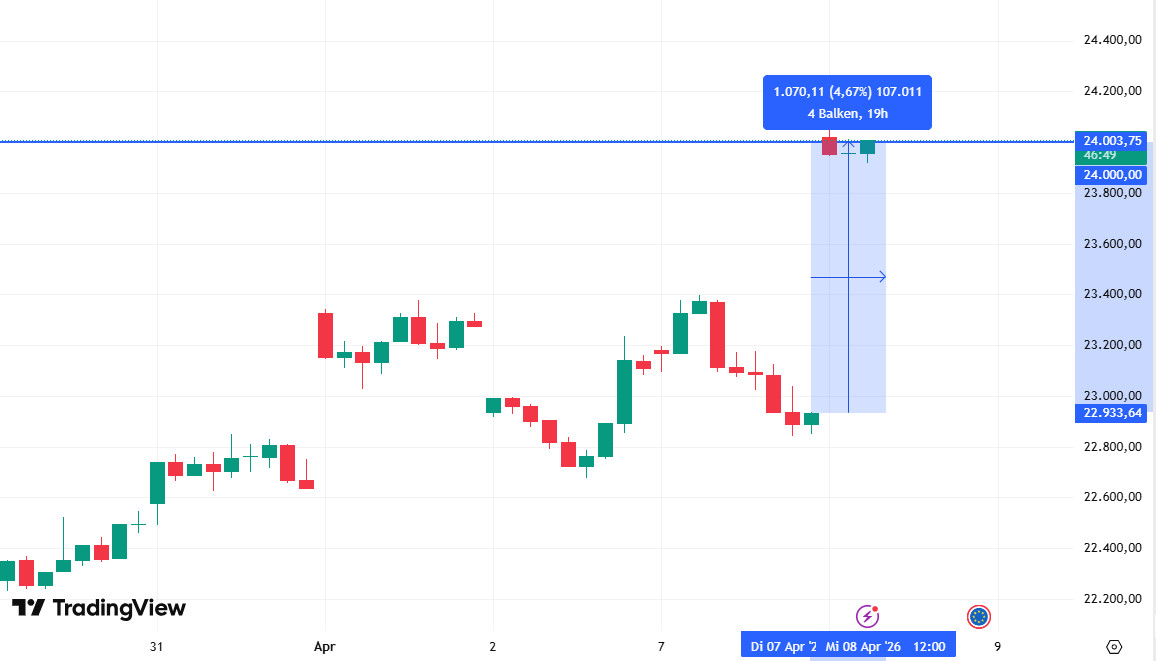
Germany’s DAX briefly moved above the 24,000-point level shortly after the market opened. It is currently trading around 23,975 points, up approximately 4.55%. France’s CAC 40 is also showing strong gains, rising about 3.95% to around 8,220 points.
US index futures are also reacting clearly to the geopolitical developments but remain somewhat behind the gains seen in Europe. Dow Jones futures are up around 2.34%, the S&P 500 gains approximately 2.52%, and the Nasdaq 100 shows the strongest increase at around 3.30%.
Gold rises despite easing tensions
The gold price is also reacting with a notable increase, gaining around 2.25% to approximately 4,812 USD per ounce.
The simultaneous rise in both stocks and gold could indicate that market participants still see a need for hedging and are not fully discounting the risk of renewed escalation.
Bitcoin back above 70,000 USD
The crypto market once again shows increasing correlation with traditional markets. Bitcoin is currently up around 4.05% and trading at approximately 71,743 USD, moving closer to the upper boundary of the price channel established over the past two months.
Whether a sustained breakout will occur remains to be seen.
Ethereum is again among the strongest performers, rising around 6.72% to approximately 2,256 USD. Cardano is also recovering after previous losses, gaining about 6.89% to around 0.2611 USD.
Uncertainty remains
Despite the strong market reaction, the remaining risks should not be overlooked. The current agreement is only a temporary solution and leaves key conflict issues unresolved.
Ceasefire is time-limited
The agreed ceasefire is initially limited to two weeks. During this period, further negotiations would need to lead to a longer-term or permanent agreement. Otherwise, the risk of renewed escalation remains.
Strait of Hormuz – reopening with questions
Although the reopening of the Strait of Hormuz has been agreed upon, its practical implementation remains uncertain. Tankers waiting in the Persian Gulf are still hesitant to pass and are demanding additional security guarantees.
In addition, future use of the route could be subject to conditions. Reports suggest that potential fees are being discussed, which could significantly increase transport costs.
Core conflicts unresolved
The central disputes between the parties remain unresolved. While Iran is demanding an end to sanctions, the United States is maintaining a cautious stance.
The issue of uranium enrichment also remains unresolved. It was a key trigger for the conflict from the US perspective, while Iran continues to hold its position.
Additionally, both sides currently present themselves as the winners of the conflict, which further complicates negotiations for a lasting agreement.
Following the current market optimism, attention may increasingly shift back to the question of whether a sustainable solution is truly achievable. As a result, the risk of renewed volatility remains high and should be considered by market participants.