



Why gold falls in crises – when the safe-haven effect does not work
Gold is traditionally seen as a safe haven in times of uncertainty. Rising geopolitical tensions or falling equity markets usually lead to higher gold prices, as investors shift capital into assets considered more stable. However, this pattern does not always hold.
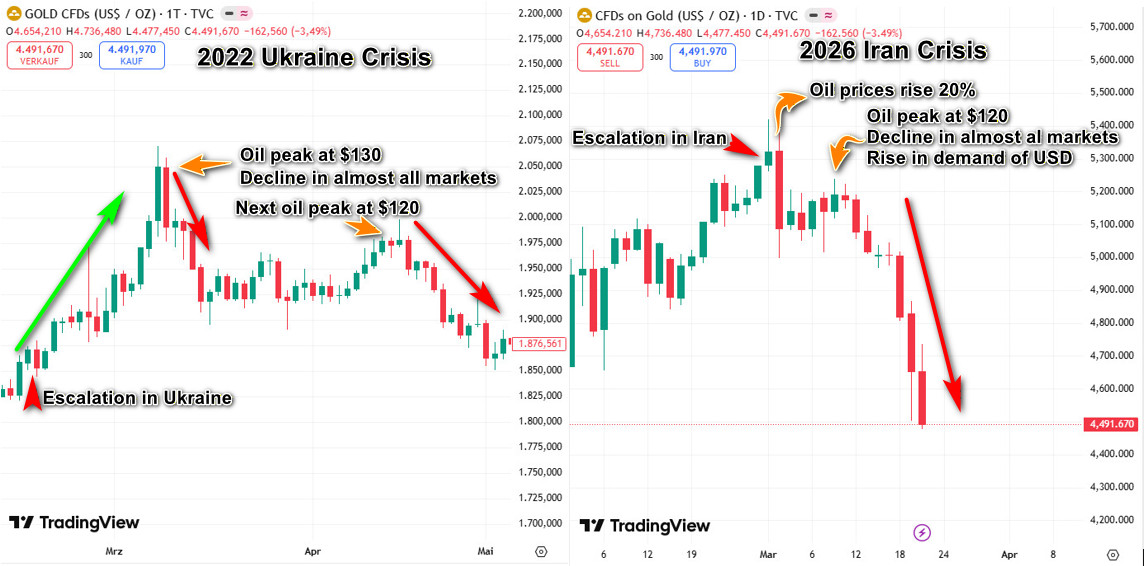
For example, in March 2026, the gold price declined significantly despite increasing geopolitical risks. For many market participants, this initially appeared contradictory.
To better understand such movements, it is useful to take a closer look at the key factors that actually drive the gold price.
The safe-haven effect is not guaranteed
The widely held assumption that gold automatically rises in every crisis is often too simplistic. It is true that the precious metal often serves as a hedge in uncertain times, but its price depends on several factors that can influence the market in different ways.
In certain situations, other forces may become more dominant, meaning that the classic safe-haven effect may not materialize.
The US dollar as a key driver
Gold is traded globally in US dollars. A stronger dollar makes gold more expensive for buyers outside the dollar area and can therefore weigh on its price.
In periods of increased uncertainty, capital often flows into the US dollar, which can strengthen it further. This can lead to situations where gold comes under pressure despite existing risks.
A look at past developments shows that this effect depends strongly on the currency perspective. Between 2022 and 2024, when the US dollar appreciated toward parity with the euro, gold performed relatively weak in US dollars. In many other currencies, however, gold rose significantly.
This example shows that gold should always be viewed in the context of the respective currency.
Interest rates and bond yields
Gold does not generate any ongoing income. Apart from potential price gains and its role as a store of value, it offers limited benefits for investors seeking returns.
Fixed-income investments can therefore become more attractive in such an environment. If government bond yields rise or remain elevated, the opportunity cost of holding gold increases.
In such phases, investors may shift capital away from gold into interest-bearing assets, which can put additional pressure on the gold price.
Liquidity and cash demand
An often underestimated factor is the demand for liquidity. During periods of falling equity markets and rising uncertainty, investors often build up cash positions to remain flexible or to offset losses in other asset classes.
Since gold is one of the most liquid asset classes, it is often sold in such situations—even when underlying risks would normally support higher prices.
After strong price increases, such as those seen between 2024 and 2025, many positions are already in profit. This makes gold a convenient source of liquidity.
In market phases where multiple asset classes come under pressure at the same time, this effect can weigh heavily on gold and override its typical behavior as a safe haven.
Interaction between oil, the dollar and gold
In certain market environments, relationships between different asset classes can also play a role. Since energy commodities are mainly traded in US dollars, rising oil prices can increase demand for the dollar. A stronger dollar can, in turn, put pressure on gold.
Market mechanics and positioning
In addition to fundamental factors, technical and market-mechanical aspects also play a role. Large market participants regularly adjust their positions, take profits, or react to losses in other areas.
In volatile phases, such adjustments can create additional selling pressure, which can influence gold independently of the actual news situation.
How to interpret such market phases
The developments in March 2026 can be better understood in this context. A stronger US dollar, attractive bond yields, and increased demand for liquidity all contributed to gold coming under pressure despite geopolitical risks.
This example shows that gold should not be viewed in isolation, but always in the context of multiple factors acting at the same time.
Conclusion: gold and the safe-haven effect
Gold can act as a safe haven in times of crisis, but this effect is not guaranteed. Its price is influenced by a complex interaction of currencies, interest rates, liquidity, and market mechanics.
For investors and traders, this means that rising risks do not automatically lead to rising gold prices. What matters is which factors dominate in a given market phase.