
The latest labor market data from Germany presents a stable picture at first glance, but a closer look reveals early signs of weakening. While the figures largely meet expectations, the typical seasonal spring recovery has so far failed to materialize.
Labor market stable but losing momentum
The unemployment rate remains unchanged at 6.3%, staying at the same level as the previous month. The change in unemployment figures is also largely neutral at 0, after a slight increase in the prior month.
The total number of unemployed declines slightly to 3.021 million, down from 3.070 million in the previous month. However, a drop below the 3 million mark has yet to occur.
The data suggests that the labor market remains stable but is losing momentum. In particular, the absence of a seasonal uptick could indicate that the economic slowdown is becoming more noticeable.
Additional data on overall employment also points to a weakening trend. Early signs of a decline in total employment underline that the economic slowdown may increasingly affect the labor market. According to recent data from Destatis, overall employment is already showing signs of softening.
Risks for export-driven economy
Further developments are likely to depend heavily on global market conditions. Germany’s export-oriented economy remains under pressure, particularly due to developments in the energy sector and ongoing geopolitical uncertainty.
If this environment persists, companies may increasingly be forced to cut costs, which could eventually impact employment levels.
DAX continues recovery
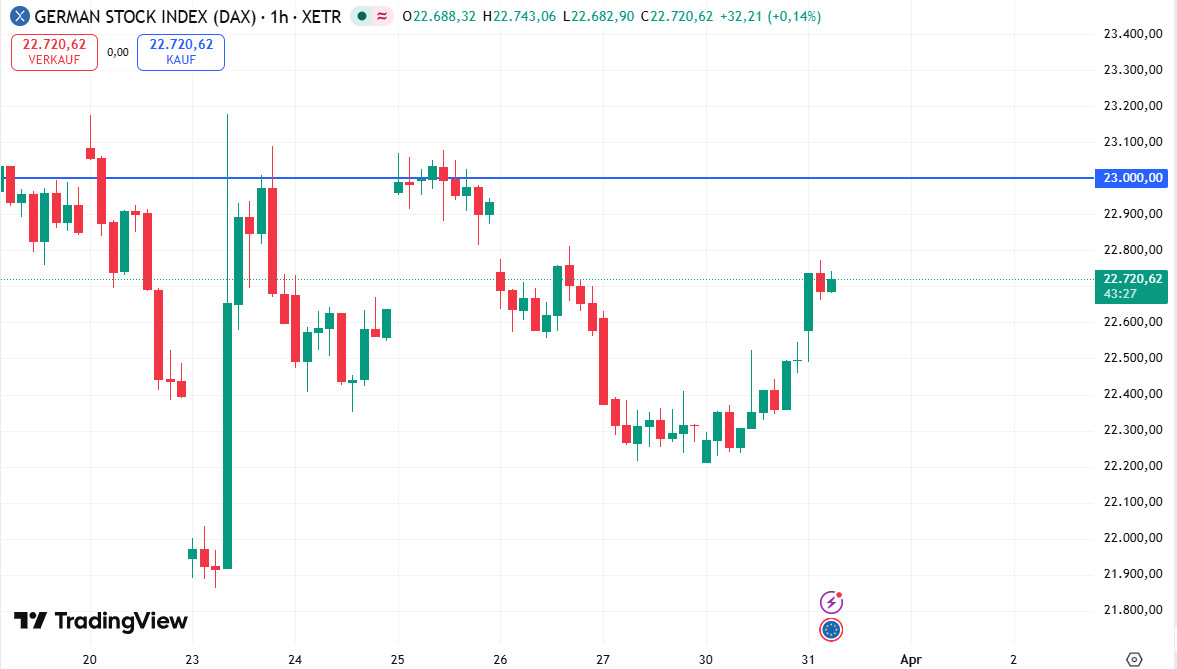
Despite these signals, stock markets are reacting positively. The DAX continues its recovery and is currently trading at around 22,707 points, up approximately 0.96%.
The positive reaction is likely less driven by the labor data itself and more by the absence of negative surprises. The largely expected figures were probably already priced in.
The Euro Stoxx 50 is also trading higher, but lags behind the DAX with a gain of around 0.53%.
Notably, US index futures are currently trading at a similar level to European markets. The Dow Jones is up around 0.97%, the S&P 500 gains about 0.96%, and the Nasdaq 100 rises roughly 0.91%.
This suggests that US markets are no longer clearly outperforming European indices in pre-market trading, which could indicate a shift in market dynamics.
Oil prices decline
There is slight easing in commodity markets. Oil prices declined overnight, with US crude WTI falling back below the 100 US dollar mark and currently trading around 99.60 USD per barrel.
Brent crude is also lower, currently trading at approximately 106.20 USD per barrel.
US dollar stable, gold price recovers
The US dollar has stabilized after slight losses overnight. EUR/USD is currently trading around 1.1474, slightly above the previous day’s level.
The gold price has also stabilized and is trading clearly above the 4,500 USD per ounce level. It is currently around 4,570 USD after failing to break higher toward 4,600 USD overnight.
Bitcoin waiting for momentum
Momentum in the crypto market remains limited. Bitcoin continues to trade within a narrow range around 67,000 USD and currently shows no clear direction.
Ethereum is slightly higher at around 2,057 USD, while other altcoins are also showing mostly moderate movements.
Outlook: Stability with underlying risks
The latest labor market data paints a stable picture but also highlights early signs of weakness. The absence of a spring recovery could indicate that economic conditions are gradually deteriorating.
Without clear impulses from geopolitics or macroeconomic data, the market environment is likely to remain a mix of stability and uncertainty. New developments—particularly in the energy sector or global trade—could quickly shift market direction.