



Geopolitical developments are among the key drivers of global financial and commodity markets. For market participants, a basic understanding of geopolitical dynamics is therefore essential, as political decisions and international tensions often have direct effects on prices, capital flows, and risk assessments.
At its core, geopolitics revolves around the pursuit of economic, strategic, and security interests by states and regions. In many cases, these interests are clearly identifiable and follow long-term objectives, which are reflected in political actions, alliances, or conflicts.
Nothing in geopolitics happens by chance
Even though individual events may appear surprising in the short term, many developments can be understood within a broader context. For the analysis of financial and commodity markets, this means: geopolitics is not a random factor but follows recognizable patterns that are reflected in market movements.
In practice, economic and security interests are closely interconnected. Economic strength provides the foundation for political action, while security measures often serve to protect economic objectives.
Only the full picture reveals the potential objective
Analyzing geopolitical interests in isolation often leads to misinterpretations. Economic, strategic, and security objectives are closely intertwined and can rarely be separated in practice.
Economic strength forms the basis of a state's ability to act, as it enables both political and security measures. Conversely, security decisions often serve to protect economic interests—for example, by safeguarding trade routes, securing access to resources, or stabilizing strategically important regions.
For market participants, this means: geopolitical developments should not be interpreted in a one-dimensional way. Instead, it is crucial to consider the underlying interests in combination in order to better assess their potential impact on financial and commodity markets.
How geopolitical developments affect markets
Geopolitical developments do not affect markets directly but unfold their impact through various economic and structural mechanisms. What matters is not the event itself, but its consequences for supply, demand, trade flows, and the risk perception of market participants.
Supply risks and resource availability
Changes in geopolitical conditions can particularly affect the availability of resources. When tensions arise in resource-rich regions, uncertainty about future supply emerges. This uncertainty is reflected in markets in the form of risk premiums and can immediately lead to rising prices. Conversely, easing tensions often leads to a reassessment of these risks.
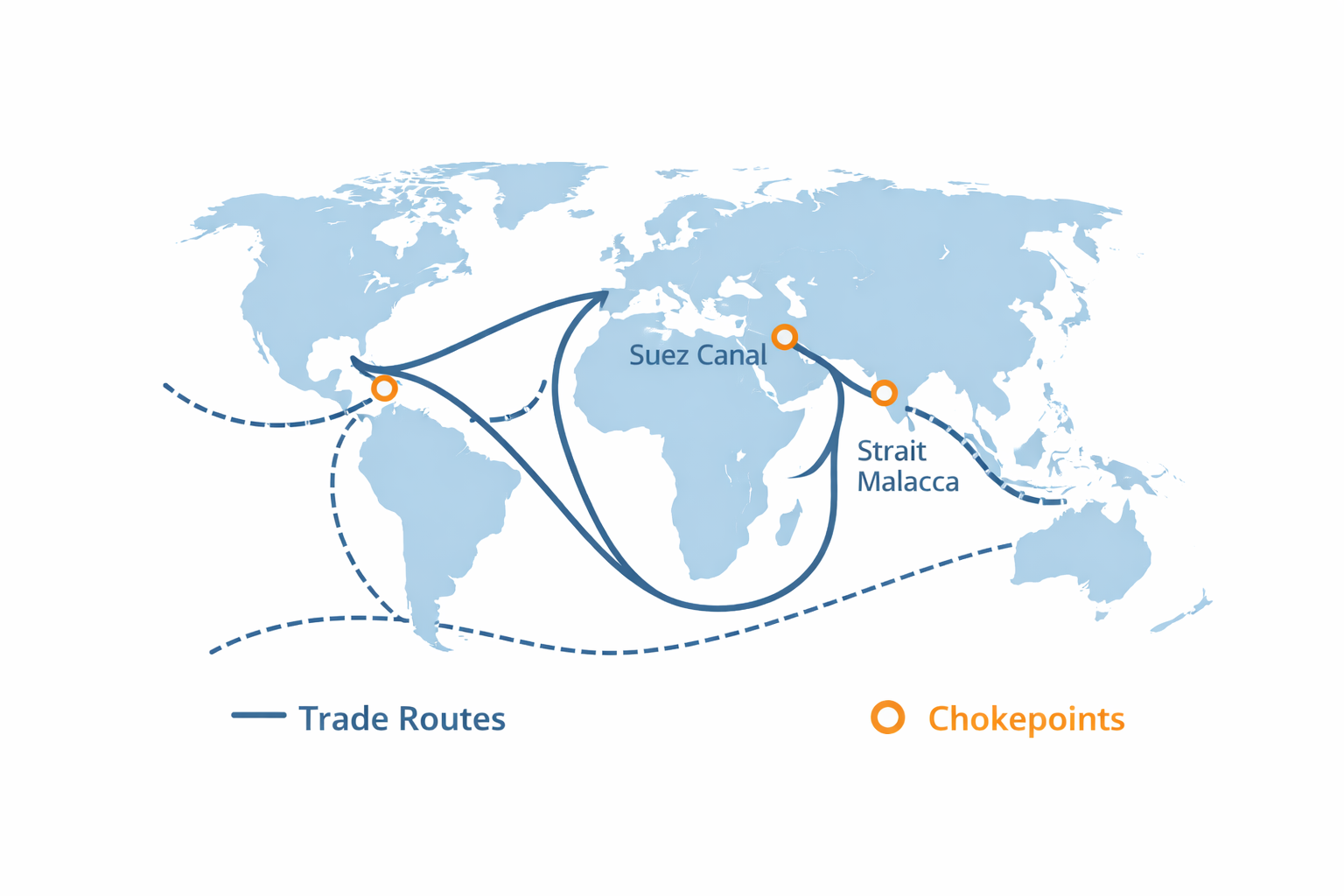
Transport routes and strategic bottlenecks
In addition to availability, the stability of transport routes plays a crucial role. Strategically important routes, through which a large share of global trade flows, are particularly vulnerable to geopolitical influences. Disruptions or risks along these routes can affect supply security and thus influence price formation and market structure.
Economic measures and market distortions
Another important mechanism involves economic measures taken in response to geopolitical developments. Trade restrictions, sanctions, or regulatory interventions can alter existing market structures by influencing supply and demand or redirecting trade flows.
Uncertainty and capital flows
In addition, general uncertainty plays a central role. Geopolitical tensions increase uncertainty about future economic developments and often lead to changes in market behavior. During such phases, capital tends to flow into assets perceived as stable, while riskier markets may come under pressure.
To properly interpret market movements, it is therefore essential to understand the underlying mechanisms. Geopolitics does not act as an isolated factor but influences markets through clearly identifiable relationships that tend to repeat themselves regardless of the specific event.
Different impacts across markets
Geopolitical developments do not affect all markets equally. Different asset classes react in different ways, depending on how strongly they are influenced by changes in supply, demand, uncertainty, or capital flows.
While some markets react directly to physical changes, others primarily reflect expectations, risk assessments, and capital movements. For a well-founded analysis, it is therefore necessary to consider each market mechanism separately.
Commodity markets and direct supply reactions
Commodity markets are among the most sensitive to geopolitical changes. Since many commodities are tied to specific regions and depend on stable conditions for production and transport, disruptions directly affect available supply.
Particularly for energy commodities such as crude oil and industrial metals, even the expectation of disruptions can lead to significant price movements. Markets react not only to actual supply disruptions but often already to the probability of potential shortages, which is reflected in risk premiums.
Equity markets and changing risk assessments
Equity markets primarily react to changing expectations regarding economic growth, corporate earnings, and overall market stability. Geopolitical tensions increase uncertainty and can lead to a reassessment of risks.
In such phases, a broader shift in market sentiment often occurs, with riskier segments coming under greater pressure, while more stable sectors tend to be more resilient.
Currencies and capital flows
Currencies are particularly sensitive to changes in international capital flows. In times of heightened uncertainty, capital often moves into currencies perceived as stable, while others may face depreciation pressure.
These movements reflect less direct economic changes and more the perception of stability, liquidity, and confidence in respective markets.
Safe-haven reactions during uncertainty
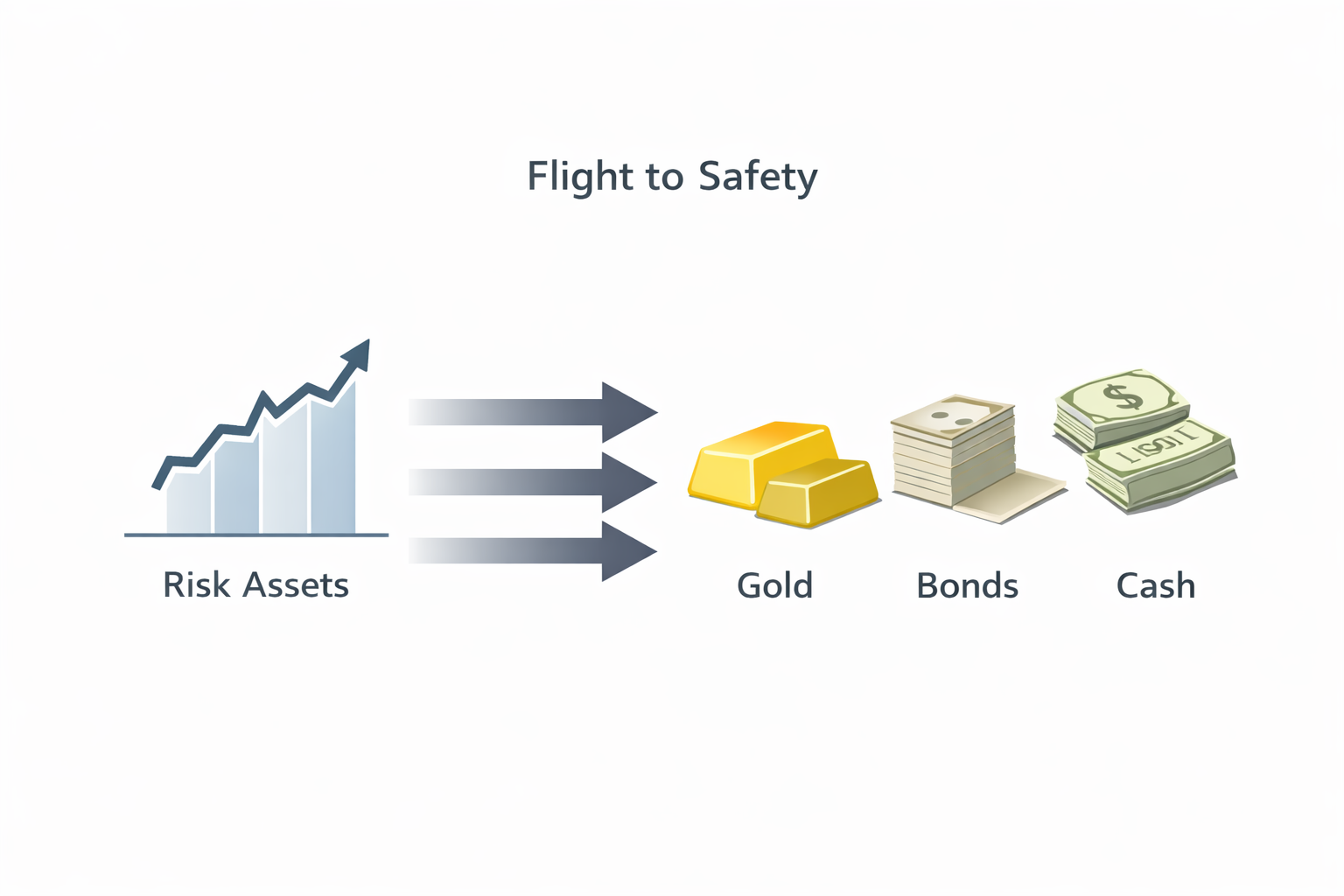
In periods of geopolitical tension, increased demand for assets perceived as stable can often be observed. These so-called safe-haven reactions typically arise when uncertainty about economic conditions, market stability, or future developments increases.
In such situations, capital is often reallocated into so-called safe-haven assets, which are considered relatively resilient. These include certain commodities as well as liquid and stable financial instruments.
These movements are less a reflection of fundamental changes and more a reaction to uncertainty and the desire for stability. They often occur alongside declines in riskier market segments and represent a recurring pattern in geopolitically driven market phases.
Geopolitical patterns and recurring market reactions
Geopolitical developments often appear as isolated events but frequently follow recurring patterns. These patterns arise from underlying interests, structural dependencies, and market response mechanisms.
For market participants, it is therefore not the individual event that matters most, but its classification within known patterns. When certain constellations repeat, typical market reactions can be observed, often independent of the specific context.
Typical market reaction patterns
A particularly illustrative example can be found in the energy sector. Over decades, geopolitical tensions in oil- and resource-rich regions have repeatedly led to similar outcomes: uncertainty about supply resulted in rising prices, while periods of relative stability led to corresponding declines.
These recurring patterns show that markets do not react to individual events, but to their impact on supply, demand, and risk perception. Even if the specific triggers differ, the underlying mechanisms remain largely consistent.
Putting current market movements into context
Current market developments can often be placed within these recurring patterns. Individual events act less as isolated triggers and more as part of a broader context in which known mechanisms unfold once again.
For analysis, this means that focusing on structural relationships is essential, while viewing individual events in isolation often leads to distorted interpretations.
Why markets rarely react to the event itself
Market movements are often attributed to specific events. In practice, however, markets rarely react solely to the event itself, but primarily to its expected impact on economic conditions, supply and demand, and overall risk perception.
The key factor is the difference between expectations and actual outcomes. Many geopolitical risks are anticipated in advance and priced in accordingly. When an expected event occurs, the market reaction is often smaller than the significance of the event might suggest.
Expectations and their impact on prices
Markets do not operate based solely on current information but primarily on expectations. As soon as potential geopolitical changes become apparent, market participants begin incorporating possible effects into their decisions.
This forward-looking pricing means that part of the market movement often occurs before the actual event. The clearer and more predictable a development appears, the more strongly it may already be reflected in prices.
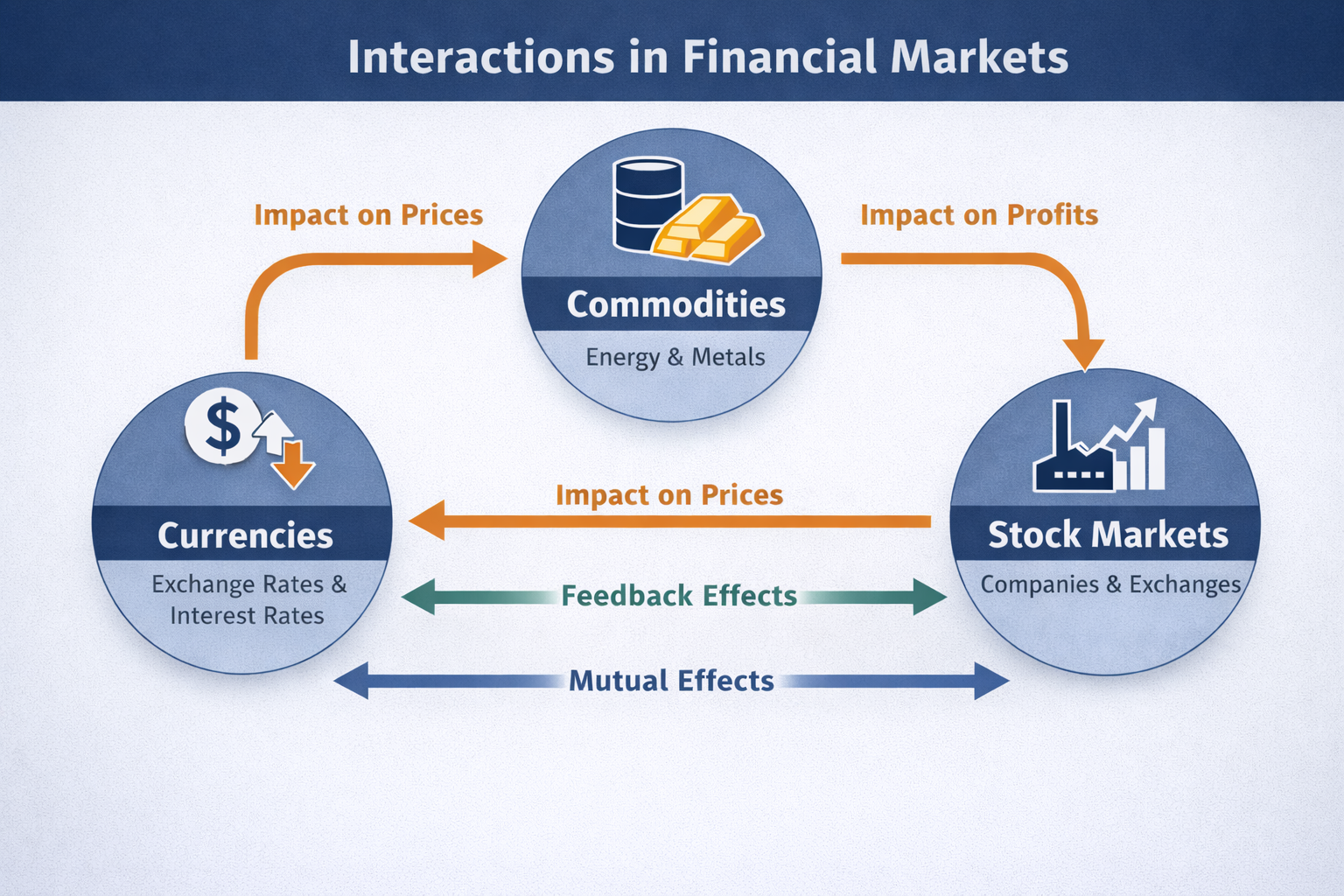
At the same time, interactions between different markets arise. Changes in currencies, commodities, and equities are often closely interconnected and can reinforce or offset each other. For example, currency movements can influence commodity prices, while rising commodity costs can affect corporate valuations and equity markets.
These relationships are not mechanical but depend on the specific context, expectations, and underlying economic conditions. For analysis, it is therefore essential to recognize potential interactions without interpreting them as fixed patterns.
Surprise as a key factor
Strong market reactions often occur when developments deviate from expectations. Unexpected changes lead to rapid reassessment of risks and can trigger significant market movements.
In this context, it is not the absolute importance of an event that matters most, but rather the degree of surprise from the perspective of market participants.
Markets react to consequences, not events
To interpret market movements, it is therefore crucial to focus on the potential consequences of an event. Markets do not primarily react to the event itself, but to its impact on economic relationships, capital flows, and risk assessments.
This perspective allows for a more differentiated analysis, shifting the focus from isolated triggers to the underlying mechanisms.
Conclusion: Geopolitics as a structural market driver
Geopolitical developments are among the key drivers of global financial and commodity markets. Their impact does not occur in isolation but through a network of interconnected mechanisms affecting supply, demand, capital flows, and risk perception.
For market analysis, it is therefore essential to view geopolitical developments not as isolated events, but within the context of structural relationships. Recurring patterns, interactions between asset classes, and the role of expectations in price formation all play a central role.
A solid understanding of these dynamics allows market movements to be interpreted more accurately without focusing solely on short-term developments or individual triggers. In this way, geopolitics becomes not an unpredictable disturbance, but an analyzable component of global market behavior.