




Financial markets are currently showing a relatively stable picture. After the sharp swings of the past week, many asset classes are moving within their established ranges. Oil prices remain elevated, the US dollar stays firm, and major equity indices are showing only moderate movements.
This cautious tone may also reflect the upcoming monetary policy decisions. Meetings of both the Federal Reserve and the European Central Bank are scheduled in the coming days, which could lead many market participants to adopt a wait-and-see approach.
However, this apparent stability does not mean that nothing is happening beneath the surface. While broader markets are currently moving sideways, individual stocks are increasingly coming under pressure – a possible sign that investors are reassessing expectations.
Rheinmetall under pressure despite geopolitical backdrop
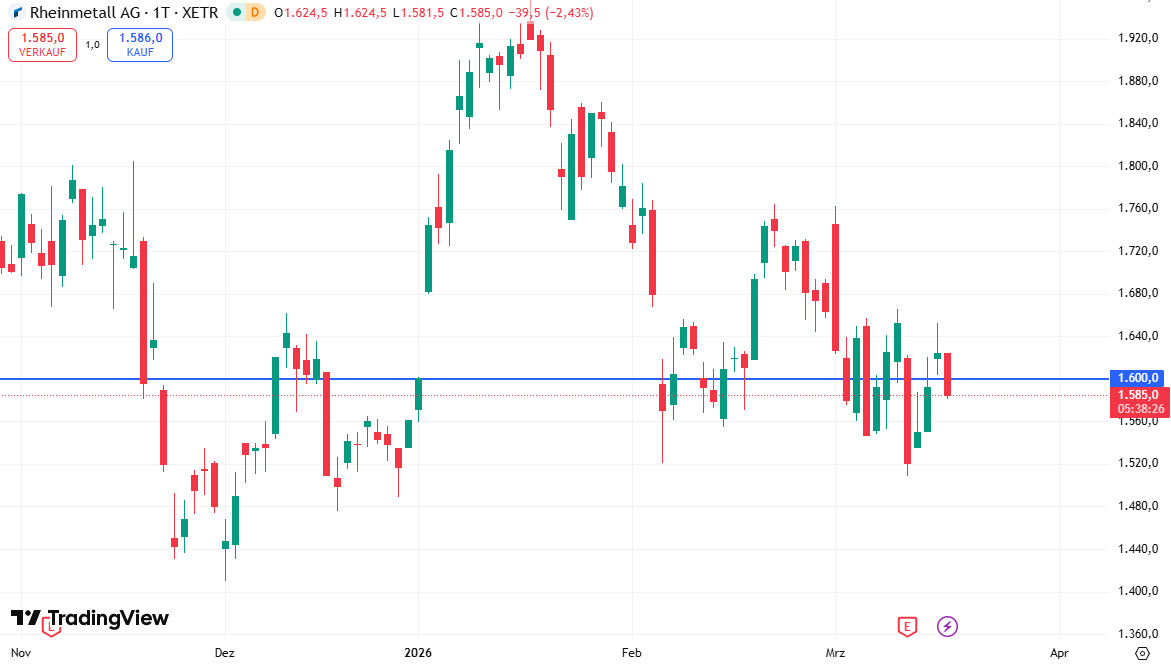
One example of this development is the stock of German defense company Rheinmetall, which is currently down around 2%. At first glance, this weakness may appear surprising, as geopolitical tensions are generally seen as supportive for the defense sector.
However, the price action could suggest that investors are reassessing expectations regarding future demand. The strong rally of recent years has been closely linked to rearmament driven by the war in Ukraine, which has been characterized by conventional land warfare.
The current geopolitical situation in the Persian Gulf, however, has a different structure, with risks to energy infrastructure and trade routes taking center stage. In such an environment, demand dynamics may be less clear, which could lead to a more cautious investor outlook.
Although the company operates across multiple defense segments, current market behavior may indicate that investors are shifting their expectations. In the view of many market participants, other aspects of modern conflicts are currently in focus, while demand visibility in certain segments appears less clear.
In addition, potential changes in the Ukraine conflict may also play a role. If the situation were to ease, expectations for future demand in certain equipment categories – which have recently driven much of the sector’s momentum – could also shift.
Winners and losers become more visible
The development in Rheinmetall highlights that market movements are increasingly becoming more selective. While major indices are stabilizing, individual stocks are reacting more sensitively to changes in the geopolitical environment and investor expectations.
Energy companies in particular continue to benefit from elevated oil prices, while sectors with high sensitivity to energy costs – such as airlines or parts of the industrial sector – are facing pressure.
This suggests that markets may currently be in a phase of differentiation. Instead of broad-based movements, the focus is shifting toward how geopolitical developments affect individual business models.
Conclusion
Even though major markets appear relatively stable at the moment, the environment remains challenging for investors. Current movements are increasingly shifting toward individual stocks, where expectations, perception, and geopolitical developments are being priced in more selectively.
For investors and traders, this could mean that stock selection is currently becoming more important than the overall market direction. Which sectors and companies may benefit from or be negatively affected by the current geopolitical situation is likely to become clearer in the coming days and weeks.