




While markets were still able to post a strong recovery on Friday and stock indices reached new all-time highs, the start of the week brings a reset. The reopening of the Strait of Hormuz announced on Friday was already declared over again on Saturday.
The situation escalated further after the US Navy fired on and boarded an Iranian container ship attempting to break through the blockade. As a result, oil prices rose by up to 7% at the start of trading, while equity indices came under pressure.
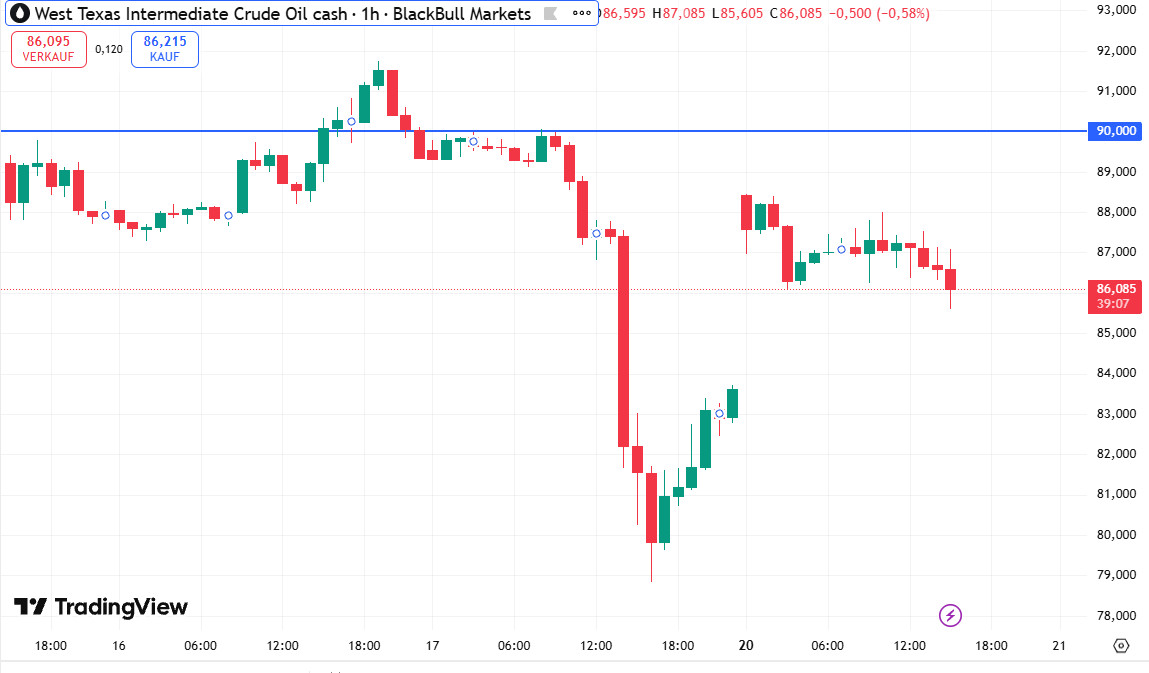
Oil price stabilizes at elevated levels after market open
Due to the renewed escalation in the Persian Gulf, oil prices rose significantly, peaking at gains of up to 7%. However, as the feared escalation did not materialize following the boarding of the Iranian vessel, oil prices eased slightly and stabilized at elevated levels.
US crude WTI is currently trading on the spot market at around 86.89 US dollars per barrel, representing an increase of approximately 5.3%. The price of North Sea Brent crude has risen back above the 90 US dollar mark and is currently trading at around 91.20 US dollars per barrel, up about 4.8%.
The relatively stable oil price may indicate that there is still hope for a solution to the conflict mediated by Pakistan.
Equity markets under pressure again amid escalation concerns
Equity markets reacted to the renewed developments in the Persian Gulf with concern over rising energy prices. Particularly in Europe, higher energy costs could place additional strain on companies in an already challenging economic environment.
The German benchmark index DAX is currently down around 1.35%, or 331 points, at 24,367. The Euro Stoxx 50 is showing a similar move, declining by approximately 1.34%, or 81.8 points, to 5,976.
The US market, however, opened Monday with only modest losses near the flatline. Shortly after the opening bell, the Dow Jones is up 0.04%, the S&P 500 is down 0.2%, and the Nasdaq 100 is trading around 0.27% lower. This suggests that US markets are, for now, more resilient to the conflict than European markets.
US dollar initially stronger, gold price declines
The US dollar initially benefited at the start of the new trading week from rising oil prices and the resulting increased demand for the currency. However, as prices stabilized, the dollar returned to Friday’s levels against most currencies.
The EUR/USD exchange rate is currently trading at around 1.1763, marking a marginal decline of 0.01%.
Gold initially fell sharply below the 4,800 US dollar per ounce mark at the start of trading. It has since regained this level, currently trading at around 4,804 US dollars, but still remains down about 1.2% compared to Friday’s close.
Bitcoin and altcoins give back part of their gains
Cryptocurrencies are also under pressure again due to the renewed escalation in the Persian Gulf. After Bitcoin briefly rose above 78,000 US dollars on Friday, it is currently trading at around 75,230 US dollars.
Ethereum has also pulled back from its recent high of 2,465 US dollars and is currently trading at around 2,317 US dollars.
Between escalation and de-escalation – markets lack clear direction
The current market development once again highlights how quickly sentiment can shift in the context of the Persian Gulf conflict. While hopes for de-escalation can trigger short-term recoveries, renewed escalation leads to immediate increases in risk premiums.
As long as this pattern persists and no concrete progress toward a sustainable solution is made, the market environment is likely to remain characterized by high uncertainty. Short-term movements will continue to be driven heavily by individual headlines, while establishing a reliable trend remains difficult.