
US Indices Under Pressure – Dow Jones Leads Declines
US equity markets are trading lower ahead of the weekend. The Dow Jones is down around 1.2 percent, clearly underperforming the broader market. The S&P 500 is currently lower by roughly 0.67 percent, while the Nasdaq 100 shows a comparatively moderate decline of around 0.38 percent.
Risk appetite appears to be fading into the weekly close. With no dominant headline driving price action, positioning adjustments and cautious profit-taking near technical levels may explain the current weakness.
DAX Holds Steady Despite US Weakness
In contrast to Wall Street, Germany’s DAX is trading largely unchanged heading into the weekend. The index remains relatively stable and is not fully mirroring the negative US momentum. However, a clear directional move is still lacking, suggesting a broadly cautious tone across markets.
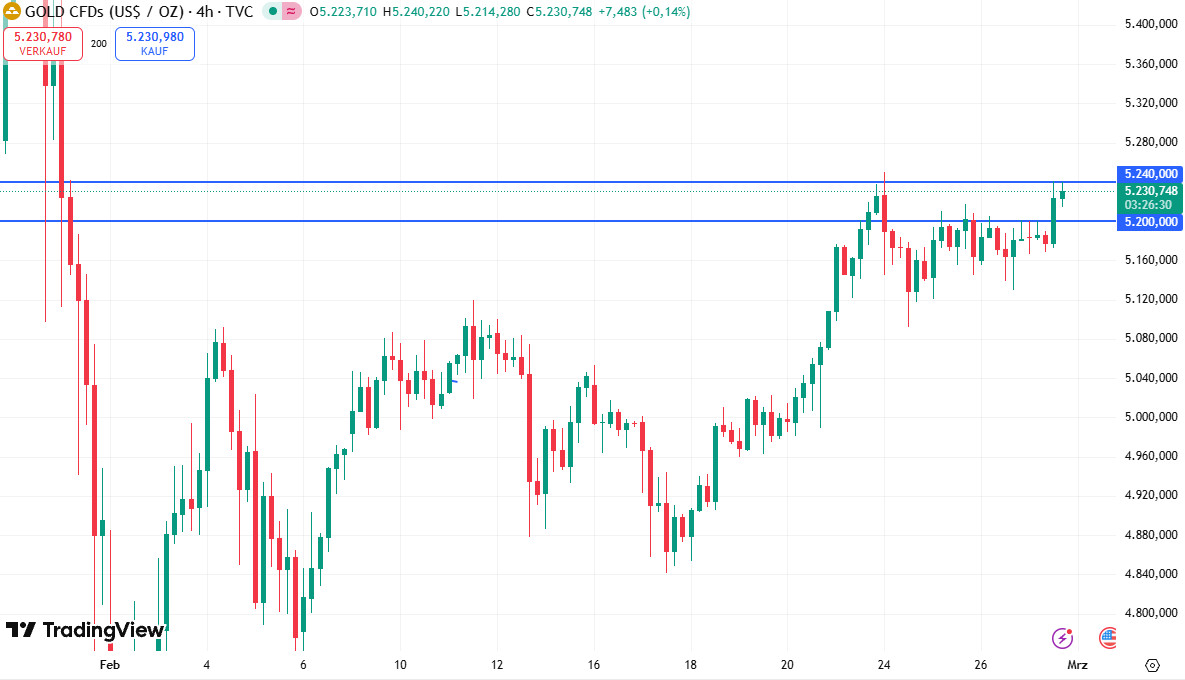
Gold Breaks Above $5,200 – Safe-Haven Demand Returns
As equities soften, gold is gaining traction. The precious metal has moved above the $5,200 level and is approaching resistance near $5,240. The move reinforces gold’s role as a traditional safe-haven asset during phases of rising uncertainty.
A sustained break above resistance could further improve the technical picture. However, with the weekend approaching, traders may remain cautious about chasing momentum at elevated levels.
Bitcoin Rejected Again at $69,000
In the crypto market, Bitcoin once again failed to break above the $69,000 level. The cryptocurrency is currently trading near $66,000, down roughly 1.9 percent on the session.
The repeated rejection confirms the relevance of the resistance zone, while support around $65,000 may come back into focus if downside pressure persists. Until a breakout occurs, the broader range-bound scenario remains intact.
Markets Turn Defensive into the Weekend
Overall, market positioning appears increasingly defensive ahead of the weekend. The pronounced weakness in the Dow Jones, combined with gold’s strength and the relative stability in European equities, suggests a temporary shift toward safer assets. Whether this develops into a broader risk-off phase will likely depend on fresh macroeconomic catalysts from the United States.