After the positive start to the week (gold stable above 5,100 USD, slight recovery in indices), the picture reversed again in the afternoon. US indices are building on the initial recovery and trading lower. Gold continues to rise and exceeds the 5,200 USD mark, while the US dollar in the EUR/USD pair is once again struggling with the 1.18 level. Here is a short update on the current developments.
Indices Fall Again After Recovery
The US indices (S&P 500, Nasdaq) were initially able to recover after the morning low, but have been giving back significantly since midday. The S&P 500 is currently around 0.6–0.8 % in the red, the Nasdaq even more so. The reason is the ongoing uncertainty surrounding the tariff ruling: Many market participants fear that the Trump administration will not accept the ruling and announce new measures. Export-oriented and cyclical stocks are suffering particularly. The initial stabilization overnight does not seem to hold – the market is waiting for clear signals from Washington.
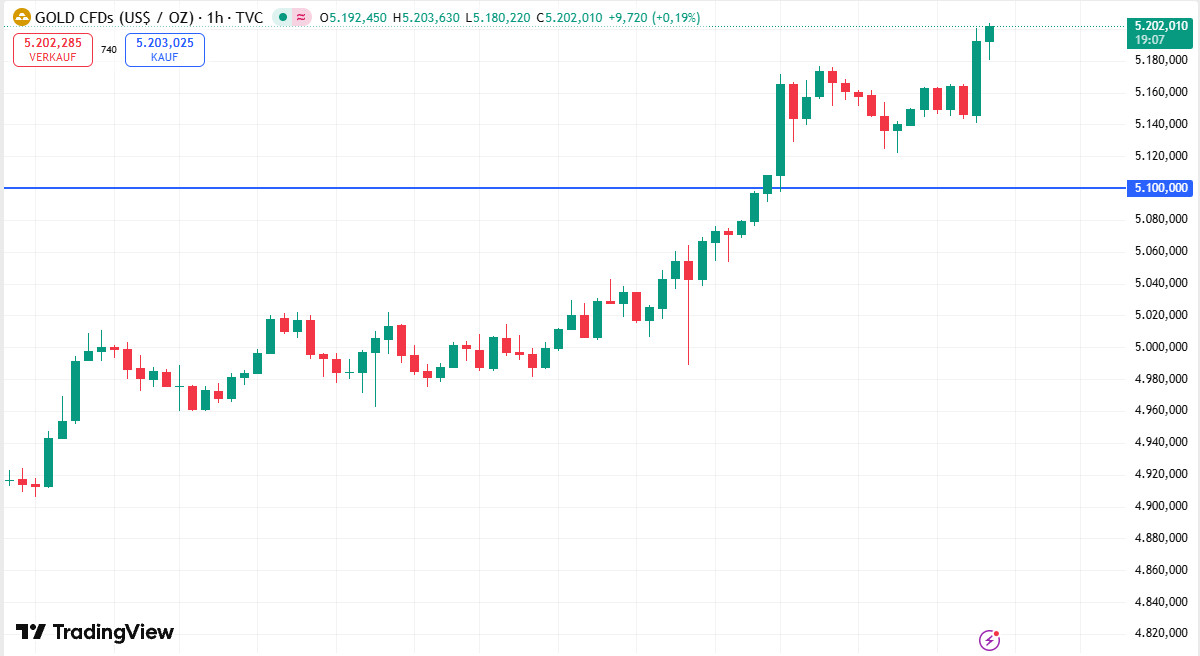
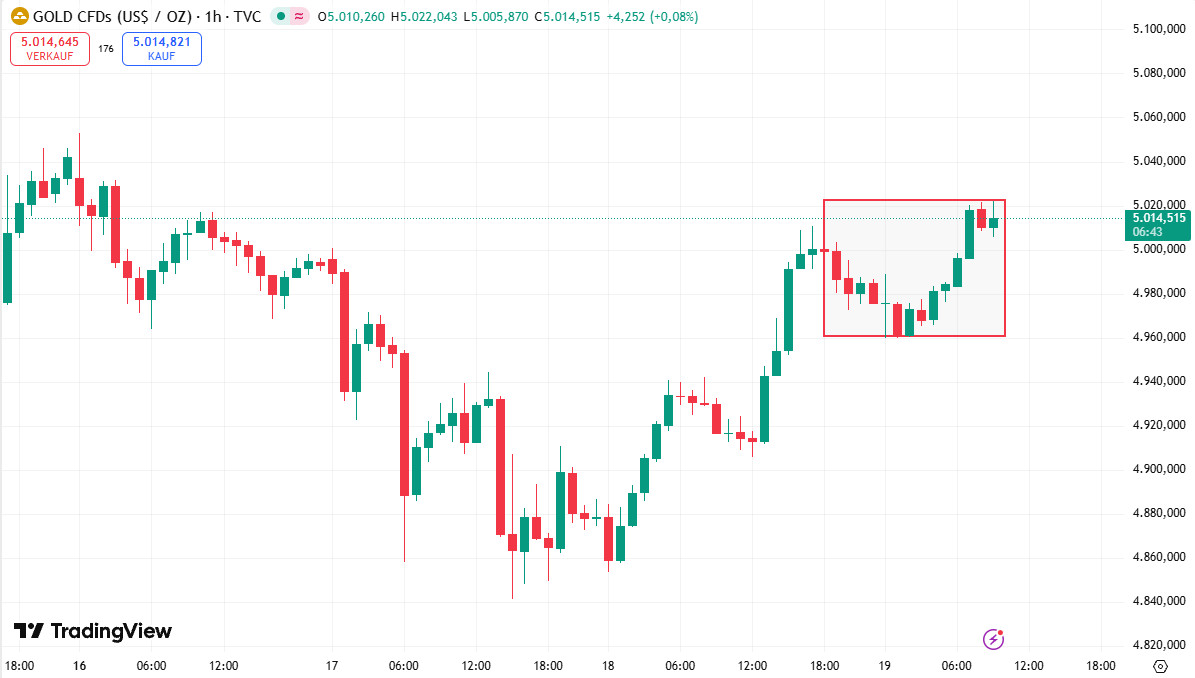
Gold Price Breaks 5,200 USD
Gold continues to benefit from the uncertainty. The price rises above 5,200 USD and shows clear upward momentum. The combination of inflation fears (due to possible tariff effects) and the safe-haven function in uncertain times is driving the price. Technically, the 5,150–5,200 USD zone has been overcome; the next resistance is at 5,250–5,300 USD. As long as no signs of relaxation appear, gold remains the clear winner of the day.
Gold price breaks the 5,200 USD mark in the afternoon – clear reaction to ongoing uncertainty. | Chart source: TradingView
US Dollar Struggles with the 1.18 Level
EUR/USD continues to trade just above 1.18, after the pair had risen more clearly overnight. The dollar shows mixed performance: Short-term it benefits from flight to “safe” currencies, medium-term the concern weighs on it that higher tariffs could slow US growth and force the Fed into a softer stance earlier. Volatility in the pair remains high – a break below 1.175 would strengthen the dollar further, a rise above 1.185 would signal relief.
Conclusion
The tariff ruling continues to act as an uncertainty factor. Gold remains the clear winner and is testing new highs, while risk assets (indices, Bitcoin) are coming under pressure again. The afternoon and evening could be decisive: New statements from Trump or the EU Commission could move the market significantly once more. Traders should closely monitor the news flow – especially the reaction at round levels (gold 5,200, EUR/USD 1.18).
Anyone who wants to follow prices live will find a neutral overview here of established platforms that cover almost the entire range of assets: To the Trading Platform Overview.
After the parabolic rise of recent days, gold experienced a very pronounced correction yesterday. From the intraday high of $5,626, it moved dynamically downward to the area around $5,200. The price is currently consolidating exactly there (spot & futures between approx. $5,180–5,230), after yesterday's Fed meeting (no further rate cut, dampened expectations for future steps) initially triggered selling pressure.
Silver behaves similarly: Here too there was a sharp correction from the all-time high of around $120 to the zone just above $100. The price is currently finding support here. Both precious metals are showing a clear consolidation phase after the previous overbought condition.
USD stabilizes for now
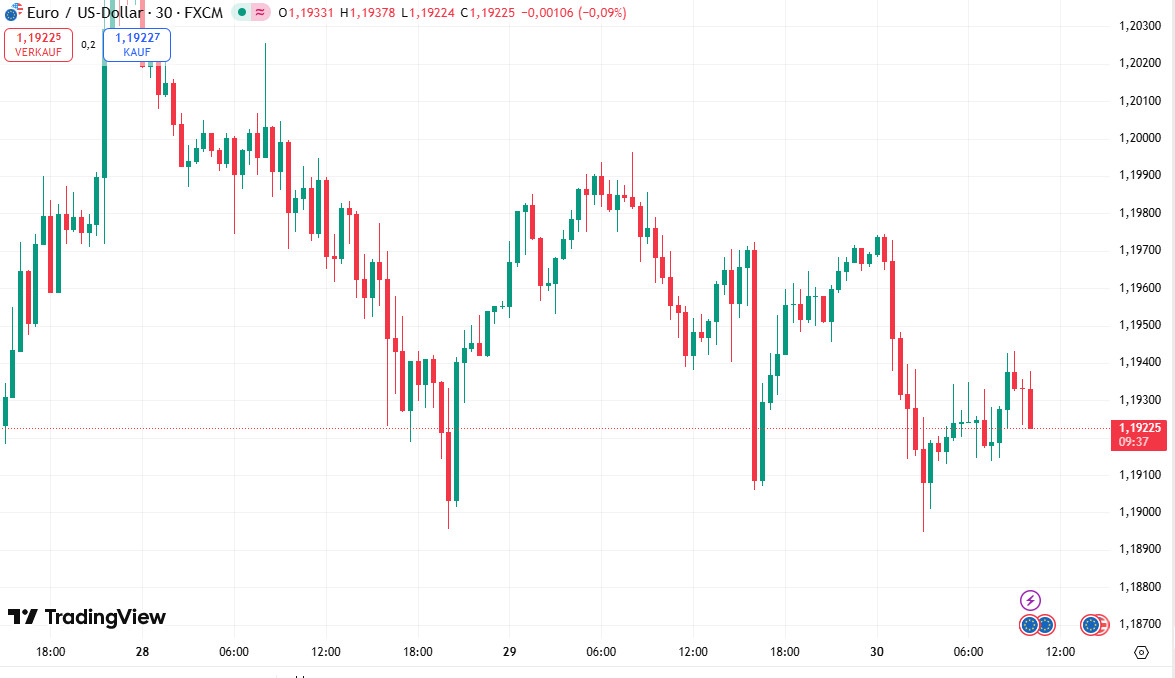
The US Dollar Index (DXY) experienced a slight stabilization yesterday and this morning. It is currently trading at around 96.50 and shows a support zone around 96.20–96.30. Against the EUR (EUR/USD ~1.19), GBP and Yen, the dollar has partially made up for yesterday's losses – the basic tendency remains weak, however.
The EUR/USD rate is currently consolidating just above 1.19 and waiting for new impulses. | Chart source: TradingView
This afternoon (14:30 CET) the US Producer Price Index (PPI) data is expected, which could provide clues about inflation developments in the US. If they come in lower than expected, hopes for a further rate cut could strengthen again and provide an impulse for precious metals prices. A higher reading could, however, have the opposite effect, but would probably support the USD.
Indices under pressure – slight recovery
The major US indices (S&P 500, Nasdaq, Dow) were initially clearly in the red yesterday evening and overnight (–0.8 to –1.5 % after the Fed). In the morning there is a partial recovery: Pre-market the S&P 500 is again nearly unchanged to slightly positive, Nasdaq and Dow also somewhat firmer. Nevertheless, sentiment remains fragile – a PPI (Producer Price Index) suggesting a decline in inflation could improve sentiment and give the stock market at least limited support.
In Europe, the indices are initially friendly after market open on the last trading day of the week. The DAX is currently (10:00 CET) showing a gain of around 0.89 % and the Euro Stoxx 50 a gain of 0.65 %.
Conclusion
The entire market continues to show high nervousness. Gold and silver correct sharply, the dollar stabilizes for now, and the indices oscillate between pressure and slight recovery. Any new impulse (this afternoon the PPI data) can lead to significant swings up or down. There is currently a kind of „holding pattern“ – the direction will probably only become clear with the next important data points.
Anyone who wants to follow the market and prices live on PC or smartphone will find a neutral overview here of established trading platforms that cover almost the entire range of assets: To the Trading Platform Overview.
The start of the week is dominated by the US Supreme Court ruling on tariffs, which is unsettling market participants. Gold stabilizes above 5,100 USD as a result, while the US dollar, indices, and Bitcoin initially come under pressure. Bitcoin falls overnight to around 64,400 USD but shows signs of recovery. Here is an analysis of the market reactions and possible consequences.
US Supreme Court Tariff Ruling and Possible Consequences
The US Supreme Court ruling, declaring the tariffs imposed by the Trump administration unlawful, is interpreted by the market as a possible signal for a continuing or reigniting trade conflict. The possible consequences are diverse: Higher import prices could further fuel US inflation, reinforce the Fed's hawkish stance, and simultaneously increase growth concerns in export-dependent economies. For risk assets (stocks, Bitcoin), this is negative, while gold benefits as an inflation and uncertainty hedge. Oil prices show no strong reaction so far, indicating that the market does not yet see an immediate supply threat.
Reaction from Trump and US Administration
The US administration has so far commented on the ruling in a restrained manner. There are indications that the government sees the decision as confirmation of its trade policy and does not rule out further measures. Concrete announcements are still pending, but the rhetoric points to a continuation of the hard line. This increases uncertainty for global supply chains and puts pressure on the dollar as a “safe haven” – paradoxically, since higher tariffs could also burden the US economy in the long term. It remains to be seen, among other things, how the tariff agreement between the USA and the EU will continue. Will the uniform tariff of 15 % remain, or could the EU Commission aim to return to the old tariffs, which would reignite the trade conflict?
Gold Price Reacts with Gains
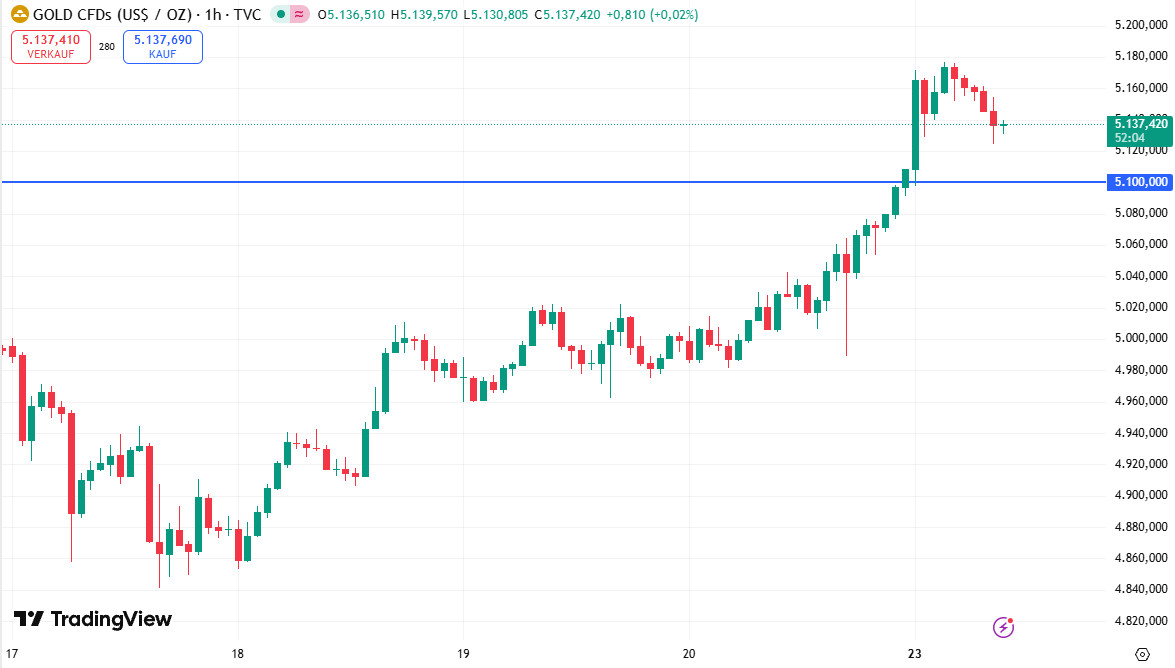
The gold price reacts classically: It rises above 5,100 USD and stabilizes there. The increase is driven by several factors: Inflation fears due to higher import prices, geopolitical uncertainty, and its function as a safe haven in uncertain times. Technically, gold has reclaimed the 5,000–5,100 USD zone. The next resistances are currently at 5,150–5,200 USD, with support in the 5,000–4,950 USD area. As long as the tariff topic remains present, gold could continue to benefit from it.
The gold price practically rose sharply above the 5,100 USD mark with market open. | Chart source: TradingView
US Dollar and Indices Under Pressure After Ruling
The US dollar showed a mixed reaction. With the start of trading overnight, EUR/USD climbed above the 1.18 level, while indices recorded almost instant losses. Overnight, the indices stabilized, and currently they show slight signs of recovery. Short-term, the dollar could still benefit from flight to “safe” currencies, but medium-term, higher tariffs could slow growth and force the Fed into a softer stance – which would burden the dollar. The indices (S&P 500, Nasdaq, DAX) declined pre-market, as higher import costs could pressure corporate profits. Export-oriented and cyclical sectors are particularly affected.
Bitcoin Takes Another Hit
Bitcoin recorded an overnight pullback to around 64,400 USD but recovered to about 65,700 USD. The reaction is typical for risk assets: Initial sell-off due to uncertainty, then stabilization once it becomes clear that no immediate escalation is imminent. Bitcoin remains volatile – a prolonged tariff crisis could strengthen the “digital gold” narrative, but short-term, risk aversion predominates.
Conclusion
The tariff ruling acts as a catalyst for uncertainty. Gold benefits as a classic safe haven, while risk assets (indices, Bitcoin) initially suffer. Medium-term, much depends on whether the administration sees the ruling as a blank check for further tariffs or whether negotiations take place. Traders should closely monitor the development of import prices, inflation expectations, and the Fed's response. Gold remains the most defensive play in this environment, while oil prices and Bitcoin are more dependent on geopolitical headlines.
Anyone who wants to follow prices live will find a neutral overview here of established platforms that cover almost the entire range of assets: To the Trading Platform Overview.
US President Donald Trump's statements (criticism of the dollar exchange rate, new 25% tariff threats against South Korea, implicit Fed criticism) have put the markets in turmoil yesterday evening and this morning. The US Dollar Index (DXY) has slipped significantly (currently 96.2), while reactions in stocks, gold and oil are diverging. The market shows nervousness, but no uniform direction.
Dollar under pressure – the central driver
The DXY has lost about 0.4–0.6 % since Trump's speech. A weaker dollar makes commodities (gold, oil, copper) cheaper for international buyers and at the same time supports riskier assets such as stocks. The combination of dollar criticism and tariff threats has split the market into two camps: safe-haven buyers (gold) and risk chasers (stocks).
Stocks: Slight gains despite uncertainty
S&P 500, Nasdaq and Dow are trading sideways to slightly positive (+0.2 to +0.5 %). The markets are interpreting Trump's rhetoric so far as „loud, but not new“ – no concrete new tariff packages, but repetitions. As long as no escalation follows, cyclicals and tech benefit from the dollar weakness. A real breakout to the upside is not yet visible, however.
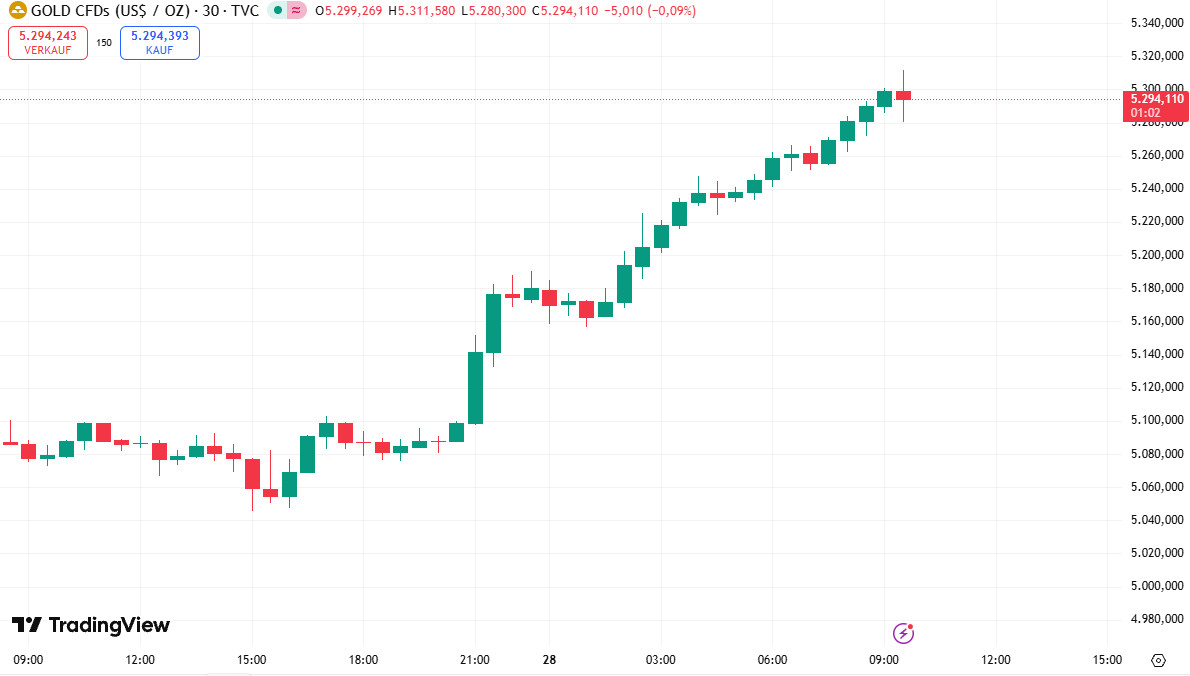
Gold: New all-time high above $5,300 despite correction attempt
Gold briefly dipped below $5,000 yesterday (low ~$4,980–4,990), but quickly recovered to the resistance at $5,100. After Trump's speech this resistance was overcome and a new all-time high above $5,300 was reached. The dollar weakness clearly dominates here – structural drivers (central bank purchases, geopolitics) keep the price stable.
At USD 5,300, the gold price had already reached the forecasts for the end of the year by the end of January. | Chart source: TradingView
Oil: Still weak
WTI and Brent are giving way (–0.8 to –1.2 %). The US winter storm has not caused major refinery outages so far, inventories remain high, demand subdued. Oil can only benefit very limitedly from the dollar decline.
Today's Trump speech in focus
Today at 14:30 CET (GMT+1:00): Another speech by Donald Trump is expected – again with high potential for market disruptions (tariffs, Fed, trade policy). Historically, such statements often trigger 1–2 % swings in indices and commodities.
Today at 20:00 CET (GMT+1:00): The US Federal Reserve's interest rate decision, followed by a press conference at 8:30 p.m. CET (GMT+1:00). If Donald Trump once again launches a sharp attack on the Fed and its chairman today, the press conference could provide clarity on whether the president and the central bank are heading towards an open conflict at an accelerated pace.
Conclusion
The market is moving, but at the same time it is in a holding pattern ahead of Trump and the Fed: the dollar is weak, equities are trending slightly higher, oil remains under pressure and gold is above USD 5,300 in search of its next all-time high. A more accurate assessment of further developments will therefore only be possible after Trump and the Fed. If you want to follow the markets and prices live on your PC or smartphone, you will find a neutral overview of established platforms that cover almost the entire range of assets here: Trading platform overview.
The FOMC meeting minutes from January 28, 2026, released yesterday evening, surprised the market with a significantly more hawkish tone than expected. The Fed emphasized ongoing inflation risks, described the economy as “solid,” and even discussed the possibility of a rate hike if inflation data continues to surprise to the upside. The immediate evening reaction was accordingly: the US dollar strengthened (EUR/USD down to 1.178), precious metals and indices declined. Overnight, however, the market reversed – EUR/USD climbed back toward the 1.18 level, gold above 5,000 USD, and indices recovered roughly half of the previous evening’s losses. Here are the details and initial assessment.
The Minutes: Hawkish and Open to Rate Hikes
Fed members continue to view inflation as too high and persistent, particularly in shelter and services. The economic outlook remains “solid,” and the labor market environment “balanced.” Notably: an explicit discussion of the possibility of a rate hike took place if data continues to surprise upward or inflation expectations rise. While the majority currently sees no need for such action, they stressed that the interest rate path remains “data-dependent” and “higher for longer” continues to be the guiding principle.
The market had hoped for somewhat softer language (e.g., earlier discussion of rate cuts). Instead, the dominant message is: no rush for cuts, with risks tilted toward the hawkish side. The CME FedWatch Tool now shows only ~45 % probability of a cut in June (previously ~50–55 %).
Evening Reaction: Dollar Strong, Risk Assets Under Pressure
The immediate reaction clearly reflected the shock of even mentioning a possible rate hike:
EUR/USD fell to 1.178 (–0.5 %)
DXY rose to 104.80 (+0.6 %)
Gold fell back below the recently reclaimed 5,000 USD level (–1.2 %)
Tech stocks and gold, which had been positioned for lower rates, were particularly affected. The 10-year Treasury yield rose to 4.28 %.
Overnight Recovery – Technical Bounce & Ongoing Uncertainty as Drivers
Overnight the market reversed sharply: EUR/USD rose back toward the 1.18 level, gold above 5,000 USD, and indices recovered roughly half of the losses. Oil prices continued to rise (WTI +0.3 % to around 65 USD, Brent +0.3 % to 70 USD), indicating persistent geopolitical tensions. The most likely drivers of the recovery are a combination of:
Technical Counter-Movement: After the strong evening sales, many markets were oversold. Short covering + technical buying at key support levels (gold 4,950–5,000, S&P 5,800–5,850) triggered a bounce.
Ongoing Uncertainty in the Iran Crisis: Reports of indirect talks (via Oman and Qatar) briefly fueled optimism, but the crisis has not de-escalated. Rising oil prices show that the risk persists – gold continues to benefit as a safe haven despite the Fed’s hawkishness.
ETF Inflows & Market Sentiment: Strong buying in gold ETFs (BlackRock, SPDR) supported the price, while indices remained volatile due to light liquidity overnight (Presidents' Day aftermath).
After the FOMC shock in the evening, tensions in Iran appear to be supporting a recovery in the gold price. | Chart source: TradingView
Outlook: Hawkish Fed and Geopolitical Uncertainty
The hawkish tone of the Fed remains dominant: As long as no clear growth risks or inflation declines are visible, “higher for longer” remains the guiding principle. The next Fed meeting (March) will be decisive – until then the dollar could stay strong and gold and indices volatile. The Iran crisis remains a wildcard – any new escalation could catapult gold higher immediately, with oil prices reinforcing the effect.
Anyone who wants to follow assets and their prices live will find a neutral overview here of established platforms that cover almost the entire range of assets: To the Trading Platform Overview.
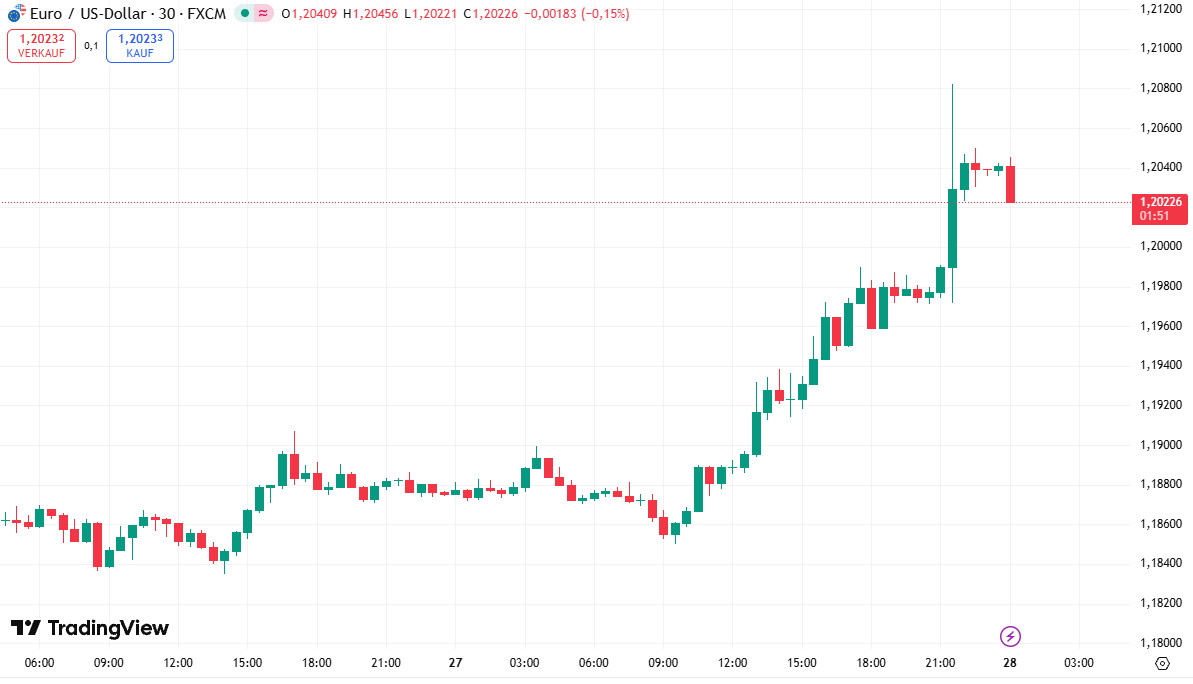
The statements by US President Donald Trump (criticism of the dollar exchange rate, new 25% tariff threats against South Korea, implicit Fed criticism) have noticeably moved the market yesterday evening and this morning. The US Dollar Index (DXY) has slipped significantly (currently 102.8–103.0), while reactions in stocks, gold and oil are diverging. The market shows nervousness, but no uniform direction.
Dollar under pressure – the central driver
The DXY has lost about 0.4–0.6 % since Trump's speech. A weaker dollar makes commodities (gold, oil, copper) cheaper for international buyers and at the same time supports riskier assets such as stocks. The combination of dollar criticism and tariff threats has split the market into two camps: safe-haven buyers (gold) and risk chasers (stocks).
Following Trump's statements, the EUR/USD exchange rate rose above 1.20. | Source: TradingView
Stocks: Slight gains despite uncertainty
S&P 500, Nasdaq and Dow are trading sideways to slightly positive (+0.2 to +0.5 %). The markets are interpreting Trump's rhetoric so far as „loud, but not new“ – no concrete new tariff packages, but repetitions. As long as no escalation follows, cyclicals and tech benefit from the dollar weakness. A real breakout to the upside is not yet visible, however.
Gold: New all-time high despite correction attempt
Gold briefly dipped below $5,000 yesterday (low ~$4,980–4,990), but quickly recovered to the resistance at $5,100. After Trump's speech this resistance was overcome and a new all-time high of $5,190 was reached. The dollar weakness clearly dominates here – structural drivers (central bank purchases, geopolitics) keep the price stable.
Oil: Still weak
WTI and Brent are giving way (–0.8 to –1.2 %). The US winter storm has not caused major refinery outages so far, inventories remain high, demand subdued. Oil can only benefit very limitedly from the dollar decline.
Tomorrow's Trump speech in focus
Tomorrow at 14:30 CET another speech by Donald Trump is expected – again with high potential for market disruptions (tariffs, Fed, trade policy). Historically, such statements often trigger 1–2 % swings in indices and commodities.
Conclusion
The market remains predominantly on hold: dollar weak, stocks slightly up, gold with new record above $5,100, oil still under pressure. Further developments this week depend heavily on Trump and his speech tomorrow. Anyone who wants to follow markets and prices live on PC or smartphone will find a neutral overview here of established platforms that cover almost the entire range of assets: To the Trading Platform Overview.
Today lacks major impulses: The US market is thinly traded, Asia largely closed (Lunar New Year). From 13:00 CET (7:00 ET), a series of less important data such as durable goods orders, building permits, capacity utilization etc. will be released – in sum they could cause slight movement, especially in combination with the FOMC meeting minutes at 20:00 CET (14:00 ET). Here is a summary of the expected data and an analysis of how the market could react to a hawkish, dovish or neutral FOMC protocol.
The Data from 13:00 CET – Potential for Small Surprises
The day in the US begins with a series of indicators that have relatively low individual impact but in sum shed light on the strength of the US economy. Here are the most important ones and their expectations:
Durable Goods Orders (14:30 CET): Forecast -1.8 % m/m (previous month +5.3 %). Ex Transportation +0.3 % (previous month +0.4 %). Cap Goods Orders Nondef Ex Air: previous month +0.4 %. A stronger decline could fuel growth concerns, a positive figure would underpin the Fed's „solid economy“ narrative.
Building Permits (14:30 CET): Forecast 1,420 million (previous month NA). Housing Starts MoM +6.3 %. The real estate market is sensitive to interest rates – weak figures could fuel dovish Fed expectations.
Capacity Utilization (15:15 CET): Forecast 76.5 % (previous month 76.3 %). Industrial Production (Jan): forecast NA. Higher utilization signals strength and could indicate inflationary pressure.
These data are normally „second tier“, but in the current directionless situation they could cumulatively cause movement: Weak figures fuel rate cut hopes, strong figures support the dollar and pressure risk assets. The market is currently in „wait-and-see mode“ until the FOMC minutes arrive.
The FOMC Minutes at 20:00 CET – The Main Event
The minutes of the January Fed meeting will be published tonight at 20:00 CET. The Fed held rates at 3.5–3.75 %, emphasized a „solid“ economy and paused the easing cycle. The market expects confirmation of the „higher for longer“ scenario, but with nuances: Discussions about the neutral rate, inflation spikes from tariffs and growth risks could color the tone dovish or hawkish. The CME FedWatch Tool shows ~90 % probability of hold in March, ~50 % for cut in June. The minutes will be scanned for hints whether the pause is long or short – especially ahead of the switch to Kevin Warsh as Fed Chair in May.
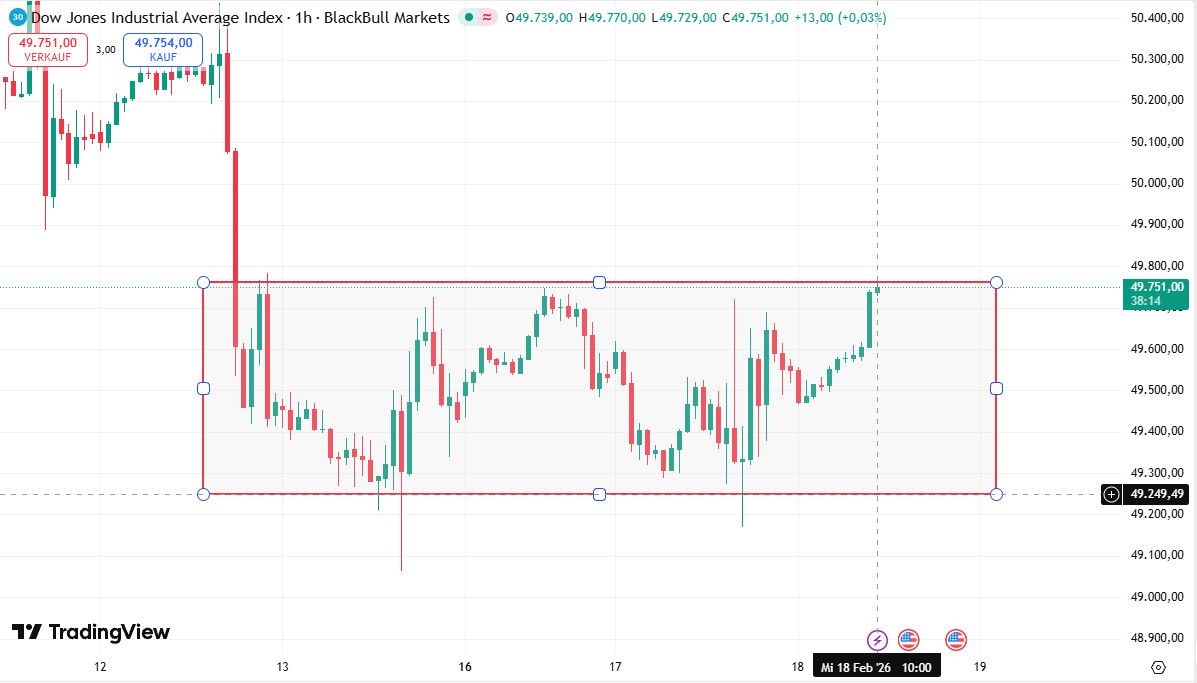
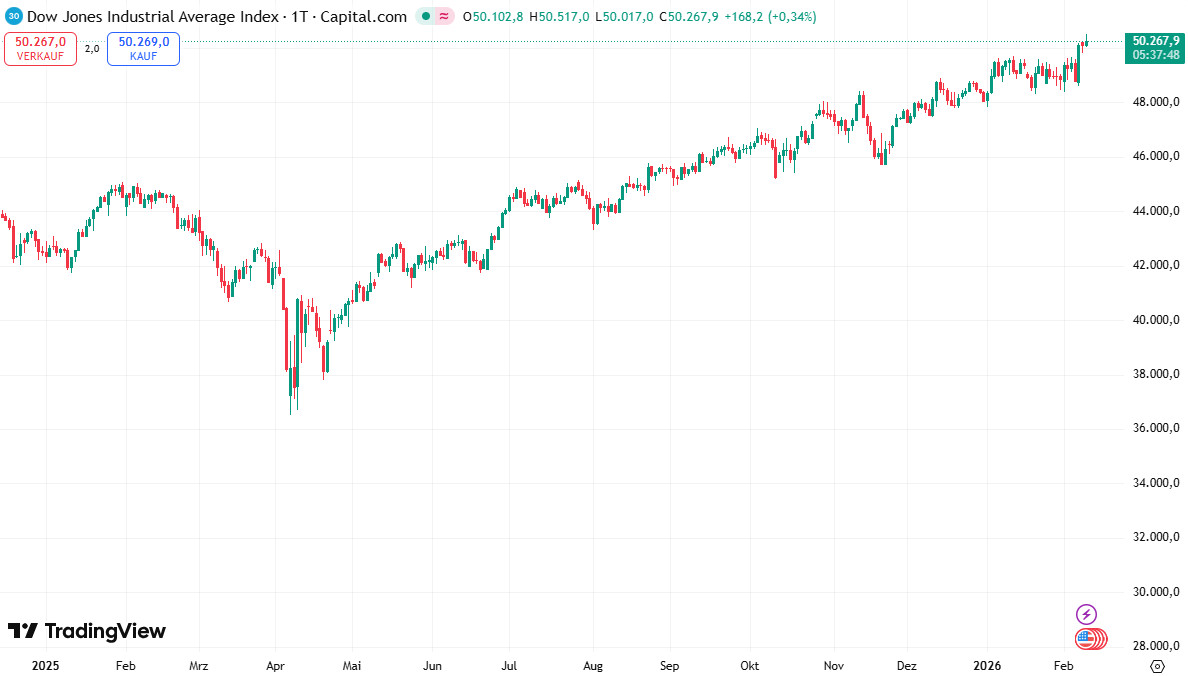
The Dow Jones has been in a tight range for a week. Can it break out today? | Chart source: TradingView
Analysis: How the Market Could React to Hawkish, Dovish or Neutral Minutes
Taking into account today's data (e.g. weak durable goods could amplify growth concerns, strong capacity utilization could indicate inflationary pressure), the minutes could move the market in three scenarios:
Hawkish Minutes (e.g. „elevated inflation“, higher neutral rate, no quick cuts): Strengthens the US dollar (DXY +0.5–1 %), euro/USD could fall (below 1.18). Indices could come under pressure (S&P 500, Nasdaq) -0.5–1 %, DAX -0.3–0.7 % and gold below 5,000 USD, Bitcoin below 65,000 USD. Stronger US data today would reinforce this.
Dovish Minutes (e.g. growth concerns, tariffs as „one-time“ impact, earlier cuts discussed): Risk-On – dollar could weaken (DXY -0.5 %), euro/USD +0.3–0.5 %. Indices +0.5–1 %, tech (Nasdaq) +1–1.5 %. Gold +50–100 USD, Bitcoin +2–4 %. Weak US data today would fuel this.
Neutral Minutes (e.g. „balanced risks“, pause confirmed, no new signals): Little movement – market likely remains flat (indices ±0.2 %, dollar stable). Gold/Bitcoin continue to hover on direction search. The sum of today's data then decides the direction, but without surprises it remains directionless.
Conclusion
The market is likely to remain directionless until the FOMC minutes, but the sum of today's data could set small impulses. A hawkish Fed protocol could create pressure, a dovish one bring recovery. Anyone who wants to follow the assets and their prices live will find a neutral overview here of established platforms that cover almost the entire range of assets: To the Trading Platform Overview.
The NFP employment data from the US is expected today at 14:30 CET. What can we expect now after the less than positive data over the course of the week?
Poor guidance from the PMIs
Looking back at last week's data, it casts considerable doubt on the forecast 202,000 new jobs in the Non-Farm Payrolls (NFP). On Monday, the purchasing managers' index (PMI) for the manufacturing sector came in slightly better than expected. However, at 48.4 points, it remains below the important 50-point mark that separates growth from decline. The fact that the PMI for prices fell from 54.8 points to 50.3 points can also be seen as a bad sign, which may completely cancel out the positive effect of the first slight increase.
The PMI for services, which make up the most important part of the US economy, looks worse. Although it is still above the 50-point mark, it has fallen significantly from 56 points in the previous month to 52.1 points now. Analysts had expected only a slight fall to 55.5 points. The PMI for employment in the service sector has also fallen from 53 points to 51.5 points.
ADP and unemployment figures are rather pessimistic
The ADP employment change figures provided an initial impression of the possible outcome of today's NFP figures. On the one hand, they were 20,000 jobs below forecasts at 146,000. But the previous month's result was also revised downwards by 49,000 jobs. These figures are also reflected, at least in part, in the data on initial applications for unemployment benefits. At 224,000, the number of new applications was 9,000 higher than the expected 215,000. The previous month had to be revised slightly upwards by 2,000 applications. Even though the NFP figures have often come as a surprise, the figures do not point to another surprise.
How will the markets respond to the NFP?
Recently, the markets have often reacted rather atypically to macroeconomic data. The gold price in particular has partially decoupled itself from the development of the US dollar. It currently looks like it is in a holding pattern until the NFP figures, fluctuating between 2634 $ and 2644 $. If the figures do indeed disappoint today, this would be a strong sign that the US Federal Reserve will cut interest rates again at its meeting next week, which usually has a positive effect on the gold price. In this case, it is likely that the gold price will resume its upward trend.
For the US dollar, on the other hand, this would be a negative signal. Having already weakened as a result of the rather poor data this week, this trend could pick up speed if the figures are disappointing. In this case, the EUR/USD exchange rate could move back towards 1.07.
The prospect of a further rate cut would be positive news for indices and equities. It therefore cannot be ruled out that the indices will once again aim for new record highs.
Tuesday starts with mixed signals from Germany: While the Consumer Price Index (CPI) for January exactly meets expectations, the ZEW economic expectations disappoint much more than feared. The euro and European indices give way slightly, while gold and Bitcoin hardly react. Here are the details and initial market assessment.
German CPI January: Exactly in the Target Corridor
The Consumer Price Index (CPI) for Germany in January stands at +0.1 % m/m and +2.1 % y/y, exactly in line with analyst forecasts. This keeps inflation in the eurozone's largest economy stable within the ECB's 2.0 % target range. After two months of slight declines, this is another indication of a controlled cooling without a strong drop in inflation. Shelter costs and services remain stubborn, which is likely to keep the ECB cautious. The euro showed little movement against the dollar after the figures (EUR/USD ~1.184), and the market reaction is correspondingly subdued.
Much more disappointing are the ZEW economic expectations for February. After a surprisingly strong 59.3 points in January (well above expectations), analysts had forecast a further rise to 65.8 points. In reality, there was a decline to just 58.3 points – even lower than the previous month. This is a clear damper on hopes for a quick recovery in the German economy. The index remains above the important 50-point mark (expansion), but the momentum is gone.
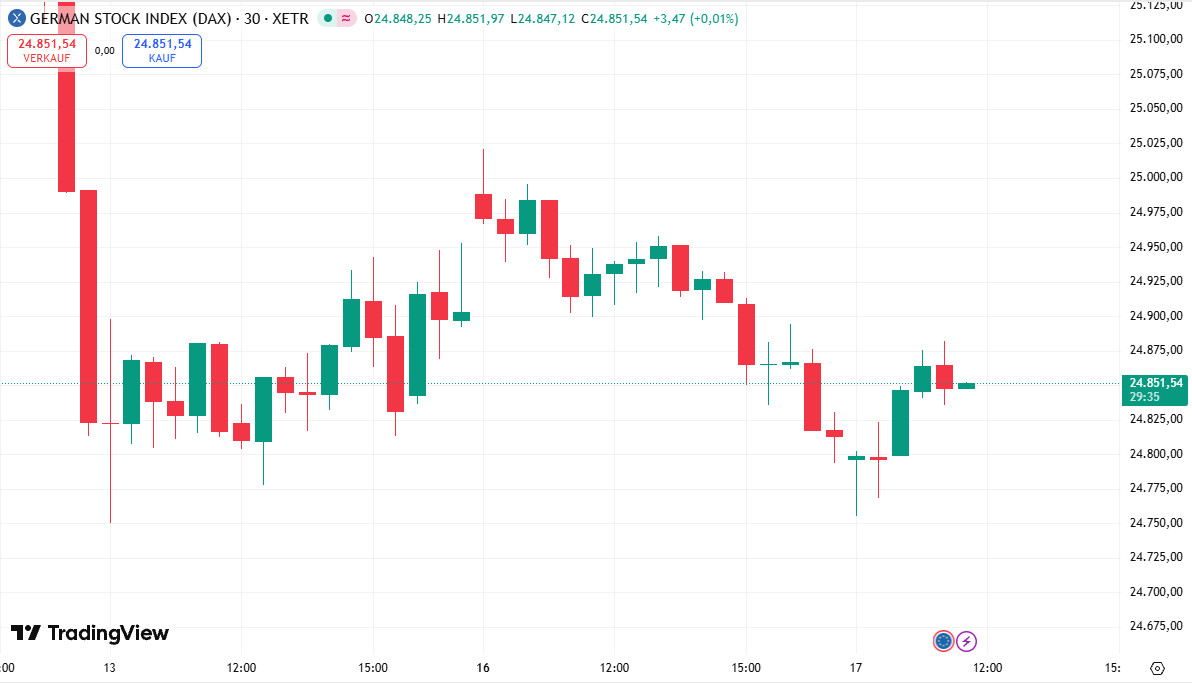
The market reaction is nevertheless subdued: The DAX initially reacted slightly positively after the CPI data, but threatens to turn after the ZEW figures and is giving back part of the moderate morning gains. It is currently still showing a small gain of 0.12 %. The euro is losing slightly against the dollar (EUR/USD at ~1.182). Cyclical sectors and bank stocks in particular are affected, while defensive titles (utilities, health) are holding up. The decline signals that investors continue to view the German economy with skepticism – despite the stable inflation data.
After a good start, the DAX is coming under pressure again after the ZEW figures. | Chart source: TradingView
Market Reaction & Outlook
Today remains thinly traded: No major US data, Asia largely closed (Lunar New Year). The focus is therefore shifting completely to the FOMC meeting minutes expected tomorrow. A dovish tone (discussion of earlier rate cuts, growth concerns) could trigger risk-on and support the euro, European indices and gold. If the Fed remains hawkish, pressure on the euro and risky assets is likely to continue.
Gold continues to trade just above 5,000 USD, Bitcoin is hovering around 66,800–67,200 USD – both are waiting for the next impulse. Anyone who wants to follow the price developments live will find a neutral overview here of established platforms that cover almost the entire range of assets: To the Trading Platform Overview.
On Thursday night, Bitcoin exceeded the USD 100,000 mark for the first time. The reason probably comes from an announcement by future US President Trump.
Possible New SEC Chairman drives the Bitcoin Price
After consolidating just below the USD 100,000 mark since mid-November, the price of Bitcoin broke through this mark for the first time on the night of 12 December, reaching a new record high of USD 104,000. There are many reasons for this. The most important, however, is likely to be Donald Trump's decision to name crypto proponent Paul Atkins as his preferred candidate for the chairmanship of the US Securities and Exchange Commission (SEC). Should this actually be realised, ETFs for further cryptocurrencies could be approved as a result. So far, these are limited to Bitcoin and Ethereum. It remains to be seen whether a broad offering will attract additional capital or whether the capital accumulated to date will be further dispersed. Overall, however, it would be positive for the broader acceptance of cryptocurrencies.
The planned establishment of a position in the White House to deal specifically with policy relating to digital currencies was also received positively by the crypto community. There is also the possibility that the USA could create a state reserve in Bitcoin under Trump. So far, it is unclear what funds will be used to create this reserve. Some speculate that it will consist of Bitcoin confiscated from criminals, which could have a rather minor impact on the price. However, there are also proposals to buy a total of 1 million Bitcoins over a period of several years. This would be almost 5% of the limited amount of 21 million Bitcoin. Such a move could have a more significant impact on the price of Bitcoin. And not only after the purchase is completed, but already after the announcement.
What's next for Bitcoin?
After reaching a new record high of USD 104,000, the price initially fell by almost USD 3,000. This was probably primarily due to profit-taking, although this was very limited. The price is currently hovering between USD 102,000 and USD 103,000. If it remains above the 100K mark until the upcoming weekend, this could be interpreted as a signal for further upward potential in the short term. If it falls below this mark, initial resistance in the USD 95,000 range is to be expected. However, it is likely that the price will consolidate in the current range until the next news, positive or negative, influences the further direction of the price.
The market starts the week cautiously: Japan delivers a clear disappointment with Q4 GDP, European indices are slightly positive amid thin news flow, gold continues to hover around the 5,000 USD mark, and Bitcoin fails again at the 70,000 USD hurdle. The US market is closed today for Presidents' Day, China and large parts of Asia are closed all week for Lunar New Year. Here is a current overview.
Japan: Q4 GDP significantly below expectations – yen weaker, Nikkei slightly recovered
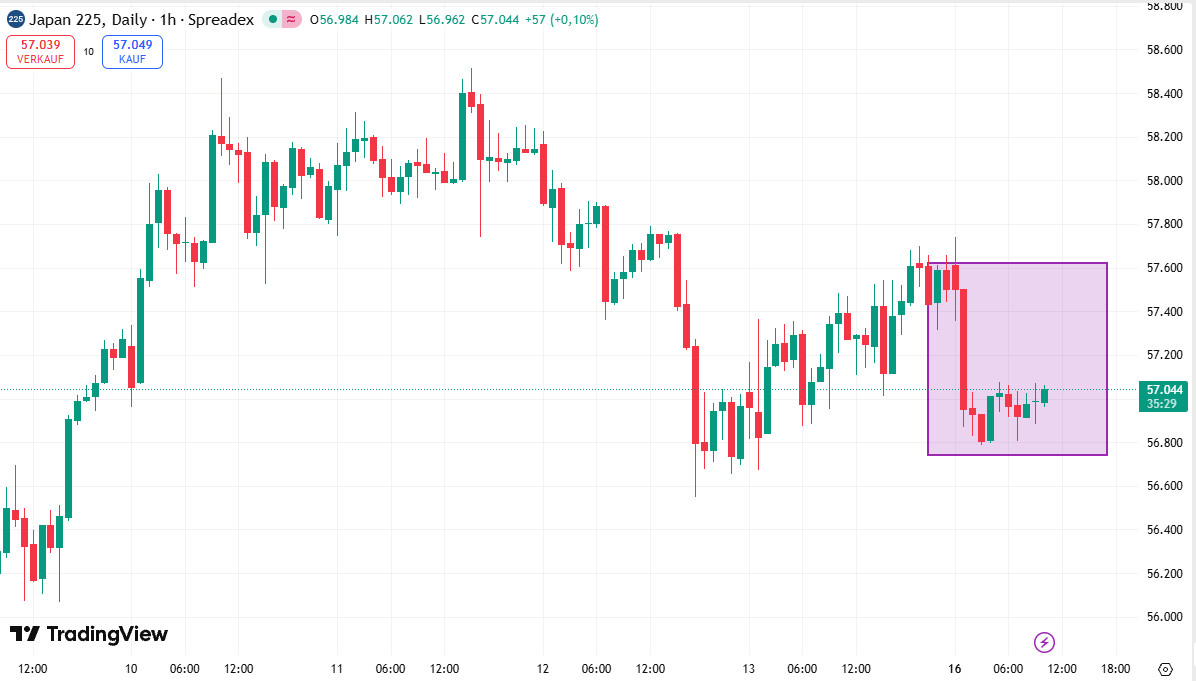
Japan's Gross Domestic Product (GDP) for Q4 2025 disappointed the markets this morning. After a decline of -2.6 % in the previous quarter (y/y), analysts had expected a strong rebound of +1.6 %. In reality, only +0.2 % was reported. Even in the quarter-on-quarter comparison (q/q), the real figure of +0.1 % was well below the expected +0.4 %.
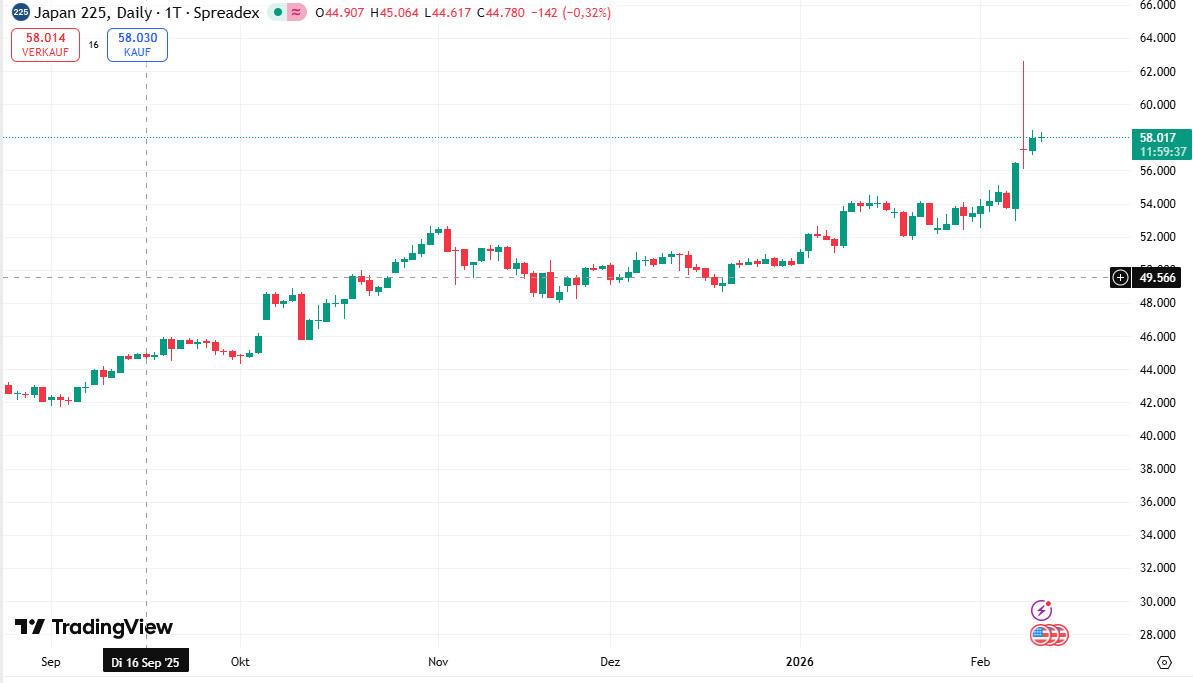
The initial reaction was negative: The yen fell around -0.4 % against the US dollar and -0.35 % against the euro. The Nikkei 225 fell by up to -0.8 % in the first trading hour, but has since recovered slightly and is currently only -0.22 % down. The disappointing figures are fueling doubts about the strength of the Japanese economy and could put further pressure on the Bank of Japan (BoJ) not to tighten its extremely loose monetary policy too quickly.
Following the GDP figures, the Nikkei 225 initially suffered significant losses. | Chart source: TradingView
Amid thin news flow, European indices are slightly positive this morning. DAX +0.2 %, Euro Stoxx 50 +0.3 %, CAC 40 +0.25 %. The Spanish IBEX 35 is significantly stronger at currently +0.95 %. The euro is barely moving against the dollar (EUR/USD ~1.185), indicating a lack of impulses. The markets are waiting – the focus is on the FOMC meeting minutes on Wednesday.
Gold & Bitcoin: Searching for direction – 5,000 USD and 70,000 USD as key levels
Gold briefly fell below the 5,000 USD mark overnight but managed to recover and is currently trading just above it (~5,010–5,020 USD). The strong US dollar and persistently high real yields (10-year Treasury ~4.20–4.24 %) continue to weigh on the yellow metal. At the same time, geopolitical risks and long-term inflation concerns keep the price stable. A clear impulse is missing – many market participants are waiting for the FOMC minutes on Wednesday. A dovish tone could push gold back toward 5,100+ USD; a hawkish tone would increase the pressure.
Bitcoin is behaving similarly: On Sunday, another attempt was made to sustainably break above the 70,000 USD mark – it failed. BTC is currently trading at ~66,800–67,200 USD and is struggling with weak risk sentiment. The strong dollar and reduced rate cut expectations (June ~50 %) are exerting further pressure. Technically, 65,000 USD remains the next important support; a break below could trigger further sales. ETF inflows (BlackRock, Fidelity) are currently providing support, but without a new catalyst, the direction remains unclear.
Outlook: FOMC minutes on Wednesday as hoped-for impulse
Today and tomorrow the markets remain thinly traded: Presidents' Day in the US, Lunar New Year in China and parts of Asia. The next real impulses are not expected until Wednesday at the earliest – in particular the FOMC meeting minutes from the last Fed meeting. Dovish tones (e.g. discussion of earlier rate cuts, concerns about growth or inflation cooling) could trigger risk-on and support gold, stocks and crypto. A continued hawkish stance would further strengthen the dollar and put pressure on risky assets.
Until then, the market remains in „wait-and-see mode“. Anyone who wants to follow the prices live will find a neutral overview here of established platforms that cover almost the entire range of assets: To the Trading Platform Overview.
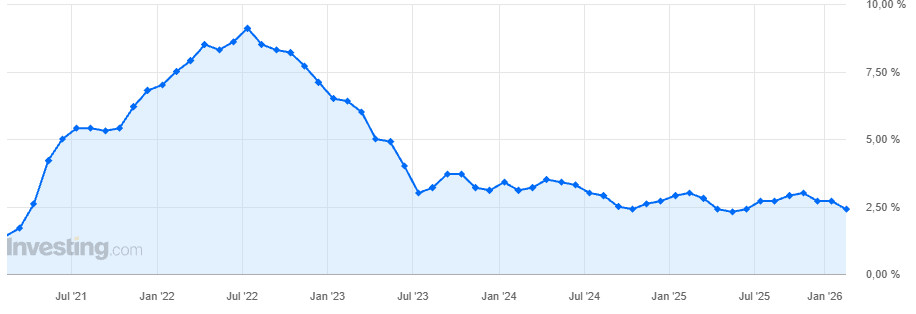
Today's US Consumer Price Index (CPI) came in slightly weaker than expected: Headline inflation +2.4 % y/y (forecast 2.5 %), m/m +0.2 % (forecast 0.3 %). Core CPI also slightly below estimates. At first glance, a clear dovish signal. Yet the market reaction is more than subdued: Indices barely moved, dollar only minimally weaker, gold and Bitcoin hardly give way. Why the CPI data seem to pass the markets without effect – and what could happen next.
CPI Figures in Detail – Slight Cooling, but Nothing Dramatic
The January CPI data show a further slight easing in consumer price increases:
Especially core inflation is crucial for the Fed as it excludes volatile components. The decline is positive, but by no means dramatic enough to seriously question the Fed's „higher for longer“ stance. Shelter costs and services remain stubborn, keeping the Fed cautious.
CPI has been declining since October. Currently seems to pass the market without trace. | Chart source: investing.com
Why the Markets Barely React
The reaction in the markets is surprisingly subdued despite dovish data:
S&P 500 Futures +0.1 to +0.3 % (practically flat)
Nasdaq Futures +0.2 to +0.4 % (slight recovery)
10-Year Yield -2 to -4 bp (only minimal decline)
DXY -0.2 to -0.3 % (dollar barely gives way)
Gold +0.4 to +0.6 % (slight bounce, remains below $5,000)
Bitcoin +1 to +1.5 % (recovers somewhat, remains below $67,000)
There are several reasons for this seemingly indifferent reaction:
Data was already largely priced in Markets have been anticipating further inflation cooling for weeks. The January NFP beat was so strong that CPI figures are perceived more as confirmation of the trend – not as new, surprising information.
Fed remains „higher for longer“ dominant Even at 2.4 % headline, core inflation remains above 3 %. The Fed has communicated very clearly in recent weeks that it does not react to a single good CPI print. Probability for March cut <10 %, June ~50–55 %. This is not enough for a real rally.
Technical factors and sentiment Many indices are technically oversold after recent pullbacks → light short-covering buys, but no real risk-on impulse. Gold continues to fight the $5,000 mark as psychological resistance. Bitcoin suffers from the strong dollar and lack of new liquidity (ETF inflows moderate).
Waiting for next data & Fed The market is already looking at PPI (tomorrow) and the Fed meeting next week. As long as Powell & Co. do not explicitly turn dovish, sentiment remains cautious.
Triggers for a Reversal – What Could Really Turn the Market?
In the current situation, a real trend reversal could only be triggered by several clear signals – and the next few days offer very little potential for that:
No major data tomorrow (Saturday) – market closed or extremely thinly traded, practically no new impulses.
Monday (Presidents' Day) – US exchanges fully closed. At the same time, China and many Asian markets are largely or completely out of operation due to Lunar New Year – partly the whole week. Until Tuesday/Wednesday, hardly any movement or new catalysts are to be expected.
First realistic impulse: FOMC minutes on Wednesday – the minutes of the last Fed meeting could provide the first concrete indications of the central bank's current stance. Dovish tones (e.g. discussion of earlier rate cuts, concerns about growth or inflation cooling) would be a strong trigger for recovery in indices, gold and crypto.
Technical bounce opportunities – As long as important supports hold (gold ~$4,900, Bitcoin ~$65,000, S&P 500 ~6,800 points), technical short-covering alone could cause a temporary bounce – even without fundamental news.
Geopolitical easing or surprises – Positive news from crisis regions (Ukraine/Middle East) or unexpected stimulus measures from China (even if the market is currently closed there) could trigger risk-on.
In short: The market is currently in a real „wait-and-see mode“ with very limited catalyst density. The next realistic impulses are likely to come only from Wednesday with the FOMC minutes – until then volatility remains high, but direction unclear. Technical supports and geopolitical developments are currently the only potential drivers for short-term movement.
Conclusion
The CPI data are „good enough“ to keep recession fears at bay, but „not good enough“ to properly reignite rate cut fantasy. This is likely the most plausible explanation for the absent reaction. The market remains in „wait-and-see mode“ – until Fed signals or technical supports give clear direction. Anyone who wants to follow current prices live will find a neutral overview here of established platforms that cover almost the entire range of assets: To the Trading Platform Overview.
According to the data already available from five German federal states, inflation in Germany is falling significantly. The German indices react with a rise.
Prior to the publication of the inflation data for Germany at 14:00 CET, the data for five federal states were published at 10:00. These show a clear slowdown in the rise in consumer prices. Inflation in Baden-Württemberg, for example, amounted to 3.4% last month, one percentage point below the forecast.In Bavaria, the price increase of 2.8% was below the 3% mark and 0.9% lower than forecast. The data from the federal states suggests that the inflation rate for Germany as a whole will also be well below the forecast 3.5%.
The German stock indices reacted to the first data on inflation in Germany with a significant rise in some cases. The DAX is currently up by around 1.05% and the TecDAX by 1.36%. In addition to the German inflation data, the Spanish inflation data was also published in the morning. Contrary to an expected increase of 0.2%, the rise in consumer prices actually fell by 0.3% and stood at 3.2% in November. Even if falling inflation does not suggest a change in interest rate policy is imminent, it is likely that the ECB's cycle of interest rate hikes has come to an end.
In contrast, the euro initially reacted to the German inflation data with losses against the US dollar. A possible end to the European Central Bank's restrictive monetary policy would significantly reduce its current advantage over the US dollar, which is weakening due to the Fed's loosening interest rate policy. The EUR/USD currency pair is currently trading at 1.9073, down 0.15 %.
Yesterday the market gave back on a broad front, partly significantly: Indices lost heavily, gold fell back below 5,000 USD (now acting as temporary resistance), Bitcoin moved further away from the 70,000 USD mark, while the US dollar benefited slightly and consolidated below the 1.19 level (EUR/USD). This decline is no coincidence, but a reaction to the week's economic data and the resulting expectations for Fed policy. Here is a detailed overview of the causes, current situation and possible triggers for a reversal.
The Causes: Strong NFP Beat and CPI Expectations Put the Market Under Pressure
The trigger for yesterday's market decline lies mainly in the strong US labor market data (Nonfarm Payrolls) from Wednesday, which significantly exceeded expectations. Instead of the forecasted 66,000 new jobs, 130,000 were added, private payrolls even 172,000 (145 % above forecast), and the unemployment rate unexpectedly fell to 4.3 % (expected stable at 4.4 %). Hourly earnings rose 3.7 % YoY, slightly above expectation. These figures signal a robust labor market that reduces the likelihood of near-term Fed rate cuts. US Treasury yields rose (10-year to ~4.22–4.24 %), pressuring risk assets such as stocks, gold and crypto.
In addition, there are expectations for today's CPI data (Consumer Price Index). Analysts expect 0.3 % m/m and 2.5 % y/y, which would mean a slight cooling of inflation. However, if inflation comes out higher, it would cement the Fed's „higher for longer“ scenario and could support the selling pressure. The markets already anticipated yesterday that the Fed could keep rates higher for longer given stable inflation and strong labor market – this led to sector rotation: Tech and growth stocks weak, defensives (financials, energy) holding up better.
Geopolitical tensions (Ukraine, Middle East) and ongoing uncertainty from the recent government shutdown reinforce the pressure: Investors seek safety in Treasuries and the dollar, weighing on risk assets such as indices, gold and Bitcoin. Overall, the decline is a classic „good news is bad news“ reaction: Strong data = fewer rate cuts = higher yields = pressure on valuations.
Indices Give Back Heavily – Tech Under Pressure
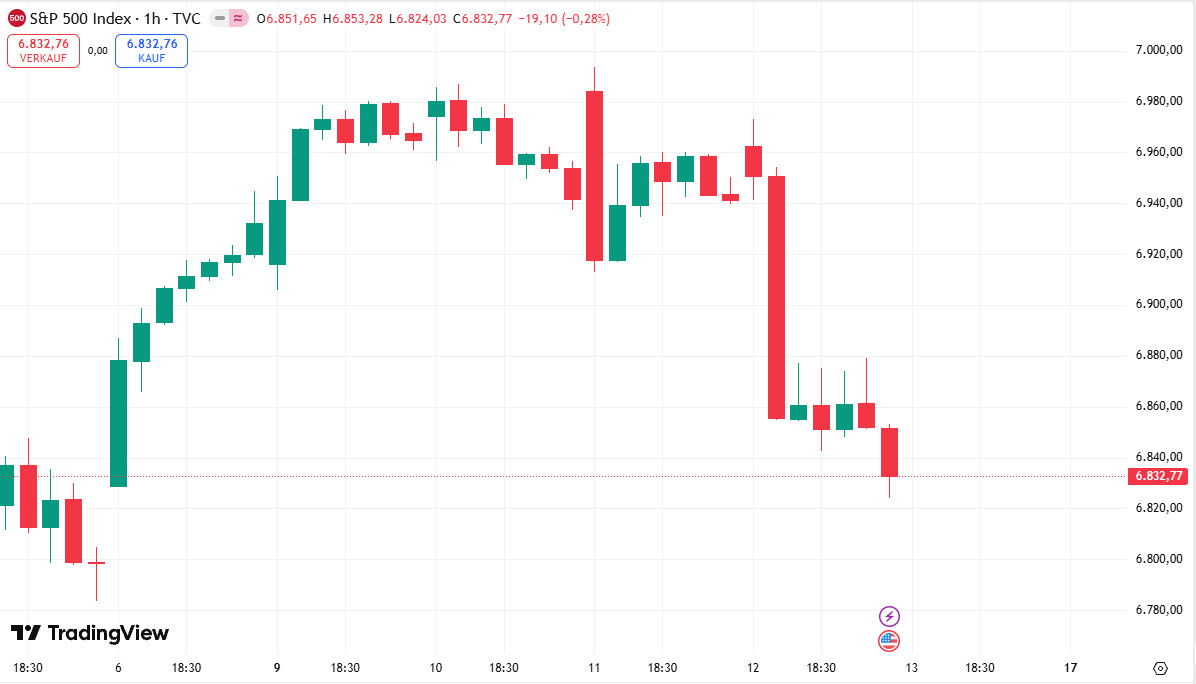
The indices gave back clearly yesterday: The Dow Jones fell -1.2 % to around 49,800 points, the S&P 500 -1.5 % to below 6,900, the Nasdaq even -2.0 % to around 21,500. Losses are broad-based, with tech sectors (Nasdaq) most affected – growth stocks like NVIDIA or Tesla suffer from rising real yields, making their high valuations (P/E >30) less attractive. Europe followed (DAX -1.0 %, CAC 40 -1.2 %), Asia was mixed (Nikkei -0.5 %, Hang Seng +0.2 %). Pre-market shows a slight stabilization this morning, but without clear triggers, pressure could persist.
US indices have given back last week's gains since yesterday. | Chart source: TradingView
Gold Back Below 5,000 USD – Temporary Resistance
Gold suffered a flash crash yesterday and fell -3.08 % to 4,941 USD per ounce, below the psychologically important 5,000 USD mark. This morning it is hovering around ~4,950 USD, with 5,000 USD acting as temporary resistance. The strong dollar and higher yields make gold less attractive as a non-yielding asset. However, geopolitical risks and long-term inflation concerns keep the price stable – a dip below 4,900 USD could trigger further sales, but the market has reflexively bought dips recently.
Bitcoin Moves Further Away from 70,000 USD
Bitcoin lost -4 to -5 % yesterday and is currently trading at ~66,200 USD, significantly away from the 70,000 mark. The strong dollar and reduced rate cut expectations are weighing on crypto as a high-beta risk asset. Like gold, BTC reacts sensitively to real yields – higher yields make alternatives like bonds more attractive. Volatility remains high, a break below 65,000 USD could trigger further sales, but ETF inflows (BlackRock, Fidelity) are currently supporting the price.
US Dollar Benefits Slightly – Consolidation Below 1.19 on EUR/USD
The USD gained +0.8–1.0 % yesterday and is consolidating below 1.19 on EUR/USD (currently ~1.185). The strong NFP beat reduces the likelihood of a near-term rate cut (June now ~45–50 %), making the dollar more attractive as a carry-trade currency. Other currencies such as EUR, JPY and GBP are losing – the DXY rises to 98.5–99.0.
Triggers for a Reversal – What Could Turn the Market?
In the current situation, a reversal could only be triggered by several factors:
Weaker CPI data today: If they come in below 2.5 % y/y, rate cut hopes rise again – dollar weaker, gold/indices stronger.
Fed signals: Dovish comments from Fed members (e.g. Powell or Yellen) could calm the market and fuel rate cut bets.
Geopolitical easing: Positive news from crisis regions such as Ukraine/Middle East (e.g. ceasefire) could trigger risk-on – indices/crypto up, gold down.
Technical levels: Gold support at 4,900 USD holds, Bitcoin at 65,000 USD, S&P at 6,800 – a bounce from there could trigger buying. Sector rotation reverses: If tech valuations fall too low, value hunters buy in – Nasdaq could then lead.
Global factors: Positive data from China (e.g. stimulus news) or Europe (ECB hints) could ease pressure. Long-term, the „higher for longer“ scenario remains dominant – a real reversal requires clear dovish signals.
Conclusion
Yesterday's decline is a reaction to strong NFP data and CPI expectations, which are dampening rate cut hopes. The dollar benefits, indices/gold/Bitcoin suffer – but revisions and geopolitical risks limit the sell-off. Triggers for reversal: Weaker CPI today, Fed signals or technical support. The market remains volatile – anyone who wants to follow the prices live will find a neutral overview here of established platforms that cover almost the entire range of assets: To the Trading Platform Overview.
Tuesday begins with a cautiously positive trend. After weak data from Asia, investors are hoping for more information on the Fed's course in the evening.
From Asia, the most important Asian indices such as the Nikkei and the Hang Seng provide moderately negative to neutral guidance on Tuesday. However, this appears to have little or no influence on the European indices. Shortly after the market opened, Germany's leading index, the DAX, was virtually unchanged, as was the Euro Stoxx 50.
A certain degree of restraint is expected on the stock market today, as many investors are eagerly awaiting the minutes of the US Federal Reserve's last meeting, which will be published this evening. After the Fed left interest rates unchanged again at the last meeting, investors are hoping that the FOMC minutes will provide information on the reasons behind the decision. In conjunction with the latest data on inflation and the US economy, a clear picture could emerge as to whether the cycle of interest rate hikes in the US may have come to an end. If investors' expectations are confirmed in the evening, the momentum of the past week could return to the markets.
Today's US labor market data (Nonfarm Payrolls) came in significantly stronger than expected: 130,000 new jobs (vs. 66,000 expected), private payrolls +172,000 (145 % above forecast), unemployment rate surprisingly dropped to 4.3 %. Nevertheless, the market reaction remains very muted: The US dollar gains clearly, indices give back moderately, gold and Bitcoin hold up remarkably stable. Is this unusual – or actually within the green zone? Here is a current assessment.
NFP Figures at a Glance
The January data clearly exceed expectations overall:
Nonfarm Payrolls: +130,000 (expected +66,000)
Private Payrolls: +172,000 (expected +70,000)
Unemployment rate: 4.3 % (expected stable at 4.4 %)
The massive downward revisions of previously reported jobs (almost 900,000 fewer jobs than originally reported) relativize the beat, however. The monthly average in 2025 was only +15,000 instead of +49,000 – this shows: The labor market was weaker than thought. January appears as an exception, not as a new trend.
Market Reaction: Dollar Strong, Rest Muted
The US dollar (DXY +0.8–1.0 %) is the clear winner – higher rates for longer, real yields rising (10-year +10–12 bp to ~4.22–4.24 %). Indices give back moderately after the initial euphoria: S&P 500 -0.4 to -0.7 %, Nasdaq -0.8 to -1.1 %, Dow Jones Industrial holding up better. Gold remains just above $5,000 (currently ~$5,018–5,025), Bitcoin stagnates further at ~$66,200 (-4 to -5 %).
Why No Classic “Strong Data = Risk-Off” Reaction?
At first glance, the market reactions appear unusual, but several factors explain this unusually muted response:
Revisions weigh heavier than the January beat: The market sees 2025 as weaker – January currently looks like an outlier, not a real trend reversal. Long-term this would be rather dovish if not confirmed next month.
Geopolitics & Safe-Haven Buying: Ukraine, Middle East, Taiwan concerns keep gold stable as a hedge. Dips are reflexively bought.
Technical Support at Gold: $5,000 is a gigantic round number + massive call wall (options strikes). Gamma support and institutional buying catch the decline.
Crypto as High-Beta Suffers More: BTC reacts more sensitively to rising real yields and dollar strength – no yield, high risk → clear decline.
Fed Remains “Higher for Longer”: Rate cut probability for June drops to ~45–50 %. This pressures tech/rate-sensitive sectors, but supports banks/financials (sector rotation).
Conclusion
The reaction to the strong NFP beat is unusually muted: The US dollar benefits clearly, indices give back moderately, gold and Bitcoin hold up remarkably stable. This is due to the massive revisions (2025 weaker than thought), geopolitical uncertainty and technical factors at gold. The market does not seem to rate January as a new trend – rather as an outlier in an overall cooling environment. Until the CPI data on Friday, much will likely remain in “waiting mode”. Anyone who wants to follow the current prices and further developments live will find a neutral overview here of established platforms that cover almost the entire range of assets: To the Trading Platform Overview.
According to figures published today, the rise in consumer prices in the US has fallen more than expected to 3.2% year-on-year.
Year-on-year inflation in the United States was still at 3.7% in September. The consensus among analysts for the rise in consumer prices for October was a price increase of 3.3% year-on-year and 0.1% compared to the previous month. However, consumer prices actually rose by 0.1 percentage points less both month-on-month and year-on-year, by 3.2% and 0.0% respectively. The core rate of the consumer price index excluding food and energy prices also fell by 0.1% to 4.0%, contrary to the expected stagnation.
The stronger decline in inflation in the US is a positive sign for the stock markets. The Federal Reserve has always emphasised that it pays particular attention to the development of the core rate when making interest rate decisions. The current decline is a further sign that the Fed's cycle of interest rate hikes may have finally come to an end. The US indices initially reacted to the inflation data with a rise in pre-market trading.
However, this falling inflation is bad news for the US dollar. The EUR/USD exchange rate rose to the 1.08 mark following the publication of the figures, but has not yet been able to overcome it. In contrast, the gold price reacted positively to the data and is currently rising to around USD 1,955 per troy ounce.
The market is showing a mixed picture this morning: Asia closes with clear gains (Nikkei +2.2 %), Europe is trending negative despite positive lead (DAX -0.32 %, CAC 40 -0.41 %), and US indices are moving rather sideways in pre-market. The focus is on the postponed NFP data at 14:30 CET – until then, much remains in waiting mode. Here is a current overview.
Asia Closes Strongly Positive
The Asian markets ended the week with clear gains: The Nikkei 225 rises +2.2 % and marks new highs, supported by the ongoing “Takaichi-Trade” sentiment following the government party's election victory. The Hang Seng gains moderately +0.31 %, Shanghai Composite +0.49 %. Sentiment in Asia remains risk-on, driven by reform hopes in Japan and slight recovery in China. This actually sets positive lead for Europe and the US.
The Monday candle on the Nikkei 225 – an impressive Bullish Engulfing that resumes the uptrend and continues today. | Chart source: TradingView
Europe Turns Negative
Despite the strong Asia lead, Europe is trending negative: The DAX loses -0.32 %, the CAC 40 -0.41 %, the Euro Stoxx 50 is also weakening. Sentiment is subdued – the weak dollar (EUR/USD at 1.191) helps exporters only to a limited extent, while the markets wait for the NFP data. Sector rotation visible: Tech and cyclicals weak, defensive (utilities, health) holding up better. The market does not seem to really buy the Asia gains – uncertainty ahead of the US labor market data is too great.
US Futures Sideways to Slightly Negative Before NFP
US futures are showing rather flat to slightly negative in pre-market: S&P 500 Futures -0.1 to -0.3 %, Dow Futures slightly positive or neutral, Nasdaq weaker. The market is nervously waiting for the NFP data (postponed due to shutdown, expected 70,000 new jobs, unemployment rate stable). A stronger than expected report could support the dollar and further pressure tech; weaker than expected would fuel rate cut hopes. Until 14:30 CET, much remains in “waiting mode”.
Possible Triggers for the Eventless Morning
In a flat market, it is worth working out the possible triggers: The weak dollar supports gold and exporters, but yesterday's weak retail sales (0.0 % instead of +0.4 %) signal cooling – this could favor rate cuts. Sector rotation (tech weak, defensive stronger) and NFP expectation keep the market in check. A breakout up or down is only likely after 14:30 CET.
Conclusion
The market is mixed this morning: Asia strong, Europe weak, US pre-market flat – all are waiting for the NFP data. The coming hours could remain eventless but offer opportunities to work out triggers such as rate cut hopes or sector rotation. Anyone who wants to follow all prices live will find a neutral overview here of established platforms that cover almost the entire range of assets: To the Trading Platform Overview.
Last Friday, the rating agency Moody's downgraded the outlook for the US credit rating from stable to negative. The credit rating itself is not affected by this.
The rating agency justified this step primarily with the enormous US budget deficit, but the political situation in the USA also played a role in the decision. The USA is once again facing a possible government shutdown if the federal budget is not passed this week. The creditworthiness of the United States retains its AAA rating. However, following this decision, it cannot be ruled out that this could change in the future. Moody's is the only one of the three major rating agencies that still has the top rating for the USA's creditworthiness. Both Fitch and S&P had already lowered their ratings by one grade.
The downgraded outlook for the credit rating could have an impact on the bond market. Bond yields could rise due to the higher risk. In the current situation on the financial markets, this would in turn have a negative impact on the stock markets. The first signs of a slowdown in the US economy are emerging and investors could shy away from the risk of stocks and flee to the high yields of bonds. The indices on the US stock markets initially reacted with a moderate fall in pre-market trading on Monday. At the opening of the US market, the Dow Jones was down 0.12%, the S&P was down 0.30% and the Nasdaq was down 0.46%.
The gold price continues to hover just above the $5,000 mark today but has so far failed to benefit from weak US retail sales. The Dow Jones has marked a new all-time high (ATH), the S&P 500 is moving just below 7,000, while the Nasdaq cannot follow the trend. Bitcoin continues to fight around the $70,000 mark. Here is a current overview of market developments on Tuesday.
Gold Price: Weak Dollar Helps, Retail Sales Disappoint
Gold is trading today at around $5,036 per ounce and is holding just above the psychologically important $5,000 mark. The weak US dollar (DXY at approx. 98.5, EUR/USD at 1.191) is supporting the price, as gold becomes more attractive as a dollar-denominated asset due to dollar weakness. However, gold has so far failed to benefit from the weak US retail sales: These stagnated in December at 0.0 % (expected +0.4 %, previous month +0.6 %). This indicates a cooling consumer demand, which would normally increase expectations of rate cuts and support the gold price. The market is now waiting for tomorrow's US labor market data (Non Farm Payrolls) and the CPI figures on Friday.
Indices: Dow at New ATH, S&P Just Below 7,000, Nasdaq Weak
The Dow Jones has marked a new all-time high at 50,512.79 points and is showing strength despite weak retail data. The S&P 500 is moving just below 7,000 at 6,977 points and remains stable at a high level. The Nasdaq, however, cannot follow the trend and is trading weaker (approx. -0.3 %). The mixed reaction indicates sector rotation: Tech weak, defensive (financials, energy) stronger. The markets are waiting for further US data to assess the further course of Fed monetary policy.
The Dow Jones marks the next All-Time High above the 50,000 points mark.
Bitcoin: Fight for the $70,000 Mark
Bitcoin is currently moving at $69,216 and continues to fight around the $70,000 mark, which has so far not been sustainably overcome. The price has fluctuated strongly in recent days, but is benefiting from risk appetite in the indices. Nevertheless, volatility remains high, and a break below $68,000 could trigger further sales. Like gold, Bitcoin is reacting to the weak dollar but is waiting for clear Fed signals.
Conclusion
The market is showing a mixed reaction today: Gold is holding thanks to a weak dollar, indices partly at ATH, Bitcoin in the range. Weak retail sales could favor rate cuts, but the next data (NFP, CPI) will be decisive. Anyone who wants to follow the prices live will find a neutral overview here of established platforms that cover almost the entire range of assets: To the Trading Platform Overview.
The stock market continued its weak start into the week on Tuesday. Weak data from Asia supports the current moderately negative attitude of investors.
Germany's leading index, the DAX, is reacting cautiously to the negative data from Asia. However, the industrial production figures published in Germany this morning are also weighing on the index. This fell by 1.4 % compared to the previous month and by 3.86 % compared to the previous year. The index is currently down around 48 points, or 0.32%, at 15,088 points. The indices in the euro area are slightly negative overall and the leading European index, the Euro Stoxx 50, is currently down around 13 points, or 0.32%, at 4,144 points.
Investor sentiment is certainly also being dampened by the Reserve Bank of Australia's decision. Last night, the Australian central bank raised the key interest rate by 25 basis points from 5.10 % to 5.35 %. The growing hope that the global cycle of interest rate hikes may have come to an end has thus been severely dampened, and the current restraint on the part of investors is further underpinned.
The European Central Bank (ECB) has left all key interest rates unchanged as expected. The deposit facility rate remains at 2.00 %, the main refinancing operations rate at 2.15 % and the marginal lending facility rate at 2.40 %. This is already the fifth rate pause in a row since summer 2025.
Statement and Lagarde Press Conference – No New Signals
The ECB statement reads verbatim: “The interest rate on the deposit facility and the interest rates on the main refinancing operations and the marginal lending facility will remain unchanged at 2.00 %, 2.15 % and 2.40 % respectively.”
Christine Lagarde again emphasized the **data-dependent stance** of the ECB in the press conference: No fixed commitments to rate cuts, but “meeting-by-meeting and data-dependent”. Inflation is expected to stabilize around the 2 % target in the medium term, and risks to the outlook are “more or less balanced”.
Implications for the Euro – Stable but Under Observation
The euro shows only minimal movement after the decision and the press conference and remains stable around 1.1840–1.1870 (EUR/USD). Key points regarding the euro's development:
Lagarde again emphasized that the ECB **has no exchange rate target** (“we have no exchange rate target”).
However, the strong euro is being closely monitored (“we keep a close eye on FX, we discussed FX today”), as it dampens inflation and additionally burdens the economy.
No indication of active intervention – the euro is not described as “too strong”, but as one factor among several.
The market interprets this as “steady for longer” without new hawkish escalation → no major euro boost, but also no devaluation panic.
In the short term, the euro therefore remains in a narrow range (1.18–1.19) as long as no new impulses (US data tomorrow, geopolitical situation) emerge.
Overall Market Reaction Muted
DAX and Euro Stoxx 50 are slightly higher (+0.3 to +0.6 %), Bund yields are falling slightly. Gold is stabilizing around $4,900–4,950. No volatility spike – the rate pause was expected, and Lagarde gave no new indications of imminent easing.
Conclusion
The ECB remains cautious: Rates unchanged, the further course is data-dependent and there is no exchange rate target. The euro remains stable but continues to be closely monitored. The markets take this as confirmation of the “higher for longer” course – without major surprise. Anyone who wants to follow further developments and current market prices live will find a neutral overview here of established platforms that cover almost the entire range of assets: To the Trading Platform Overview.
After last week's positive results, the European indices are starting the new trading week in negative territory. This could have different reasons.
After the strong gains of the previous week, profit-taking is certainly a key reason why the indices were unable to carry their momentum into the new trading week. In addition, the purchasing managers' indices from several EU countries published today do not seem to have convinced investors. While the data from Germany was largely in line with expectations or slightly better, the important services sector in France and Italy, for example, failed to fulfil expectations and fell well short of them. With a value of 45.2, an increase of 0.8 points was recorded in France. However, analysts had expected an increase of 1.7 points to 46.1. In Italy, on the other hand, where a fall of 1.4 points had already been expected, the PMI for services fell by 2.2 points to 47.7.
Only the Spanish PMI for services was convincing, climbing 0.6 points from 50.5 to 52.1 despite an expected decline of 1.2 points. Overall, the services sector in the euro area is below the 50-point mark, which is regarded as the threshold for growth. This less than positive development appears to be leading to a certain reluctance on the part of investors to invest in European equities.
The leading German DAX index is currently down by around 0.30% after starting the trading day with a slight gain. The situation is similar for the French CAC40, which is currently down by around 0.50%. Only the FTSE 100 is currently down somewhat more moderately at around 0.10%.
The US economic data published today for January/February 2026 show a mixed picture: ADP jobs significantly weaker than expected, ISM/PMI Services and Composite slightly better, oil inventories fell more strongly than forecast. The market reacts subdued: Gold falls back below $5,000, indices are mixed, oil prices remain in a narrow range.
Labor Market Data: ADP Disappoints, ISM/PMI Hold Up
The ADP Nonfarm Employment Change for January came in at +22k, significantly below expectations of +46k (previous month revised down by -4k to +37k). This indicates weaker private job dynamics and fuels speculation about a more cautious Fed stance.
The ISM Services PMI rose to 52.7 (slightly above previous value expectations), the Composite Index to 53.0 (each +0.2 points above expectation). Both values continue to signal expansion in the services sector, albeit moderate – a small sentiment brightener after the ADP shock.
Oil Inventories: Stronger Decline Than Expected
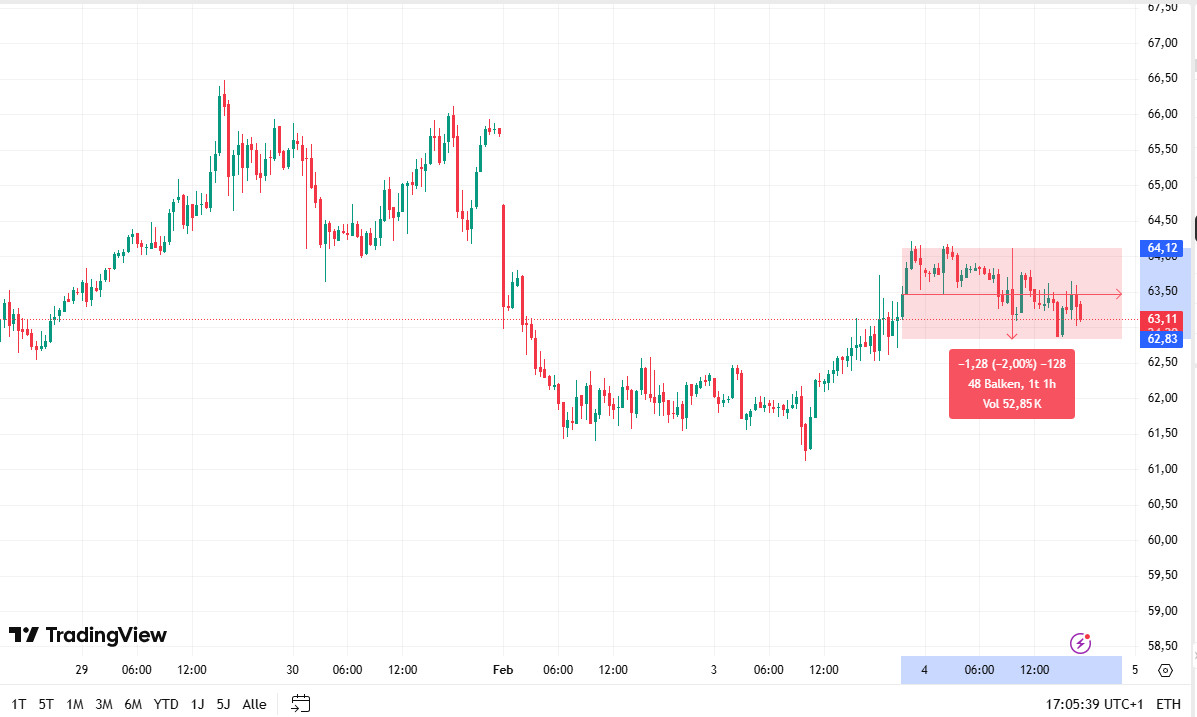
The EIA crude oil inventories fell by -3.455 million barrels (expected -2 million). This is a clear bullish impulse (less supply), but refinery utilization and gasoline production were slightly declining. Brent and WTI cannot benefit from this and continue to move within their narrow daily range at around 67.30 and 63.10 USD per barrel respectively.
Crude oil remains within the narrow price range even after actually positive data | Chart source: TradingView
Precious Metals: Gold Below $5,000
Gold has fallen back below the $5,000 mark after the data and is struggling there with technical weakness. The combination of a firmer dollar and dampened rate cut expectations (after PMIs) continues to weigh. Silver shows similar dynamics. Volatility remains high – if the price cannot sustainably overcome the resistance at $5,000, this could trigger further selling pressure. Especially if the current support in the 4,900 USD area does not hold.
Indices: Mixed, Dow Slightly Positive
The US indices are uneven: The Dow is trending slightly positive (+0.22 %), while S&P 500 (-0.43 %) and Nasdaq (-0.78 %) are in the red. Sentiment remains fragile – positive PMI signals support, weak ADP data and firmer dollar brake. The S&P 500 is fighting around the 7,000 mark.
Conclusion
The market continues to show nervousness: ADP disappoints, PMI hold up, oil inventories bullish but without price effect. Gold below $5,000, indices mixed, cryptos sideways. The direction depends on the next impulses (Nonfarm Payrolls tomorrow, geopolitical situation). Anyone who wants to follow prices live on PC or smartphone will find a neutral overview here of established platforms that cover almost the entire range of assets – with the right platform, react quickly to surprising data: To the Trading Platform Overview.
The US non-farm payrolls data published today failed to fulfil analysts' expectations. The unemployment rate also rose by 0.1% to 3.9%. While the US dollar is experiencing pressure, stocks and indices are benefiting from developments on the US labour market.
The figures in today's report on the labour market in the United States show that it may be less robust than the Fed announced after its meeting last Wednesday. Although the forecast of 180,000 new jobs created was already considerably more modest than in previous months, the actual figure of only 150,000 new jobs was significantly lower. At the same time, the previous month's figure had to be revised downwards by 39,000 jobs. Expectations for average hourly wages and weekly working hours were also not met. The only sector that was able to create new jobs was the public sector, with 51,000 new positions. In industry, on the other hand, 35,000 jobs were lost.
The US dollar came under pressure following the publication of the data and is currently trading around the 1.07 mark against the euro. US indices, on the other hand, reacted positively to the figures and were able to extend their recovery following the publication. The poor figures from the labour market are clearly diminishing fears of a further interest rate hike by the US Federal Reserve, as they can be seen as a sign that high interest rates are having an increasingly negative impact on the economy.
Yields on US Bonds are also continuing to fall, which could have a positive impact on the stock market. In recent weeks, they have often been blamed for the fall in share prices, as many investors have fled from riskier shares in favour of safe bonds with high yields. Despite the poor figures, the US economy can still be considered relatively stable. However, they are an important indicator that the Fed's cycle of interest rate hikes may have come to an end.
After yesterday's correction phase, the markets are showing a slight recovery on Tuesday morning. Precious metals and cryptocurrencies are struggling with resistance levels, while US indices are trending somewhat firmer again. The dollar remains stable. Here is an overview of the most important developments.
Precious Metals: Recovery, but Resistance at $4,900 / $86
Gold has recovered after yesterday's low and is currently trading around the $4,900 mark (spot & futures). From yesterday's daily low, the price has gained around 5–6 %, but is hitting exactly here a technical resistance (former intraday high and round number). A sustainable break above could end the correction and revive the uptrend. If the price stays below, a further test of the 4,800–4,850 zone is threatened.
Silver shows a similar picture: Currently around $86, after a strong rebound from the low. Here too there is a resistance (former high and Fibonacci level) that is currently braking the price. Silver remains more volatile than gold and reacts more strongly to dollar movements and risk appetite.
Cryptocurrencies: Bitcoin Fails at $79,000
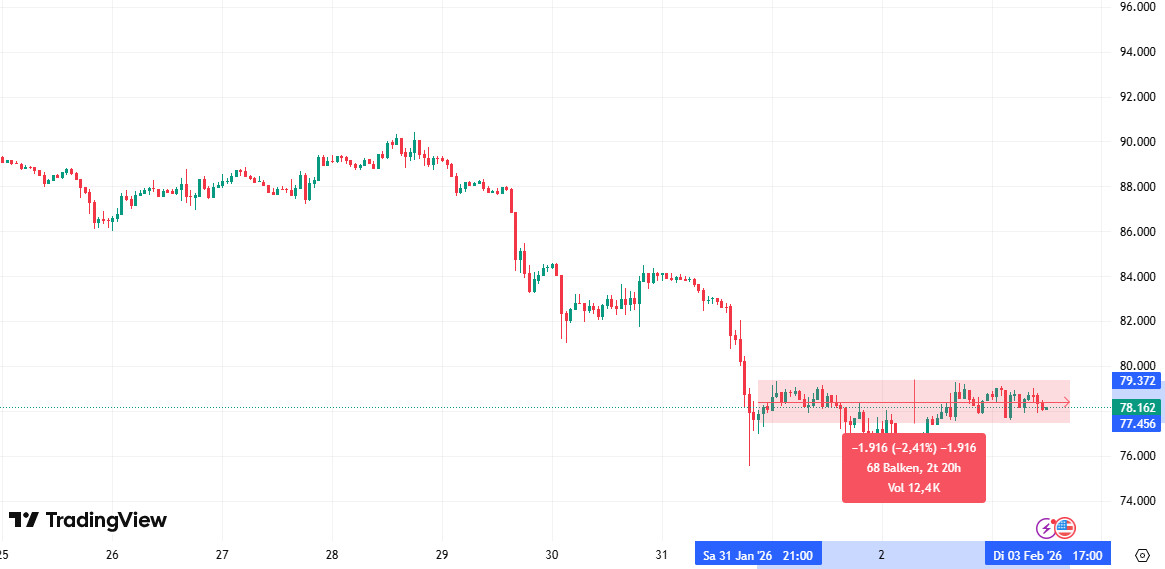
The crypto market is moving predominantly sideways. Bitcoin is currently trading at around $78,100 and has not yet been able to sustainably overcome the $79,000 mark. After yesterday's pullback, BTC has gained a bit again, but remains in a narrow range (77,000–79,000 USD). Ethereum and larger altcoins show similar patterns – no clear direction, rather waiting. The correlation to stocks is still high, which is why a firmer US stock market could also support cryptos.
Bitcoin is currently unable to break out of the range and is searching for its direction | Chart source: TradingView
US Indices: Pre-Market Back Above 7,000 Points
The major US indices are trending slightly positive again this morning after yesterday's light minus. The S&P 500 is in pre-market at around 7,012 points and thus back above the important 7,000 mark. Nasdaq and Dow show similar recovery tendencies. Sentiment is still fragile – the market is waiting for new impulses from data or news. As long as no negative surprises come, the zone 6,900–7,000 could hold as short-term support.
Dollar stable – EUR/USD just above 1.18
The US Dollar Index (DXY) remains stable and is currently trading around 97.17. Against the euro (EUR/USD ~1.1850), the dollar has held its position. The stabilization comes after yesterday's PPI data and Fed hawkishness – a firmer dollar burdens commodities and risky assets, but indirectly supports US stocks.
Conclusion
The market remains nervous, but shows first signs of stabilization: Precious metals and cryptos recover slightly, but hit resistance, while the indices climb back above important marks. The dollar holds. The direction of the markets depends heavily on the next impulses (data, news, geopolitical situation). Anyone who wants to follow prices live on PC or smartphone will find a neutral overview here of established platforms that cover almost the entire range of assets: To the Trading Platform Overview.
The most important indices on the global stock exchanges developed positively today after the interest rate decision of the US Federal Reserve. The German leading index DAX was able to overcome the 15,000 point mark again.
After the US Federal Reserve left interest rates unchanged for the second time in a row at yesterday's meeting, the indices were able to continue the recovery they had begun yesterday with significantly more momentum. The DAX, for example, began today's trading session in Frankfurt above the important 15,000 point mark. The index is currently up around 213 points or 1.40 %. The most important US indices are also posting significant gains in pre-market trading. As yesterday, the Nasdaq is leading the way with a current increase of over 1.50 %, followed by the S&P 500 with a gain of around 1.00 % and the Dow Jones with a price increase of around 0.65 %.
Fed Chairman Jerome Powell made it clear at yesterday's press conference that the Fed's inflation target of 2% should be achieved definitely. But even though this did not explicitly rule out a further interest rate hike, investors seem to assume that the peak of interest rate hikes has been reached due to the economic development. Another reason for the emerging optimism could be that Powell took a side swipe at the US Treasury in a remark. The reason for this is probably the current high bond rates of around 5%, which are strongly influenced by the actions of the Department. At the moment, it still looks as if the positive trend will continue. At least until tomorrow, Friday, when the next important figures on the US economy will be published in the form of labour market data.
The markets are showing clear risk aversion on Monday morning. Precious metals and cryptocurrencies are correcting strongly, US indices are trending negative overnight, while the US dollar is stabilizing again. Here is an overview of the most important developments.
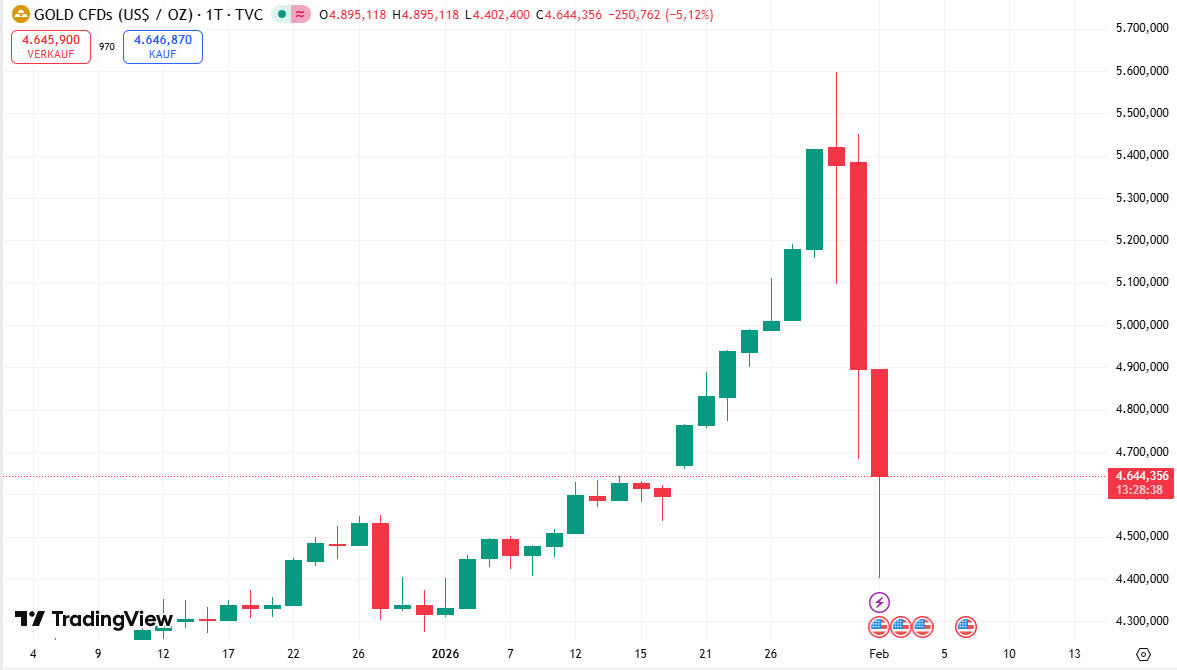
Gold: Massive Pullback to $4,600
Gold has experienced a very pronounced correction in the last hours. From the recent high area, the price has fallen to currently $4,638 (– approx. 18 % from the all-time high a few days ago), with the current daily low already reaching $4,423.20. The decline appears dynamic and is driven by several factors:
Stabilization of the US dollar (DXY back above 97)
Subsiding acute geopolitical premium after recent news situation
Technical overextension after the extremely rapid rise in January/February
Gold is currently fighting around the zone 4.550–4.600 USD. Holding above the mark could initiate stabilization, a break below could bring the next support at 4.400–4.500 USD into play. Volatility remains very high.
A look at the gold chart shows the drama of the crash | Chart source: TradingView
Silver: Parallel Development – Below $75
Silver shows an almost identical pattern to gold, only with even higher amplitude. Current price: **$74.35** (– approx. 38 % from the recent high area). Silver suffers from the same drivers as gold (dollar strength, risk aversion), but is additionally burdened by its industrial demand. The support zone is currently at 72–75 USD. A break below would activate the next larger zone at 65–70 USD. Silver remains significantly weaker than gold and shows a classic „high-beta“ reaction to the overall market.
Cryptocurrencies: Bitcoin Below $77,000
The crypto market is also correcting massively. Bitcoin is currently trading at $76,711 (– approx. 15–20 % from the recent high). Sentiment has clearly clouded since the end of January:
Declining risk appetite after Fed signals
Correlation with stocks and precious metals in risk reduction
Technical overextension (RSI strongly overbought)
Ethereum and altcoins show similar or even stronger declines. The 75,000–78,000 USD zone is now decisive – holding above it could initiate bottom formation, a break could activate $70,000 as the next major mark.
US Indices: Overnight Negative, Pre-Market Slight Stabilization
The major US indices trended negative overnight: S&P 500 currently at 6,885 (– approx. 0.8–1.2 % from Friday's close). Nasdaq and Dow show similar declines. Sentiment is dampened by the combination of Fed hawkishness, PPI surprise and geopolitical uncertainty. In pre-market, a slight recovery is emerging – the S&P 500 is fighting around the 6,900 mark. As long as no new negative news comes, the zone 6,800–6,900 could hold as short-term support.
Dollar Finds Hold Again
The US Dollar Index (DXY) has recovered after yesterday's losses and is currently trading at 97.17. Against the EUR (~1.1850), the dollar has consolidated its position. The inflation impulse from PPI and the dampened expectations of quick rate cuts give the dollar short-term tailwind.
Conclusion
The market continues to show high nervousness. Precious metals and cryptos correct significantly, the indices trend negative, only the dollar can stabilize. The current phase is characterized by high uncertainty – any new impulse (geopolitical news, data, Trump statements) can lead to strong swings. There is currently a kind of „holding pattern“. Anyone who wants to follow prices live on PC or smartphone will find a neutral overview here of established platforms that cover almost the entire range of assets – with the right platform always at hand in volatile markets: To the Trading Platform Overview.
Ahead of today's upcoming interest rate decision by the US Federal Reserve, the major US indices are able to record moderate gains. Investors expect the Fed to leave interest rates at their level for the second time in a row.
The current gains show the cautious optimism that prevails among investors. The technology-heavy Nasdaq is benefiting most from this, currently up around 0.60 %. The rise in blue chips is somewhat more restrained, but the Dow Jones is currently up almost 0.40 % and the S&P 500 almost 0.50 %.
That the Fed will leave interest rates unchanged is considered relatively certain before the FOMC meeting. However, there is uncertainty about what tone will be adopted in the published statement on the interest rate decision and at the subsequent press conference with Fed Chairman Jerome Powell. In its statement after its last meeting, the Fed had not ruled out the possibility of another rate hike before the end of the year. However, it made this very dependent on the state of the US economy and the development of inflation in the US.
So market participants will be listening to every word in New York today. If the tone turns out to be more conciliatory today, the indices could at least moderately continue the recovery they have started. If the Fed maintains its hawkish tone, the lean period for investors is likely to continue for a while.
The US Producer Price Index (PPI) for December came in significantly stronger than expected: YoY +3.0 % (expected 2.7 %), MoM +0.5 % (expected 0.2 %). This is a clear inflation impulse that further reinforces the dampened rate cut expectations from the previous day. The market is reacting promptly: Gold continues to correct, the dollar stabilizes slightly, and the indices oscillate nervously.
Gold and Silver Fighting for Important Levels
Gold has corrected sharply from yesterday's high of around $5,626 and is now fighting around the $5,000 mark after the PPI data (currently ~$5,015–5,050, –10 % from the high). Silver is similarly affected – from the high area around $120 it fell below $100 and is now trading just below it. Both metals are showing clear consolidation after the previous overbought condition, with possible support zones around $5,000 (gold) and $100 (silver).
USD Stabilizes
The US Dollar Index (DXY) has slightly gained on the PPI data and is stabilizing at around 96.50–96.70. Against the EUR (EUR/USD ~1.19), GBP and Yen, the dollar has partially made up for yesterday's losses – the basic tendency remains weak, but the inflation impulse gives it short-term support.
The EUR/USD rate is currently consolidating just above 1.19 and waiting for new impulses. | Chart source: TradingView
Indices Under Pressure – Slight Recovery
The major US indices (S&P 500, Nasdaq, Dow) were initially in the red after the PPI release, but are partially recovering in pre-market (S&P 500 +0.1 to +0.3 %). Sentiment remains fragile – a PPI confirming inflation pressure dampens risk appetite, but the robust US economy is preventing a real sell-off so far.
In Europe, the indices are initially friendly after market open on the last trading day of the week. The DAX is currently (10:00 CET) showing a gain of around 0.89 % and the Euro Stoxx 50 a gain of 0.65 %.
Conclusion
The entire market continues to show high nervousness. Gold and silver correct sharply, the dollar stabilizes for now, and the indices oscillate between pressure and slight recovery. Any new impulse can lead to significant swings up or down. There is currently still a kind of „holding pattern“ – the direction will probably only become clear with the next important data points.
Anyone who wants to follow the market and prices live on PC or smartphone will find a neutral overview here of established platforms that cover almost the entire range of assets: To the Trading Platform Overview.
The situation in the conflict between Israel and Hamas seems to be escalating. The IDF began attacking targets in Gaza with ground troops and tanks on Saturday. Fears of a major escalation could drive up oil prices.
Oil prices initially showed the urge to go up after the Hamas attack on 7 October. Thus, WTI briefly rose to over 89 US dollars per barrel at the peak and Brent reached the 92 US dollar mark. However, when it became clear that the Israeli forces would not launch a quick offensive into the Gaza Strip, oil prices fell back somewhat and are currently hovering around $84 and $88 respectively.
Fear of oil supply collapse
On Saturday night, the IDF has now intensified its attacks and has advanced with ground troops into the north of the Gaza Strip. If this is the beginning of the announced offensive, there is a danger that Hezbollah will open a second front from Lebanon and possibly even a third front also from Syria. In this case, it is to be expected that US troops will intervene more strongly in the conflict on the ground. This is to be expected in particular because various US bases in the region have already been attacked by drones. An escalation is likely to intensify these attacks and force the US to act.
Since Iran, which is not officially involved but which supports both Hamas and Hezbollah in the background, could increase its role in the conflict, there is a risk of a conflagration. This threat could significantly increase fears of a significant drop in oil supply and send oil prices northwards again. In this case, it cannot be ruled out that WTI will exceed the $90 per barrel mark quite quickly and Brent will strive towards $100 per barrel.
US President Donald Trump has nominated Kevin Warsh as successor to Jerome Powell for the position of Fed Chair. The announcement came surprisingly early and immediately moved the markets. Gold and silver are correcting sharply, the dollar is stabilizing, while the indices initially came under pressure.
Gold and Silver Under Pressure
Gold has corrected sharply from yesterday's all-time high of around $5,626 and is currently trading at about $5,100 (–3.7 %). Silver has given way similarly strongly – from the high area around $120 it fell below $100 (–9–10 %), now fighting around this mark. Both metals initially found support in the zone around $5,150 (gold) and just above $100 (silver), but show clear uncertainty after the previous overbought condition.
Why Warsh is considered hawkish
Kevin Warsh, former Fed Governor (2006–2011), is considered rather hawkish in monetary policy. In the past he has advocated a tighter stance, criticized the strong expansion of the Fed balance sheet and warned of inflation risks. While he has been more open to lower interest rates in recent times, many observers see in him a candidate who tends toward more restrictive policy rather than aggressive cuts. That would mean: longer higher interest rates, stronger dollar potential, less liquidity – classic headwind for gold and other commodities.
Market Reaction
The US Dollar Index (DXY) has gained on the news and is stabilizing at around 96.50–96.60. The US indices (S&P 500, Nasdaq, Dow) initially slipped into the red, but are partially recovering in pre-market. The announcement is interpreted as a signal for a more independent, but potentially tighter Fed policy – which dampens risk appetite.
Conclusion
The nomination of Kevin Warsh creates new uncertainty and nervousness. After Trump's statements about a potentially weak US dollar, the exact opposite was certainly expected from Kevin Warsh. Gold and silver, which benefited significantly from Trump's dollar statement a few days ago, are now correcting sharply, the dollar remains stable and the indices are oscillating. The market is now waiting for further details on confirmation. Any new impulse could lead to strong swings. Anyone who wants to follow the market and prices live on PC or smartphone will find a neutral overview here of established platforms that cover almost the entire range of assets: To the Trading Platform Overview.
Risk Warning: Trading CFDs and other leveraged financial products on margin and derivatives always involves a high degree of risk. There is a possibility of losing all or part of your invested capital. Therefore, these products may not be suitable for all investors. Please ensure that you obtain detailed information on these products and/or consult an independent financial advisor.
The website operator may be remunerated by advertisers on this website based on your interaction with the advertisements or advertisers.
Disclaimer: The authors' assessments of market behaviour contained on this website do not constitute financial advice or a solicitation or recommendation to buy or sell financial products, but are merely a personal assessment. If you incorporate the author's assessment into your decision, you do so entirely at your own risk. If you trade in financial products, you must be aware that you may incur a loss of up to the amount of your entire investment. Actively familiarise yourself with trading and the characteristics of the instruments, especially leveraged derivatives, and/or seek independent advice before investing your own money and only use capital that you can afford to lose.