
Global financial markets reacted sharply on Friday afternoon following the release of the latest US labor market data. The Nonfarm Payrolls (NFP) report came in significantly weaker than forecasts, triggering immediate selling pressure in equity markets.
Major stock indices in the United States and Europe moved lower after the release, while traditional safe-haven assets such as gold and the US dollar showed only brief strength.
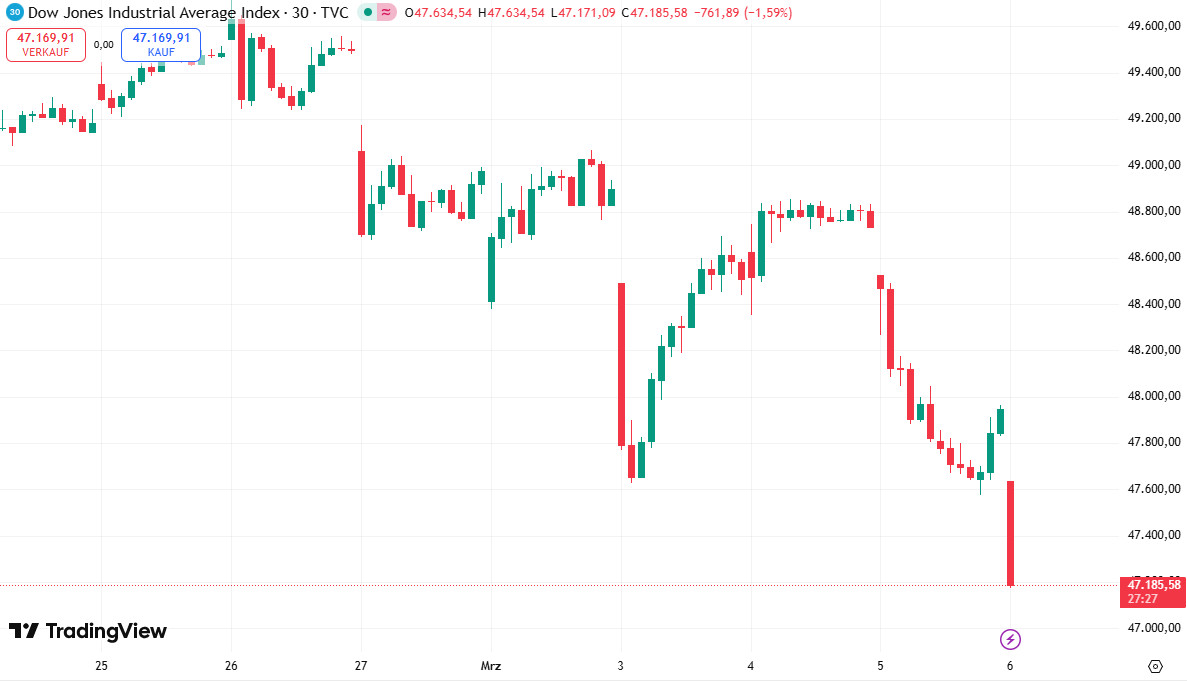
Stock markets react negatively to labor market data
After the release of the data, the major equity indices declined noticeably. Market participants interpreted the weaker employment numbers as a potential signal of slowing economic momentum in the United States.
The US labor market is considered one of the most important indicators of economic activity and also plays a central role in the monetary policy decisions of the Federal Reserve.
As a result, markets tend to react sensitively to unexpected deviations from forecasts. The S&P 500 fell below support near 6,735 points, while the Dow Jones is currently down around 1.6% at 47,190 points. Germany’s DAX has also extended its losses and is trading near 23,400 points, down roughly 1.6%.
Gold and US dollar only briefly in demand
In commodity and currency markets, the initial reaction followed a typical pattern for weaker economic data. Gold prices briefly moved higher, while the US dollar also saw an initial uptick.
However, this momentum faded quickly. So far, neither market has shown a pronounced safe-haven move despite the pressure on equities. The EUR/USD pair is currently trading at 1.1552, down 0.47%, while gold is up around 0.4% at 5,098.
This may indicate that investors do not yet interpret the latest data as a clear signal of a significant economic slowdown.
Why the NFP data came in weaker
The surprisingly weak labor market report could be attributed to several factors. In addition to potential signs of moderate cooling in the US labor market, temporary effects may also have played a role.
For example, strikes in certain industries or weather-related disruptions in sectors such as construction or transportation can temporarily distort monthly employment figures.
Additionally, labor market data are regularly revised once more complete datasets become available, meaning individual monthly figures can change significantly after the initial release.
Oil prices remain elevated due to Middle East tensions
While equity markets reacted to the economic data, oil prices remain elevated due to rising geopolitical tensions in the Middle East.
Reports of further military activity involving Iran and neighboring Gulf states continue to raise concerns about potential disruptions to global energy supplies. Officials in Qatar have reportedly warned that oil production in the Persian Gulf could be severely disrupted within weeks if the conflict escalates further.
US crude oil (WTI) has now broken above the technical resistance seen earlier in the day and is currently trading between 85 and 86 USD per barrel. Brent crude has also moved higher and is approaching the 84–85 USD per barrel zone.
Bitcoin also comes under pressure
The cryptocurrency market is also showing signs of weakness. Bitcoin fell below the 69,000 USD mark following the market reaction to the US labor market data.
The move erases part of the gains seen in recent days and pushes the cryptocurrency further away from the previously closely watched 73,000 USD level.
This development highlights that the crypto market is currently sensitive to macroeconomic shifts and is showing a stronger correlation with movements in traditional financial markets.
Focus remains on Federal Reserve policy
For investors, the key question now is how the new labor market data will be interpreted within the broader macroeconomic context.
The condition of the US labor market is considered a crucial factor for future interest rate decisions by the Federal Reserve. If additional economic indicators also weaken in the coming weeks, this could influence expectations regarding the Fed’s monetary policy path.