



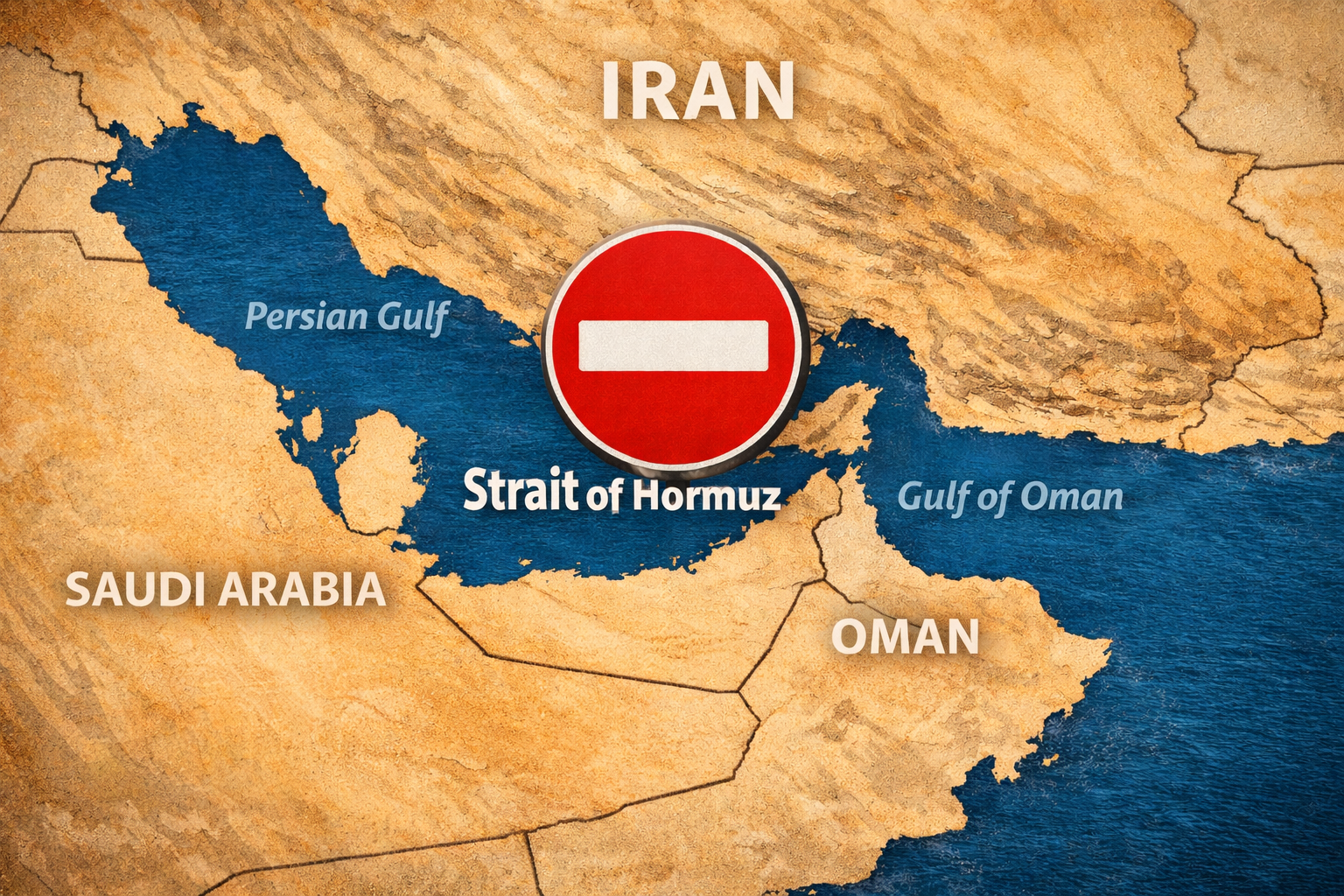
Financial markets are starting the new week relatively composed, even though the geopolitical situation has clearly intensified. Following the breakdown of negotiations between the United States and Iran and the announcement of a blockade on Iranian oil exports by the United States, market participants are now focusing on the start of the measure, which is scheduled to take effect at 10:00.
Oil reacts, but remains notably restrained
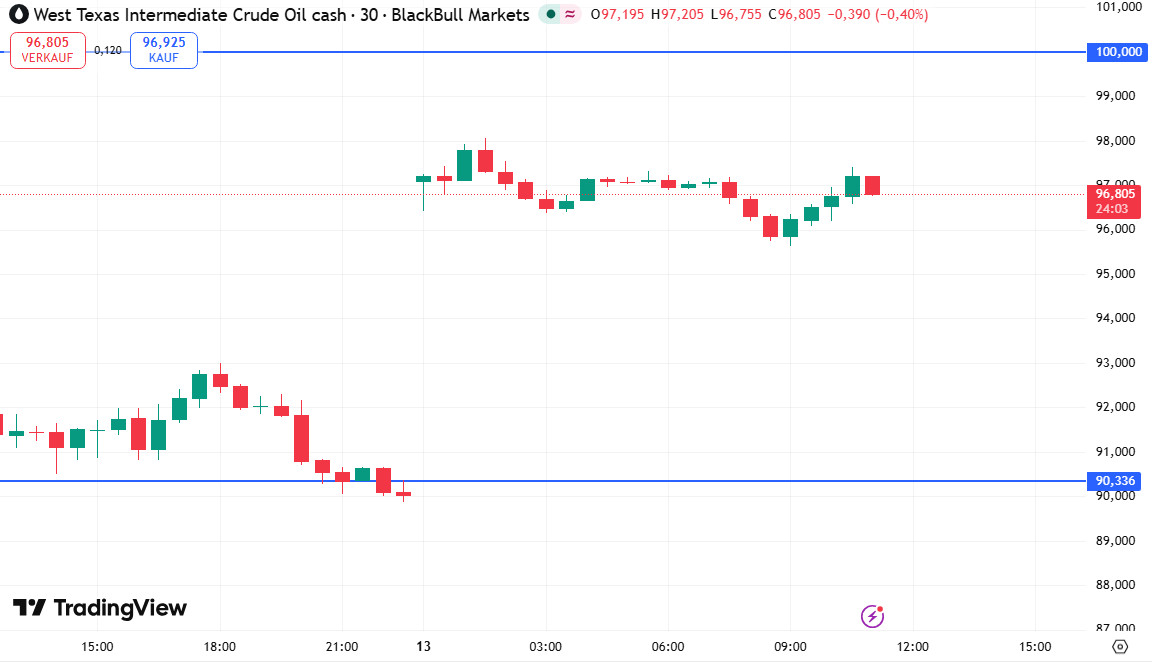
What stands out above all is the market reaction: Despite a potentially affected share of around 20–25% of global oil trade, a move above the 100 US dollar mark has so far failed to materialize. Oil prices did rise, but remain clearly below the levels that had been discussed as possible escalation scenarios before the negotiations began. WTI briefly rose to 98.13 US dollars per barrel on the spot market, while North Sea Brent only briefly reached 100.19 before immediately falling back below the 100 US dollar mark.
Equity market shows slight recovery
At the same time, equity markets already showed a slight recovery in pre-market trading after having started the new trading week significantly lower. Overall, the reaction is noticeably less hectic than during the broader course of the conflict and in the days before the negotiations, when even the mere possibility of escalation led to noticeable risk premiums at times.
The German DAX is currently recording a loss of around 1.22% at 23,563 points, after a daily low of 23,502 points. The Euro Stoxx 50 is currently trading 1.05% lower, while the French CAC 40 is down around 1.10%.
A look at US index futures shows that they are also trading lower in pre-market trading, although losses remain relatively moderate so far. Futures on the Dow Jones are currently down around 0.49%, the S&P 500 by 0.61%, and the Nasdaq 100 is the biggest loser with a decline of around 0.72%.
Dollar stronger and gold searching for direction
The US dollar started the trading week stronger, not least due to the prospect of rising oil prices. Although it has given back part of its initial gains, it is still up around 0.25% against the euro at 1.169. A similar picture can be seen against the Japanese yen, which at 159.66 is currently losing around 0.24% against the US currency.
The gold price fell sharply to around 4,670 US dollars per ounce after the breakdown of US-Iran negotiations. Due to the unclear situation as to whether the escalation will actually be implemented, it has since recovered and moved back above the 4,700 US dollar mark. Gold is currently trading at around 4,731 US dollars.
Bitcoin holds above 70,000 US dollars
Bitcoin and altcoins are also recording losses due to the changed situation in the Persian Gulf. Bitcoin is currently down around 1.33%, but remains above the important 70,000 US dollar mark at 70,665 US dollars.
The situation is similar for Ethereum. The second-largest cryptocurrency by market capitalization is currently down around 1.41% and is trading at 2,182 US dollars. On a weekly basis, however, both cryptocurrencies are still showing gains: BTC +2.31% and ETH +2.23%.
Assessment and outlook
At first glance, this behavior appears contradictory. A blockade in the region around the Strait of Hormuz affects a central hub of global oil trade and carries the potential for significant supply disruptions. Nevertheless, the market does not currently appear to be pricing in an immediate worst-case scenario, but rather a combination of limited disruption, possible rerouting of supply flows, and continued uncertainty regarding the actual implementation of the measures.
Oil prices received additional support from a new threat from Tehran. Iran stated that in the event of a threat to its own ports, no port in the entire region would remain safe. The statement points to a possible expansion of tensions beyond the Strait of Hormuz.
However, this has so far only led to a moderate counter-movement in the market after prices had previously eased slightly. A clear escalation premium has therefore not yet emerged, suggesting that market participants are still waiting for concrete disruptions in physical oil flows.
The threat itself remains conditional. While the United States is initially targeting Iranian oil exports through a blockade and has so far not announced any direct attacks on ports, Tehran is explicitly linking an expansion of tensions to the event that its own port infrastructure is threatened.
This distinction may be one reason why the market is acknowledging the statements but is not yet pricing in immediate escalation.
Iran threatens infrastructure in neighboring states
With the latest threat from Tehran, another risk is moving into focus for the markets: a possible expansion of tensions to infrastructure across the entire Persian Gulf. Iran stated that if its ports are threatened, no port in the region would remain safe.
Such a scenario would go far beyond a disruption of shipping through the Strait of Hormuz. During earlier phases of the conflict, there have already been attacks on energy facilities and critical infrastructure in several Gulf states, underlining the vulnerability of the entire region.
For the oil market, such a development would have far-reaching consequences. In addition to possible disruptions to production and exports, uncertainty regarding the safety of transport routes and loading ports would increase significantly. This would extend the risk beyond individual routes to the entire regional energy system.
At the same time, it remains unclear whether such an escalation will actually occur. The threats are still conditional and have therefore been interpreted cautiously by the market.