
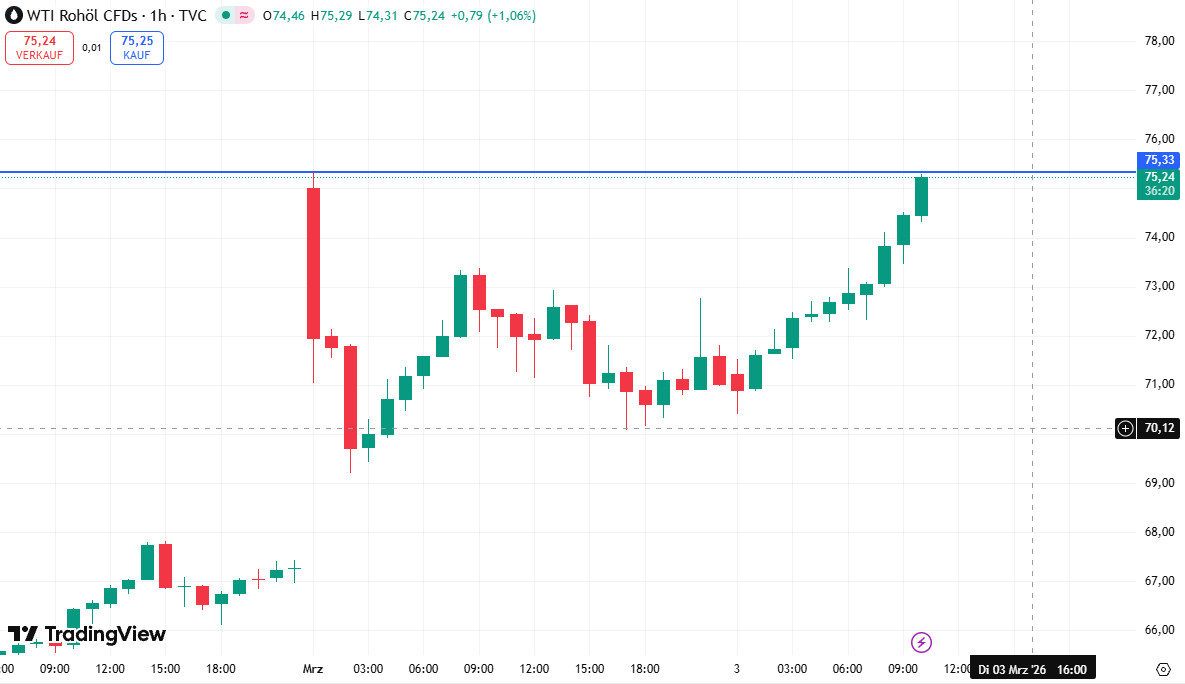
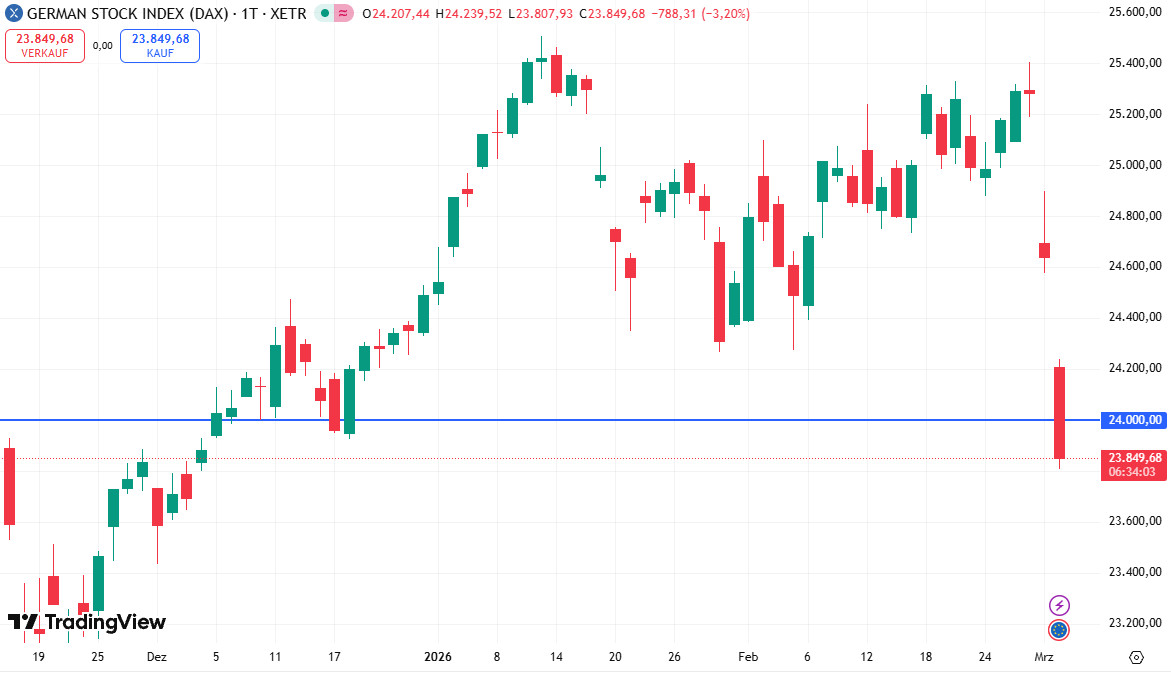
Markets are reacting sharply this morning: WTI crude oil is trading above 74 USD, European indices are under significant pressure, Germany’s DAX is down more than three percent, and the Nikkei closed with steep losses. At the same time, the US dollar is strengthening, while EUR/USD has slipped toward the 1.16 area.
What stands out, however, is that no new military escalation was reported overnight. The Strait of Hormuz had already been under restrictions, and no fresh headlines indicating immediate intensification have emerged. Why, then, are markets reacting more aggressively today?
The answer lies less in a new phase of escalation and more in the growing pricing-in of a prolonged risk scenario.
Markets React Not Only to Events – But to Probabilities
Financial markets do not assess only current events; they primarily evaluate potential consequences. If a geopolitical conflict does not de-escalate quickly, the probability of tangible economic impacts increases with each passing day.
In the current environment, this implies:
- Persistent uncertainty regarding energy supply stability
- Market participants factoring in extended shipping disruptions
- Potential increases in insurance premiums and transportation costs
The longer diplomatic progress remains absent, the more the risk premium expands – particularly in the energy sector. Oil prices therefore respond not only to actual supply disruptions but also to the rising probability that such disruptions could materialize.
This helps explain why WTI is not merely spiking briefly but sustaining gains above technically relevant levels.
Oil: Risk Premium Rather Than Demand Surge
The current move is not driven by a classic demand impulse. Instead, it reflects a geopolitical risk premium.
As long as tensions surrounding the Strait of Hormuz persist, the scenario of constrained supply remains embedded in market pricing. Even without a complete shutdown, uncertainty alone is sufficient to trigger hedging flows.
A breakout above the 73 USD resistance level – trading at 74.75 USD at the time of writing – further reinforces technical momentum as stop orders are triggered and trend-following strategies become active.
Equity Markets: Oil as a Pressure Factor on Margins and Inflation
While energy stocks may benefit from rising prices, broader indices tend to react sensitively to higher commodity costs.
A persistently elevated oil price implies:
- Rising input costs for corporations
- Potential pressure on profit margins
- A renewed inflationary impulse
In an environment where monetary policy remains sensitive to inflation dynamics, sustained oil strength adds another layer of uncertainty regarding future rate expectations.
Markets discount such risks early. This helps explain why equity indices are reacting more forcefully than a single headline might suggest. What we are observing is a reassessment of the broader macroeconomic risk profile.
Equity Indices: Futures Signal Broad Risk Aversion
A look at index futures highlights clear risk aversion: US index futures are trading notably lower, while European and Asian benchmarks are recording even steeper losses. Germany’s DAX has fallen below the 24,000 level after trading above 25,300 as recently as Friday.
US futures are also under pressure, with Dow Jones futures down 1.60% and S&P 500 futures lower by 1.70% in pre-market trading. The comparatively sharper declines in European and Asian markets indicate that global risk sentiment is broadly deteriorating.
This pattern suggests that the move is not confined to individual sectors but reflects an adjustment in overall positioning. Rising energy costs weigh on earnings expectations, while macroeconomic uncertainty prompts portfolio rebalancing. Futures serve as early indicators of how regular US trading may unfold.
These equity signals align with other risk indicators, including US dollar strength and increased volatility in digital assets, reinforcing the current risk-off environment.
Bitcoin Tests 70,000 USD – Risk Asset Under Pressure
The cryptocurrency market is also showing elevated volatility. Bitcoin briefly tested the 70,000 USD level overnight before retreating toward the 67,000 USD area.
While Bitcoin is sometimes discussed as an alternative store of value, periods of pronounced risk aversion often reveal its correlation with broader risk assets. The recent pullback suggests that investors are prioritizing liquidity and reducing overall risk exposure.
Currency Markets: US Dollar Benefits from Risk-Off Flows
The US dollar is strengthening alongside the broader shift in sentiment. During periods of heightened uncertainty, capital typically flows into highly liquid reserve currencies.
The dollar benefits from:
- Its status as the world’s primary reserve currency
- Deep and liquid capital markets
- Relative interest rate dynamics
The move in EUR/USD toward the 1.16 level reflects not only dollar strength but also a broader shift toward defensive positioning.
Why the Reaction Is Intensifying Now
Geopolitical market reactions often unfold in phases:
- Initial shock response
- Assessment of potential economic impact
- Positioning adjustments if de-escalation fails to materialize
Current price action suggests markets are entering the third phase. Institutional investors appear to be adjusting risk exposure as the probability of a prolonged conflict scenario increases.
It is not a new escalation driving markets today, but rather the growing likelihood that tensions will not ease quickly.
Outlook: News Flow Remains the Key Catalyst
Incoming headlines will likely continue to dominate price action in the coming sessions. Key factors include diplomatic developments, shipping activity in the Middle East, and further movements in energy markets.
If tensions remain unresolved, the embedded risk premium may persist. Conversely, clear signals of de-escalation could trigger sharp counter-movements across asset classes.
Today’s market action illustrates a central principle: Markets are driven not only by events, but by their duration and the probabilities investors assign to future outcomes.