
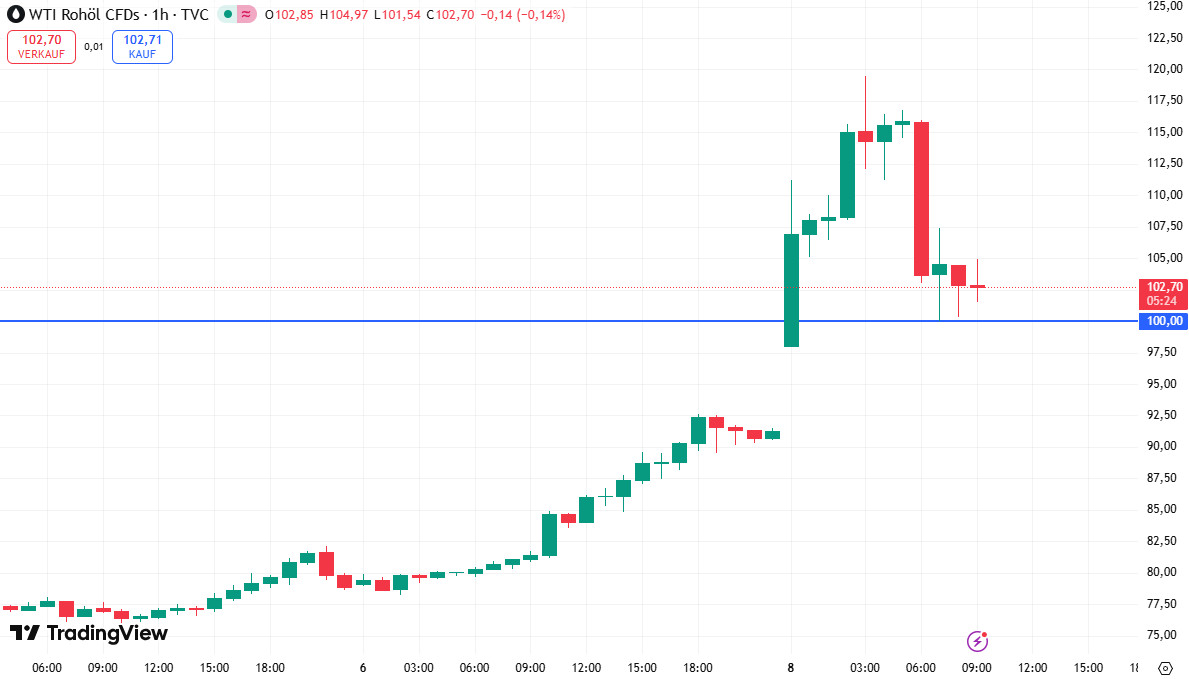
Oil prices rose above the $100 per barrel mark at the start of the week. The move is causing nervousness in financial markets. Major indices in Asia came under pressure, and the trend is continuing in Europe. Just minutes after trading began, Germany’s benchmark DAX index fell below the 23,000-point mark.
Oil prices rise after attack on Iranian oil infrastructure
The latest market movements are being driven by rising oil prices. The background could be geopolitical tensions in the Middle East following reports that Iranian oil infrastructure was attacked by Israel.
Crude oil prices reacted sharply at the start of the week. The US benchmark WTI (West Texas Intermediate) is currently trading at around $101 per barrel. Brent crude from the North Sea has climbed to about $107.
Rising energy prices are often seen as a risk factor in financial markets because they could fuel inflation and weigh on economic growth.
Asian markets fall sharply
The biggest losses at the start of the week were seen in Asia. Japan’s benchmark Nikkei 225 closed down 5.24 percent, or roughly 2,913 points.
Investors had already reacted during the Asian session to the geopolitical tensions and rising energy prices.
Losses continue in Europe
Negative sentiment is also continuing in Europe at the start of trading. Germany’s benchmark DAX index is currently down around 2.6 percent and has fallen below the 23,000-point mark.
Markets are not only being weighed down by rising energy prices. Weak economic data from Germany are also adding pressure. According to the latest figures, German industrial orders fell by 11.1 percent, significantly more than expected. Economists had anticipated a decline of “only” 4.2 percent. In addition, the previous month’s figures were revised downward by 1.2 percent.
The data are considered an important indicator for economic developments in Germany, the largest economy in the eurozone.
The European benchmark index Euro Stoxx 50 is also currently trading about 2.9 percent lower.
US futures show more moderate losses
Pre-market signals from the United States are somewhat less negative. Futures on major US indices are currently down around 1.5 percent.
This suggests that while market participants are reacting to rising energy prices, they are initially taking a more differentiated view of the situation.
Gold stable – US dollar firmer – Bitcoin returns to downward channel
While stock markets are under pressure, the gold price remains relatively stable. The precious metal is still trading around $5,100.
At the same time, the US dollar is showing strength. The EUR/USD exchange rate is currently stabilizing around 1.15. A stronger dollar can tend to limit gains in gold, since the precious metal is traded internationally in US dollars.
The cryptocurrency market, meanwhile, is showing renewed weakness. The cryptocurrency Bitcoin appears to have ended its previous breakout for now and is moving back within an existing downward channel.
Morning outlook
Developments in financial markets at the start of the week are being driven primarily by geopolitical tensions in the Middle East. The sharp rise in oil prices above the $100 mark is creating nervousness in stock markets and is weighing particularly on equities.
The current situation suggests that markets could remain exposed to increased volatility. The overall direction is likely to depend largely on whether the conflict escalates further or whether signs of de-escalation begin to emerge.