




Financial markets appear surprisingly stabilized following recent geopolitical tensions. While the situation around the Strait of Hormuz had been marked by significant risk premiums in recent days, the current absence of immediate military action is now contributing to a noticeable easing.
One of the triggers for the latest move was a statement by US President Donald Trump, suggesting that Iran remains interested in an agreement. Similar signals in recent weeks had repeatedly triggered short-term recoveries, which, however, later proved to be unsustainable.
Lack of new attacks seen as positive signal
In the current situation, however, a potential difference is emerging: despite the now ongoing blockade of Iranian oil exports and continued mutual threats, there have so far been no confirmed military incidents at sea. There are also currently no reports of new attacks on Tehran or military bases in Iran. As a result, the ceasefire remains stable for now, and immediate escalation is avoided, which markets interpret as a cautiously positive signal.
The key question now is how the situation develops over the next 24 to 48 hours. Observers assume that Iran may use this phase to test the actual enforcement of the blockade at sea without immediately risking open military confrontation.
If no incidents or military clashes occur during this period, it could further support the current market stabilization. At the same time, it remains unclear whether this represents a sustainable de-escalation or merely a temporary phase without immediate military action.
Stock markets firm, but rally not broadly supported
US markets: New highs, but mixed picture
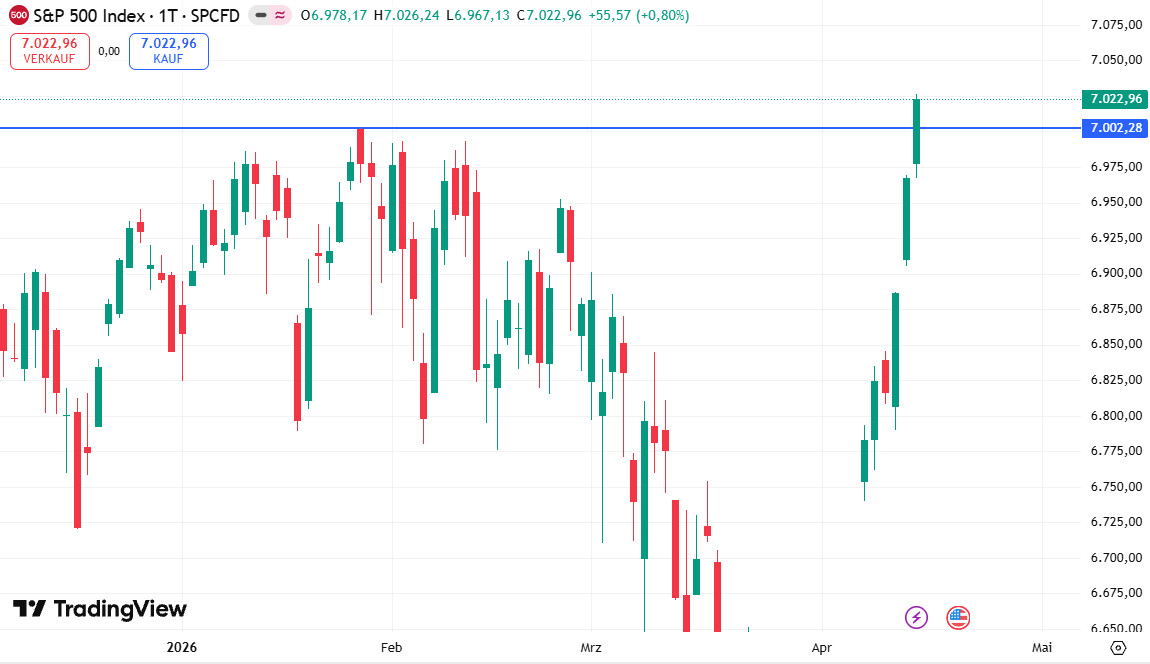
The positive momentum for the trading day comes from the US, where major indices were mostly able to post gains in the previous session. The S&P 500 reached a new all-time high, while the Nasdaq 100 closed just below it. In contrast, the Dow Jones showed weakness and ended the session with a slight loss of 0.15%.
This development suggests that the current upward move is primarily driven by growth-oriented and technology-focused stocks, while traditional industrial and blue-chip stocks are already showing early signs of weakness.
Strong earnings support sentiment
The market is also supported by the ongoing earnings season. In particular, major US banks reported quarterly results that in some cases clearly exceeded expectations, strengthening confidence in the economic outlook. The current rally is therefore not driven solely by geopolitical hopes but is also supported by solid fundamentals.
Europe: Mixed picture despite positive cues
Asian markets largely followed the positive trend overnight and started the trading day higher. In Europe, however, a more differentiated picture is emerging.
While the CAC 40 is currently up around 0.45%, the DAX remains significantly more cautious and is hovering around the flatline.
This divergence suggests less of a unified market impulse and more of a sector rotation. While more defensive and consumer-oriented stocks are in demand in the CAC 40, the DAX is weighed down by more cyclical sectors such as industry and exports. The weaker performance of the Dow Jones provides additional context.
Current price action
In detail, the DAX is currently trading at around 24,100 points, nearly unchanged from the previous day, while the CAC 40 is up approximately 0.45%. The Euro Stoxx 50 is also slightly higher but does not fully match the strength of the French market.
Oil stabilizes – weaker US dollar provides support
After the sharp movements of recent days, the oil market is currently much calmer. Prices are stabilizing below the 100 US dollar per barrel mark, signaling no immediate escalation in the Persian Gulf.
This relative stability is viewed by markets as a supportive factor. While fears of supply disruptions recently led to noticeable risk premiums, the current development suggests that market participants are now assuming a more limited disruption rather than a sustained supply shock.
Oil supported by weaker US dollar
Oil prices are also supported by developments in the foreign exchange market. The US dollar is currently weaker, trading against the euro at around 1.1785. A weaker dollar tends to support commodity prices, as oil is traded in US dollars and becomes cheaper for buyers outside the dollar area.
In the current market environment, these effects reinforce each other: while geopolitical tensions are not signaling immediate escalation, the weaker dollar adds further stability. Oil therefore remains a key indicator of how seriously markets currently assess the risk of further tensions.
Gold above 4,800 US dollars – crypto market consolidates
The gold price remains robust and has once again established itself above the 4,800 US dollar mark. It is currently trading at around 4,832 US dollars per ounce, slightly higher on the day. This development underscores that, despite improved market sentiment, there is still a degree of demand for hedging.
Gold thus reflects the current market environment: while risk assets benefit from hopes of de-escalation, some market participants remain cautiously positioned. The renewed move above 4,800 US dollars can therefore also be seen as a sign that confidence in a lasting easing has not yet been fully established.
Bitcoin consolidates below 75,000 US dollars
The crypto market, on the other hand, is entering a phase of consolidation. After Bitcoin and many altcoins posted strong gains over the past three trading days, momentum is currently limited.
Bitcoin is currently trading at around 74,688 US dollars, remaining below the 75,000 US dollar level, which has increasingly acted as resistance. The broader crypto market is also largely unchanged and is digesting recent gains in a sideways movement.
Overall, the development suggests that markets are entering a stabilization phase after the recent rally. While gold remains in demand as a hedge, the crypto market currently lacks fresh catalysts for further upside.
Hope drives outlook in a fragile environment
Current market movements present an overall constructive picture but are largely driven by expectations. The absence of new military incidents, stable oil prices, and strong corporate earnings support risk appetite and contribute to a noticeable easing in markets.
At the same time, there is still a lack of reliable signals pointing to a sustainable de-escalation. There are no concrete developments in negotiations or a clear shift in the geopolitical situation so far.
This leaves the current trend vulnerable to rapid reversals. Should new tensions arise or hopes for a diplomatic solution be disappointed, sentiment could deteriorate just as quickly as it has recently improved.