
Just yesterday, statements by US President Donald Trump on the Iran conflict fueled optimism across financial markets. Only one day later, renewed comments have shifted sentiment back toward fears of escalation. Oil prices are rising sharply, while stocks are once again coming under increased pressure.
This development once again shows how strongly markets are currently reacting to individual statements. A closer look at the key points of the speech and the subsequent market movements provides insight into the underlying causes.
Key statements from Trump’s speech
The speech had been highly anticipated after the US president had already spoken the day before about a “quick end” and a timeframe of two to three weeks. Based on this, expectations of a near-term de-escalation were not entirely unreasonable, and markets reacted broadly positively. This was also supported by expectations of further clarification in the televised address to the nation later that evening.
Threat despite timeframe
While the two-to-three-week timeframe was confirmed, it was simultaneously combined with a clear threat. Trump suggested that the US could launch a massive attack on Iran within that period and stated that the country could be “bombed back to the Stone Age.”
This immediately weakened the previously established expectation of de-escalation.
Warning of retaliation
Regarding potential retaliation by Iran, he stated that this would only lead to even stronger attacks, saying: “If we see them make a move, even a move for it, we’ll hit them with missiles very hard again.” This explicitly included possible strikes on Iran’s energy and oil infrastructure.
The statement suggests that further escalation remains possible at any time. An attack on Iran’s oil infrastructure could have long-term effects on global supply.
Strait of Hormuz in focus
The most critical statement, which may have contributed significantly to market frustration, concerned the Strait of Hormuz. Trump emphasized that the US is not dependent on oil from the region and suggested that countries that are should take responsibility for securing shipping routes themselves, stating: “Go to the strait and just take it.”
The remark that Iran would reopen the strait once the conflict ends did little to reassure markets, especially given the developments of the past four weeks since the conflict began.
Market participants appear to have interpreted this as a signal that the US may not guarantee the security of this key trade route.
Oil prices rise sharply
The reaction in the oil market is correspondingly strong. After the previous day’s decline, prices are rising again significantly, at times gaining up to 7%.
US crude oil (WTI) is currently trading at around 101.00 USD per barrel, once again moving above the 100 USD mark. Brent crude is trading at approximately 105.70 USD.
The move suggests that market participants are once again pricing in a higher risk premium for potential supply disruptions.
Stocks come under pressure
Rising oil prices and increasing concerns about escalation and possible further disruptions to oil supply are weighing on stock markets. If these risks materialize, higher energy prices could further pressure companies and economic growth.
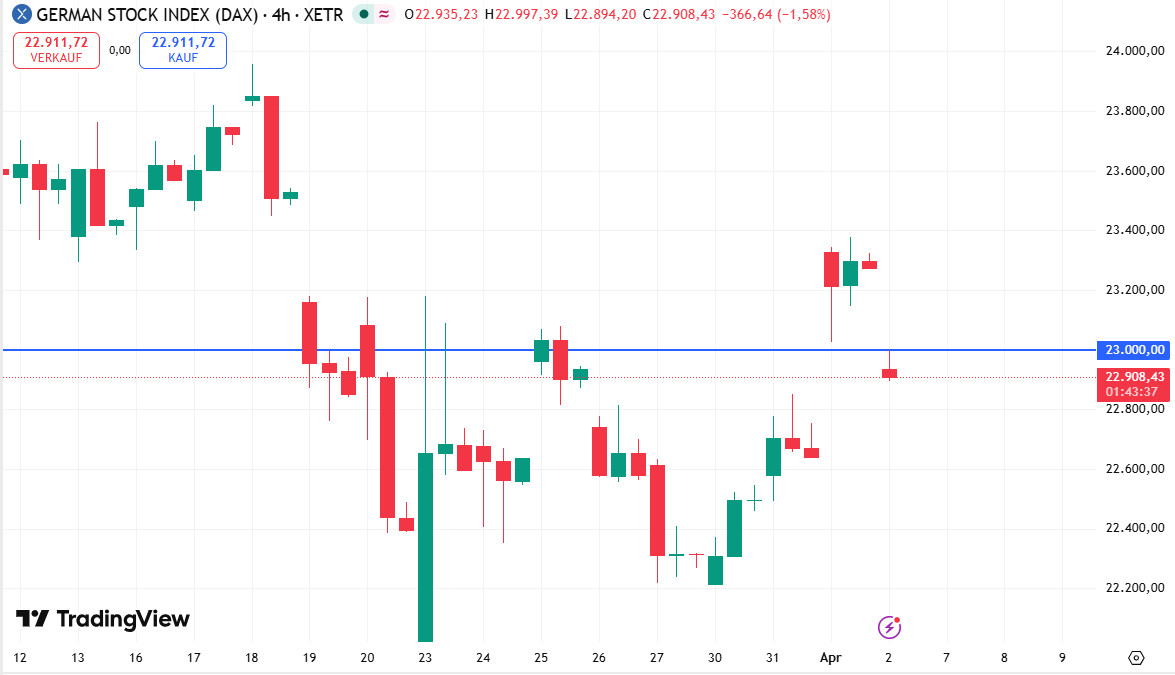
The DAX has given back all of the previous day’s gains and is currently down around 1.30% at approximately 22,968 points. The Euro Stoxx 50 is showing a slightly stronger reaction, falling around 1.70%.
The look at index futures shows that US indices are also expected to open lower. Dow Jones futures are down around 1.18%, while S&P 500 futures are falling by about 1.28% and Nasdaq 100 futures by around 1.61%.
Gold price under pressure from rising yields
The gold price is also under pressure, which could be due not only to rising oil prices but also to higher bond yields.
The yield on 10-year US government bonds rises to around 4.38% amid inflation concerns driven by higher oil prices, increasing the opportunity cost of holding gold.
Gold is currently down around 3.25% and trading at approximately 4,623 USD per ounce.
US dollar gains strength
The US dollar benefits from the situation and is gaining against most currencies. The EUR/USD pair falls back below 1.16 and is currently trading at around 1.1520.
The dollar is also stronger against the Japanese yen. USD/JPY rises to around 159.61, approaching the 160 level again.
Bitcoin and altcoins decline
The crypto market is also seeing losses, although they remain within the recently established trading range.
Bitcoin falls around 2.6% to approximately 66,880 USD, while Ethereum declines slightly more, down about 3.55% to around 2,054 USD.
Outlook: High uncertainty remains
Recent developments once again show how quickly market sentiment can shift. Even individual statements are enough to trigger significant movements.
With upcoming holidays and partially closed markets, uncertainty could increase further. In such an environment, a more defensive positioning may become increasingly important for many market participants.