Exness – Test and Review of the CFD Broker
Exness was founded in 2008 and is among the internationally active providers in the field of online trading. The company is headquartered in Cyprus, where it holds a license from CySEC. The entities based there now operate exclusively in the institutional or B2B segment.
The original retail business in Europe, the European Economic Area and the United Kingdom was discontinued in 2019. Since then, retail clients have been served via legally separate entities outside these regions. New retail clients from these regions are no longer accepted.
For retail clients, Exness is currently regulated in several international jurisdictions. The regulatory structure includes, among others, licenses in South Africa, Kenya and Mauritius, as well as in Seychelles, the British Virgin Islands and Curaçao. This is complemented by authorizations in the United Arab Emirates, Jordan and Belize.
This results in a globally oriented but fragmented structure, where regulatory responsibilities, product offering and accessibility may vary depending on the region.
Accessibility and regional differences
Access to Exness services depends strongly on the respective region. While users in Europe, the European Economic Area and the United Kingdom are no longer accepted as retail clients, access in other regions is provided via separate, internationally regulated entities.
During testing, access to the platform from European regions was found to be restricted. For clients outside these regions, the registration process is generally available, although services and regulatory conditions may vary depending on the responsible entity.
Transparency and access to information
Key information regarding services, account models and conditions is only partially consolidated on the public website. In practice, a more comprehensive overview of the offering becomes available only after registration.
The registration process itself is comparatively simple and requires only the country of residence, an email address and the creation of a password. After registration, access to further information as well as a demo account is provided.
If the broker’s offering and platform are convincing, full verification in line with applicable KYC requirements is required before live trading can begin.
Structure of the offering
The broker’s offering is structured flexibly and includes, among other things, high leverage, various cryptocurrency wallets and the option to deposit and withdraw via digital currencies.
Some of these features can be understood in a historical context. High leverage, as currently offered, already corresponded to the standard in the early years of online trading.
With the tightening of regulatory requirements, conditions in many markets have changed significantly, meaning that certain features can no longer be implemented everywhere today.
Against this background, the current regional structuring of the offering appears less as a fundamental strategic shift and more as an adaptation to changing regulatory conditions, while continuing the company’s existing philosophy in the markets it serves today.
The offering is complemented by features in the area of digital assets, which were not relevant in earlier years and now provide additional flexibility in payment processing.
Trading offering and conditions
The trading offering includes various asset classes such as currencies, commodities, indices, stocks and cryptocurrencies. Trading is mainly conducted via derivative products, particularly CFDs.
| Asset class | Examples |
|---|---|
| Forex | EUR/USD, GBP/USD |
| Commodities | Gold, silver, oil |
| Indices | S&P 500, NASDAQ |
| Stocks (CFDs) | International companies |
| Cryptocurrencies | BTC, ETH and other coins |
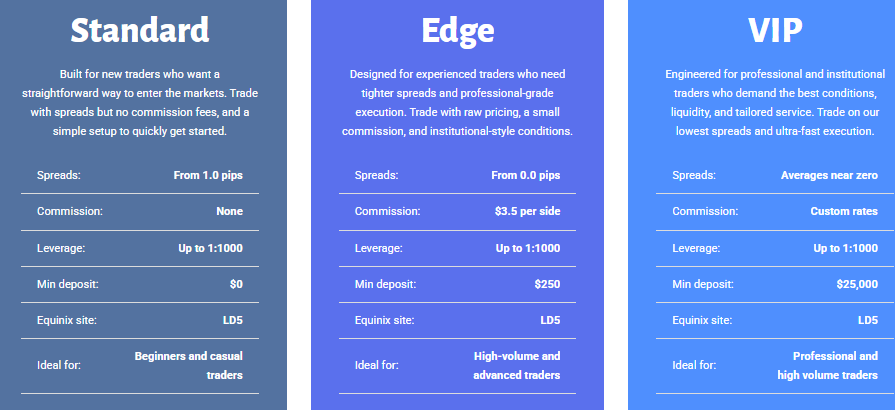
In addition to the scope of the offering, the structure of trading conditions plays a central role. These are based on different account types, which differ primarily in terms of spreads and commissions. While standard accounts do not charge additional commissions and reflect costs mainly via the spread, other account types offer tighter spreads combined with commissions per traded volume.
Available leverage may vary depending on the instrument and account type, allowing flexible adjustment of position size. Particularly high leverage, including so-called “unlimited” leverage, significantly increases not only potential gains but also the risk of losses. Even small market movements can lead to disproportionate losses in such cases.
Additionally, so-called negative balance protection is applied. This ensures that the account balance cannot fall below zero in the event of extreme market movements and is automatically reset to zero if it does. Losses are therefore limited to the deposited capital and there is no obligation to make additional payments.
Trading conditions differ depending on the selected account type, particularly with regard to spreads, commissions and execution type.
Account types at Exness
| Account type | Min. deposit | Spreads from | Commission | Leverage | Features |
|---|---|---|---|---|---|
| Standard | from 10 USD | from 0.2 pips | none | up to 1:Unlimited | beginner-friendly, no commission |
| Standard Cent | from 10 USD | from 0.3 pips | none | up to 1:Unlimited | smaller lot sizes, lower risk |
| Pro | from 200 USD | from 0.1 pips | none | up to 1:Unlimited | instant/market execution, tighter spreads |
| Raw Spread | from 200 USD | from 0.0 pips | up to 3.50 USD/lot per side | up to 1:Unlimited | direct market pricing, for experienced traders |
| Zero | from 200 USD | from 0.0 pips | from 0.05 USD/lot per side | up to 1:Unlimited | 0-pip spreads on selected instruments |
Deposits and withdrawals at Exness
Various methods are available for deposits and withdrawals, including traditional payment methods as well as digital solutions. The selection may vary depending on the region and account type. By supporting cryptocurrencies for deposits and withdrawals, Exness expands its range of payment methods beyond traditional options.
| Method | Deposit | Withdrawal | Notes |
|---|---|---|---|
| Bank card | yes | yes | widely available, depends on provider |
| Bank transfer | yes | yes | longer processing time possible |
| E-wallets | yes | yes | often fast processing |
| Cryptocurrencies | yes | yes | Bitcoin, Ethereum, Tether and others |
Deposits and withdrawals are usually processed via the same method used for the initial deposit. This approach supports compliance with regulatory requirements and enhances transaction security.
Processing times may vary depending on the selected payment method. While some transactions are processed almost instantly, traditional bank transfers may take longer.
Advertisement
Compare all account features on the Exness website now
Your capital is at risk. The majority of retail investor accounts lose money when trading CFDs
Trading environment and platforms at Exness
For trading, both MetaTrader 4 and MetaTrader 5 platforms are available, as well as a proprietary web-based trading platform. All solutions are also accessible in mobile versions and allow access to trading accounts across multiple devices.
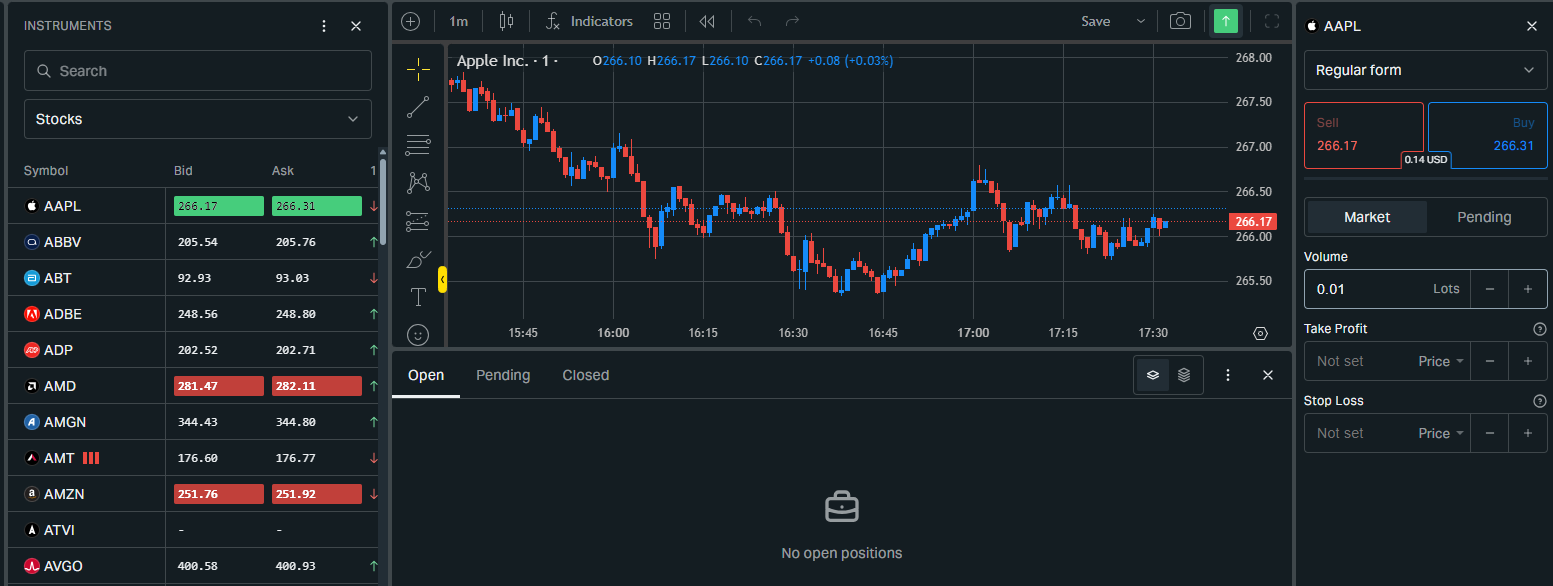
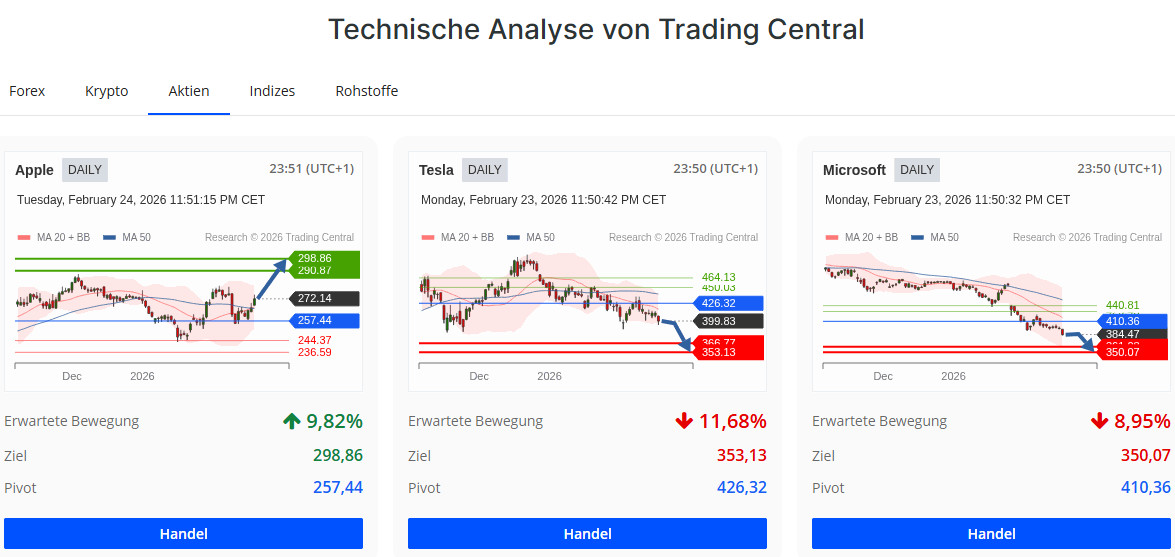
Additionally, various informational tools are available within the platform and the client area. These include an economic calendar as well as external content such as Trading Central Web TV and FXStreet, which can be used for market monitoring and analysis.
Final assessment of the CFD broker Exness
Exness is structured as an internationally operating provider, where offering, regulation and accessibility depend on the respective entity.
The trading offering includes CFDs across the most common asset classes, as well as several account models with different conditions. This is complemented by a selection of trading platforms available on desktop and mobile devices, as well as various deposit and withdrawal options.
Access to the offering is initially provided through a simple registration process requiring only an email address and country of residence. A large part of the functionality, including a demo account, is already available after registration. For live trading, however, full verification in accordance with KYC requirements is required.
Advertisement