



Short squeeze in financial markets – explained simply
In financial markets, price movements sometimes occur that are difficult to explain at first glance. Occasionally, prices rise sharply within a short period of time even though the fundamental factors of a market have barely changed.
One possible reason for this can be a so-called short squeeze. In this situation, market participants who previously bet on falling prices and built short selling positions come under pressure. Their buybacks can further strengthen an upward price movement.
What does short squeeze mean?
A short squeeze is a market movement in which rising prices force traders to close previously opened short selling positions. To do this, they must buy back the securities they previously sold.
This additional buying pressure can push prices even higher. In some situations, this can create a rapid and strong upward movement.
Short squeezes can occur in almost any market where short selling is possible.
How does a short squeeze occur?
The development of a short squeeze is a process consisting of several sequential steps. Below we describe these steps, explain them using a simplified example and then show how this mechanism can also occur in real financial markets.
Many market participants bet on falling prices
Initially, many traders speculate on declining prices of an asset and therefore build up a high volume of short selling positions according to their market expectations.
The price begins to rise
If the price of a security or market begins to rise contrary to the expectations of many short traders, their short positions come under pressure due to increasing losses.
Short positions are closed
To avoid further losses, traders must close their short positions, which means they buy back the positions they previously sold. These appear as additional buy orders and create increased demand in the market.
The price increase accelerates
These additional buybacks can push the price even higher, increasing pressure on other short sellers. This mechanism can temporarily reinforce itself and lead to rapid price movements that may appear extreme or difficult to explain on price charts.
Example of a short squeeze
As described above, short squeezes can occur in almost any market. The following example shows in simplified form how such a mechanism can arise.
Assume that many traders have shorted a stock because they expect prices to fall. Unexpectedly, buying interest increases and the price begins to rise.
As the price rises, the losses of short traders increase. Some therefore decide to close their positions and buy back the shares they previously sold.
These additional purchases increase demand further and push the price even higher. As a result, other short traders come under pressure to close their positions as well. This mechanism can reinforce itself in the short term and lead to rapid price increases.
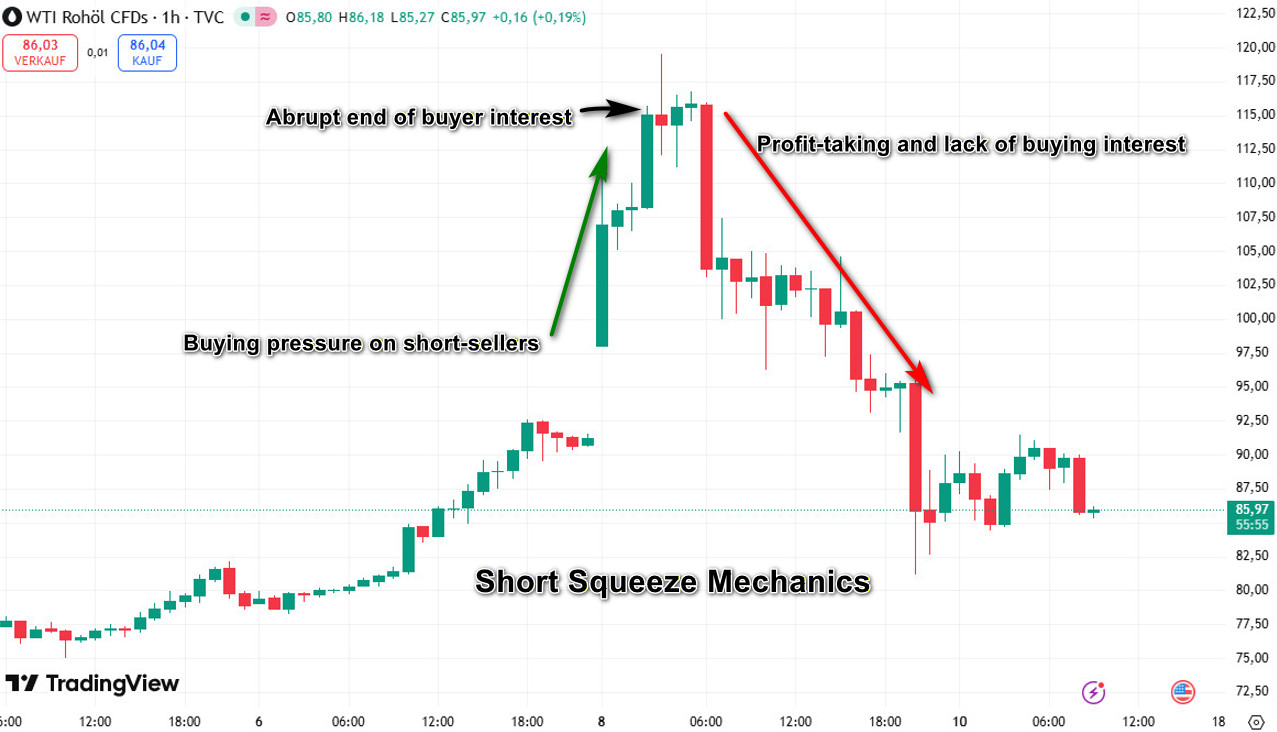
To move beyond theory, it is worth looking at an example from real market activity. On 9 March 2026, we observed a short squeeze and its consequences in the oil market. In our article “Oil price yo-yo: little war and a lot of market mechanics”, we show how market mechanics can temporarily lead to strong price movements.
Why can short squeezes trigger strong price movements?
The decisive factor in a short squeeze is the additional buying pressure. Traders who previously bet on falling prices must close their positions to protect themselves from increasing losses. To do this, they must buy back the securities they previously sold short.
If many market participants attempt to close their short positions at the same time, this can lead to strong demand. In markets with low liquidity, this effect can be particularly pronounced.
However, this effect can fade just as quickly as it appears. Once many short positions have been closed and the additional buying pressure declines, prices may fall again just as quickly as they previously rose.
Conclusion
A short squeeze is a market mechanism in which rising prices force traders with short selling positions to buy back securities in order to limit losses. These additional purchases can strengthen an upward movement and lead to strong short-term price increases.
This phenomenon can occur in various markets and illustrates how market mechanics can influence price movements in financial markets.