




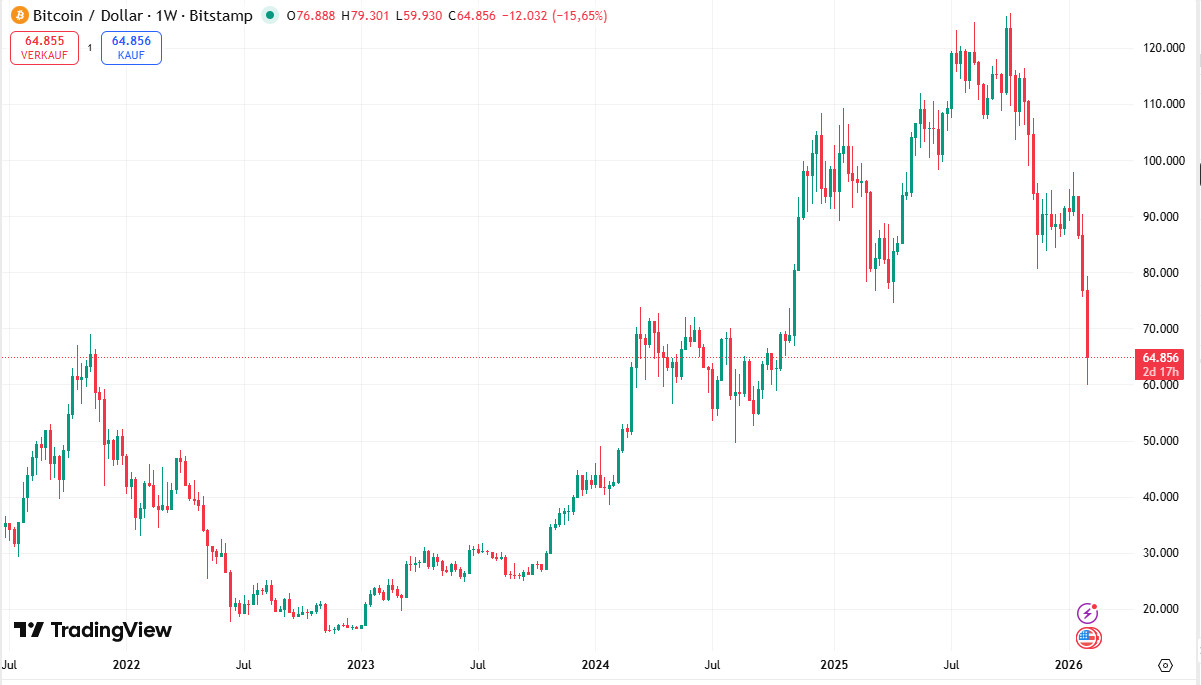
The Bitcoin price has experienced a dramatic crash in recent months and is trading at around $64,875 as of 06.02.2026, corresponding to a decline of over 40 % since the all-time high in October 2025. This crash is comparable in magnitude to the bear market of 2021/2022, but has unfolded in a much shorter time – only 4 months instead of a year. The situation remains highly volatile, with strong fluctuations and general risk aversion in the market. Other cryptocurrencies such as Ethereum (ETH) and Solana (SOL) are similarly affected and have experienced comparable declines, showing that the causes are not exclusively Bitcoin-specific but are affecting the entire crypto sector.
Development Since the All-Time High
Bitcoin reached its all-time high (ATH) in October 2025 at approximately $126,296, driven by institutional adoption, ETF inflows and optimistic market sentiment. Since then, the price has shown a steady downtrend:
- November 2025: First pullbacks due to Fed signals and tech sell-offs, price falls below $100,000.
- December 2025 to January 2026: Further losses due to ETF outflows (over $1 billion in one week) and global market declines, price tests $80,000.
- February 2026: Accelerated crash, triggered by the nomination of Kevin Warsh as Fed Chair and ongoing hawkishness of the US Federal Reserve. On 06.02.2026 Bitcoin fell to a low of $60,074.80, the lowest level since November 2024.
Similarly or worse for ETH and SOL: Ethereum has lost about 60 % since its ATH and is trading at $1,895, Solana has lost around 70 % in recent weeks and is currently at $78.20. The correlation to the tech sector (e.g. AI stock crash) and precious metals (gold and silver also under pressure) is high, underscoring the cross-sector nature.
Causes of the Crash
The crash is not due to a single cause, but to a combination of macroeconomic, political and market-specific factors:
- Fed policy and hawkishness: The nomination of Kevin Warsh as Fed Chair has strengthened expectations of “higher for longer” interest rates. Higher rates make cryptos less attractive (no dividends, high risk) and strengthen the dollar, putting pressure on BTC and cryptocurrencies in general.
- ETF outflows: US spot Bitcoin ETFs have seen net outflows of over $1 billion in the past week, including BlackRock's IBIT with $373 million in one day. This signals the withdrawal of institutional capital.
- Global tech and market sell-off: The crash correlates with declines in tech stocks (AI crash) and precious metals. Liquidations in the crypto space (Massive Wave of Liquidations) have accelerated the downtrend.
- Technical overextension: After the parabolic rise in 2025, BTC was extremely overbought (RSI >90), making a correction overdue. The break below $80,000 triggered further stop-losses and accelerated the crash.
- Political uncertainty: Government shutdown fears, US policy and geopolitical risks (Ukraine, Middle East) are driving risk aversion – cryptos suffer particularly as “high-beta” assets.
These causes affect not only BTC but the entire crypto market: ETH and SOL suffer from the same factors such as ETF outflows, dollar strength and tech correlation.
Possible Further Development
The market is in a classic bear phase – with potential for further declines or bottom formation. Technical levels:
- Resistances: Currently the $65,000 mark. A sustainable break above could initiate a recovery and drive the price up to $75,000 (former high, Fibonacci level).
- Supports: $60,000 (psychological mark, 200-day MA), $54,000 (former support from 2025), $44,000 (lowest level from 2024 – could be reached in a prolonged sell-off).
For ETH and SOL, similar patterns apply: ETH could find support at $2,800–3,000, SOL at $100–120. A trend reversal depends on positive impulses (Fed dovishness, ETF inflows, geopolitical easing). Otherwise, the crash could extend to $40,000–50,000 for BTC, as in previous cycles.
Conclusion
The Bitcoin crash of 2026 is dramatic and cross-sectoral – BTC, ETH and SOL are suffering from the same macroeconomic and market-specific factors. Volatility remains high, and the outlook depends on external impulses. Anyone who wants to follow prices live on PC or smartphone will find a neutral overview here of established platforms that cover almost the entire range of assets: To the Trading Platform Overview.

